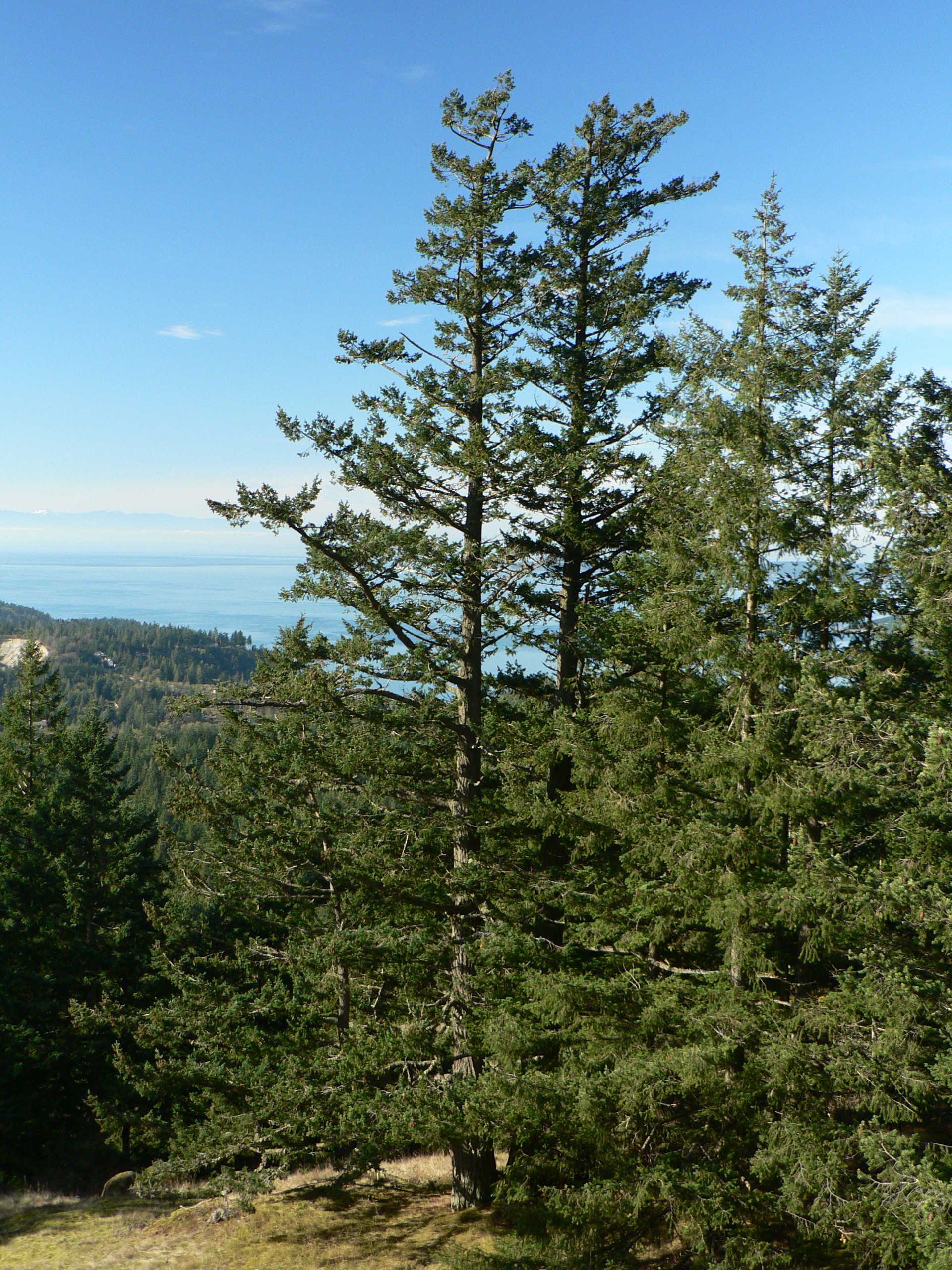
Pseudotsuga is a genus of five to six species of evergreen coniferous trees in the family Pinaceae (subfamily Laricoideae), order Pinales. Commonly known as Douglas firs or Oregon pines, the genus includes some of the tallest and most massive trees on Earth. The best-known member, Pseudotsuga menziesii (coast Douglas-fir), is native to western North America and is among the most economically important timber trees in the world.
Trees range from medium to extremely large, growing 20–120 metres tall. The leaves are flat, soft, and linear, 2–4 cm long, borne singly and arranged so as to completely encircle each branch. The female cones are pendulous and persistent — unlike those of true firs (genus Abies) — and are immediately recognisable by a distinctive tridentine bract that protrudes conspicuously above each cone scale, resembling the hindquarters of a mouse with two feet and a tail.
The tallest well-documented individual, the Mineral Tree in Washington State, was measured at 120 metres in 1924. The current tallest living Douglas-fir, the Brummitt Fir in Coos County, Oregon, stands at 99.4 metres, exceeded among living trees only by coast redwood and Eucalyptus regnans.
The genus is distributed across two widely separated regions: western North America (two species) and eastern Asia (two to four species, mostly in China and Japan). The Asian species are of restricted range, often rare, and all carry unfavourable conservation status. Nineteenth-century botanists struggled to classify Douglas firs because of their similarity to Pinus, Picea, Abies, Tsuga, and even Sequoia; the French botanist Carrière finally erected the genus Pseudotsuga in 1867, distinguished primarily by the unique tridentine cone bracts.
Douglas-fir timber is prized for structural applications requiring high load resistance, and is widely used in construction, boat building, and mast building. It is also one of the most popular Christmas tree species sold in the United States.
Etymology
The genus name Pseudotsuga derives from Greek and Latin roots meaning "false hemlock" (pseudo- = false, tsuga = hemlock), coined by the French botanist Carrière in 1867 to distinguish the group from the superficially similar genus Tsuga. The English common name "Douglas fir" honours David Douglas, the Scottish botanist who introduced P. menziesii into cultivation in Britain at Scone Palace in 1827. The hyphenated spelling "Douglas-fir" is preferred by many authorities to signal that these trees are not true firs (genus Abies).
Distribution
Pseudotsuga menziesii is widespread across western North America, occurring in two major varieties: the coast Douglas-fir along the Pacific seaboard and the Rocky Mountain Douglas-fir through the interior west, with populations extending south into Mexico. The remaining species are confined to eastern Asia — principally China (three species, variously treated) and Japan (one species, P. japonica) — where they occupy restricted ranges and are often scattered within mixed forests.
Ecology
Douglas-firs are dominant or co-dominant trees in several major forest types of western North America, capable of reaching 120 metres in height and living for over a thousand years. The coast Douglas-fir forms vast old-growth forests in the Pacific Northwest, including the Olympic and Quinault rainforests where several of the world's largest individuals by volume are found. The Asian species grow in mixed temperate forests at moderate to high elevations and are considered rare within their native habitats.
Cultivation
Pseudotsuga menziesii was introduced to British cultivation by David Douglas in 1827 and is now widely planted in temperate regions for timber production, where plantation-grown trees yield faster-growing but lighter wood than old-growth individuals. It is also one of the most commercially important Christmas tree species in the United States. Rocky Mountain Douglas-fir is frequently used in ornamental and reforestation plantings in the interior west of North America.
History
Nineteenth-century botanists repeatedly reclassified Douglas firs, placing them at various times in Pinus, Picea, Abies, Tsuga, and even Sequoia because of their resemblance to multiple conifer genera. The genus Pseudotsuga was formally established by the French botanist Élie-Abel Carrière in 1867, anchored by the distinctive tridentine cone bracts that set the group apart from all previously recognised genera. The genus gained broad economic significance following David Douglas's 1827 introduction of P. menziesii to European cultivation, after which it rapidly became one of the most planted timber trees in the temperate world.
Taxonomy Notes
The number of accepted species in Pseudotsuga has long been debated. Two North American species are generally recognised: P. menziesii and P. macrocarpa. The Asian contingent is more contentious; the most recent treatment accepts four species (three Chinese, one Japanese), though the Chinese taxa have variously been treated as varieties of P. sinensis or split into additional species and varieties. Morphological and genetic evidence suggests Mexican populations of Douglas-fir are best treated as a distinct variety within P. menziesii rather than separate species.










