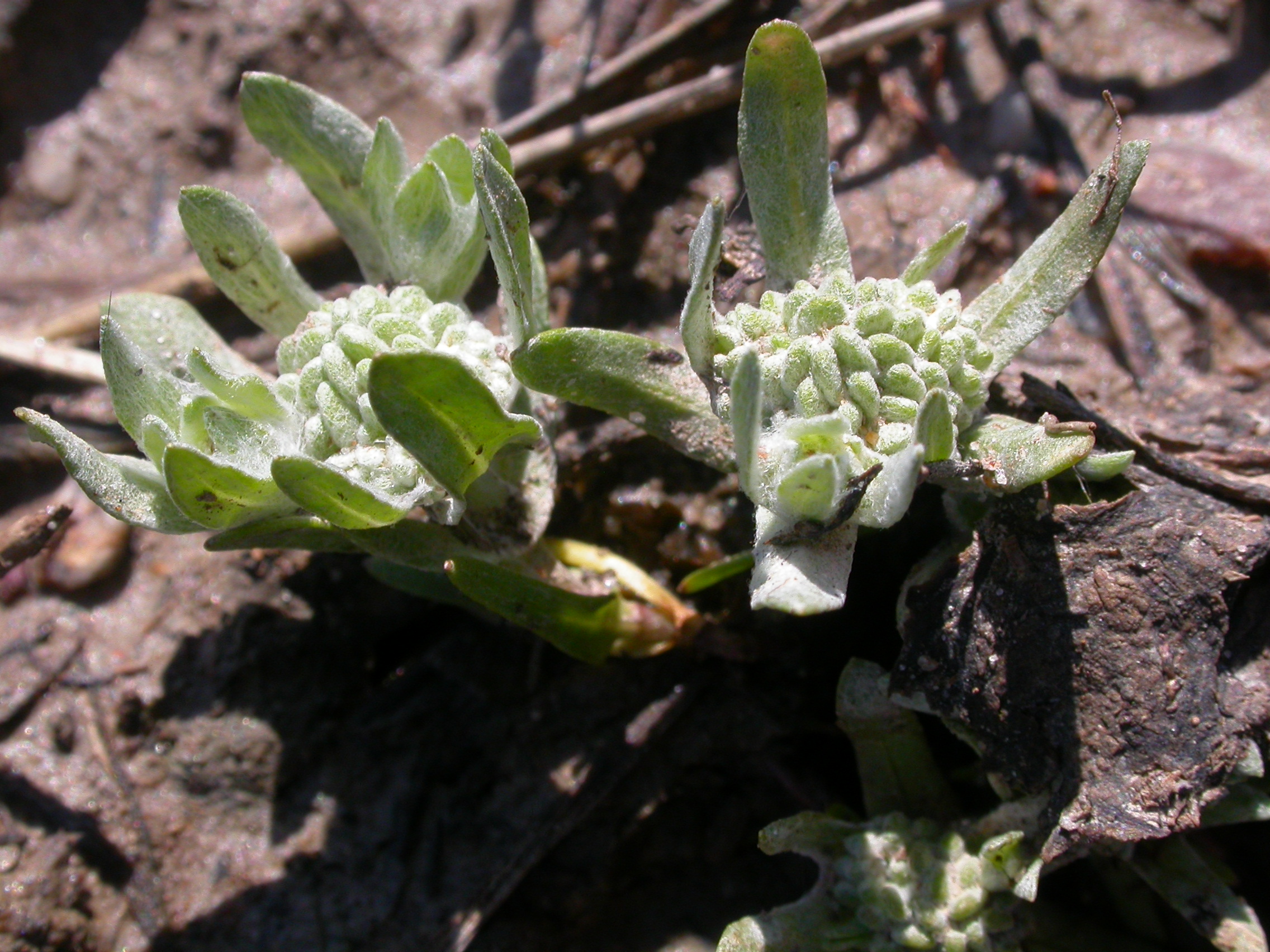
Psilocarphus, commonly known as woolly marbles or woollyheads, is a small genus of annual flowering plants in the daisy family Asteraceae, placed in the tribe Gnaphalieae. The genus was first described in 1840 in the Transactions of the American Philosophical Society and today comprises around five to six accepted species.
Plants are low-growing annuals, typically 1–15 cm tall, with stems that may be single and erect or branched and spreading to prostrate. Leaves are cauline, mostly opposite, and range from linear to ovate or obovate in shape. The most immediately recognizable feature of the genus is its densely woolly-white indumentum and its compact, rounded clusters of heads that resemble little bunches of woolly grapes or marbles — the source of both common names.
In botanical terms, Psilocarphus lacks involucres and phyllaries entirely. Each head contains (8–)20–100 or more pistillate florets and 2–10 functionally staminate florets, with no bisexual florets. The receptacle is obovoid and glabrous; the pistillate paleae are cucullate or galeate (hood-shaped or helmet-shaped), reticulately nerved, saccate along most of their length, and fall away at fruit maturity. Cypselae (achene-like fruits) are brown, terete to slightly compressed, smooth, and shiny, lacking a pappus. The base chromosome number is x = 14.
Psilocarphus is native to western North America, ranging from British Columbia south to California and Baja California, and eastward across the Great Basin, Columbia Plateau, and northern Rocky Mountains to the western edge of the Great Plains; it is absent from the hot Mojave and Sonoran deserts. The genus also shows an amphitropical disjunct distribution, with several species occurring in Chile and Argentina. Migratory shorebirds are thought to facilitate the occasional long-distance seed dispersal that produced this pattern.
Phylogenetically, Psilocarphus is monophyletic and is probably sister to Micropus, with ancestral links to Stylocline, all within the subtribe Filagininae of Gnaphalieae.
Etymology
The name Psilocarphus is derived from the Greek psilos (bare, smooth) and karphos (chaff or straw), referring to the character of the receptacular paleae. The common names "woolly marbles" and "woollyheads" describe the conspicuously white-woolly, rounded clusters of heads.
Distribution
Psilocarphus is native to western North America, from southwestern British Columbia south through Washington, Oregon, and California to Baja California, and east across the Great Basin, Columbia Plateau, and northern Rocky Mountains to the western edge of the northern Great Plains (Idaho, Montana, Nevada, Utah, Wyoming). The genus also has an amphitropical disjunct in southern South America (Chile and Argentina). It is confined to Mediterranean, semiarid, and cool-temperate climatic zones, and does not enter the Mojave or Sonoran deserts.
Ecology
Species of Psilocarphus occupy seasonally moist to temporarily flooded habitats, including vernal pools, pond margins, moist flats, and open disturbed ground. Ongoing degradation of vernal pool habitats in California has raised potential conservation concern for P. chilensis and P. brevissimus var. multiflorus. The amphitropical species (P. brevissimus var. brevissimus, P. chilensis) occupy littoral habitats, and their light cypsela-palea complexes are thought to be dispersed occasionally over long distances by migratory shorebirds. Species are self-pollinating, and populations can establish from a single cypsela.
Taxonomy Notes
Psilocarphus is placed in the tribe Gnaphalieae, subtribe Filagininae, within Asteraceae. It is monophyletic and probably sister to Micropus, with ancestors in or near Stylocline (Morefield 1992). The genus was described in 1840 in Trans. Amer. Philos. Soc., n. s. 7: 340. A formerly included species, Psilocarphus caulescens Benth., has been transferred to Hesperevax as H. caulescens (Benth.) A.Gray.










