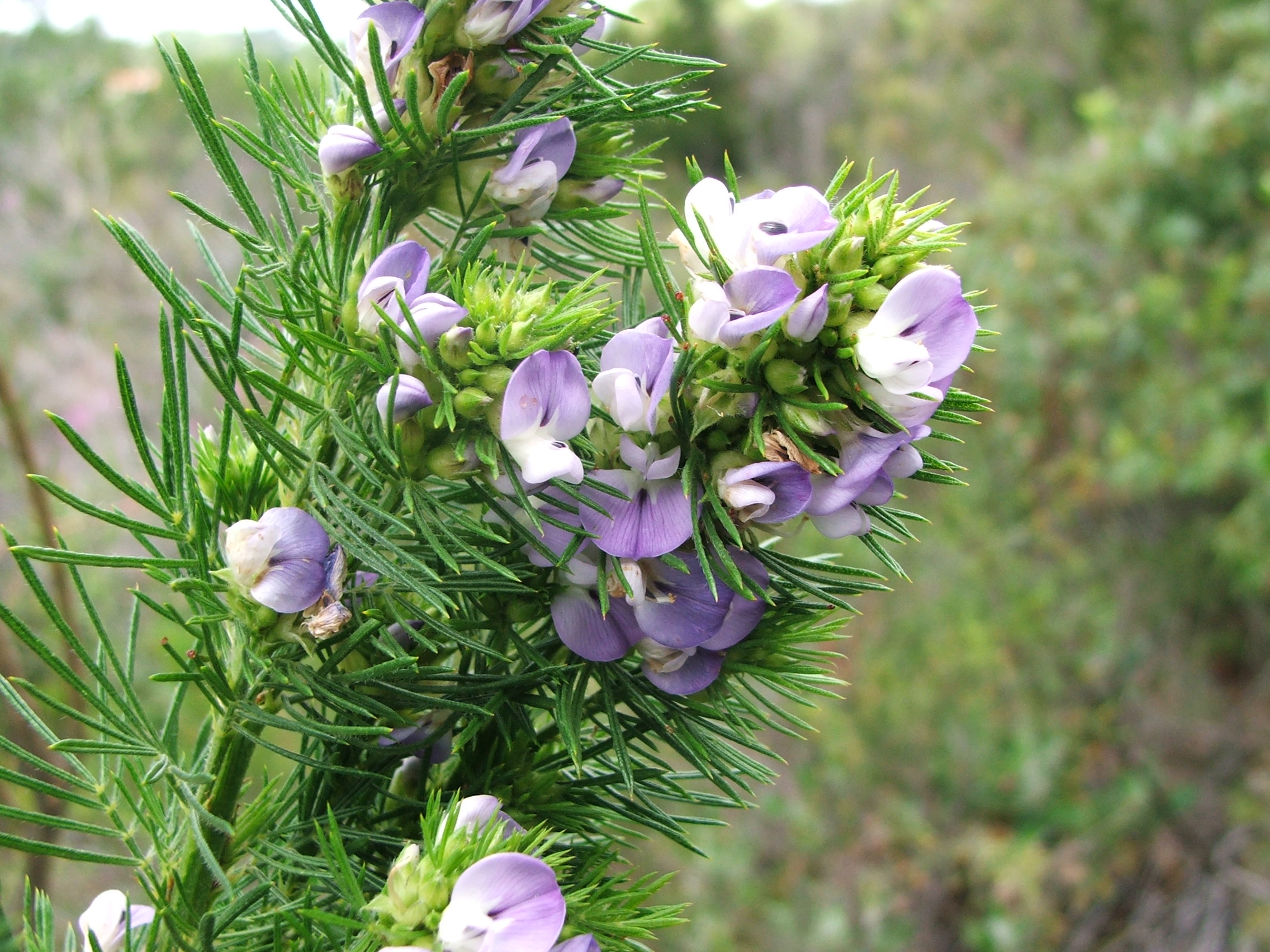
Psoralea is a genus of roughly 121–127 species of shrubs, trees, and herbs belonging to the legume family Fabaceae, placed in the order Fabales. The genus is native to southern and eastern Africa, with its centre of diversity in South Africa, where species range northward through eastern Africa as far as Kenya.
Members of Psoralea vary considerably in growth form, encompassing low shrubs and small trees as well as herbaceous perennials. Many species are strongly aromatic and are associated with the fynbos and Karoo biomes of southern Africa. In South Africa, Psoralea species are collectively known in English as "fountainbush," a name reflecting their tendency to grow near water sources and springs in otherwise dry landscapes. The Afrikaans common names include fonteinbos, bloukeur, and penwortel, while the Zulu name is umHlonishwa.
The genus is best known pharmacologically for Psoralea corylifolia, whose seeds contain the furocoumarin psoralen. Psoralen is the active compound in PUVA (psoralen + UVA) phototherapy, a treatment used for psoriasis, vitiligo, and other dermatological conditions. The genus name itself derives directly from this chemical association, coming from the Greek psoraleos ("affected with itch or with leprosy").
GBIF recognises 126 accepted descendant taxa within the genus. Species represented in cultivation and botanical records include both South African endemics—such as Psoralea pinnata, the blue pea or fountain bush widely planted as an ornamental—and more localised Karoo and montane species.
Etymology
The genus name Psoralea is derived from the Greek psoraleos, meaning "affected with itch or with leprosy." The name alludes to the compound psoralen, which occurs naturally in the seeds of Psoralea corylifolia and has long been associated with skin-affecting properties. Psoralen is today used medicinally in PUVA (psoralen + ultraviolet A) phototherapy for conditions including psoriasis and vitiligo.
Distribution
Psoralea is native to southern and eastern Africa, ranging from Kenya in the north to South Africa in the south, with the greatest species diversity in South Africa. Species occur across a range of biomes including fynbos, Karoo scrubland, and montane grassland. In South Africa the genus is commonly called "fountainbush," reflecting a tendency for many species to grow near springs and watercourses in semi-arid environments.
Cultural Uses
The most pharmacologically significant member of the genus is Psoralea corylifolia, whose seeds yield psoralen, a furocoumarin compound. Psoralen is the active ingredient in PUVA phototherapy, a clinical treatment for psoriasis, vitiligo, and other skin disorders. The use of psoralen-containing plant preparations for skin conditions has historical roots in traditional medicine across several cultures.










