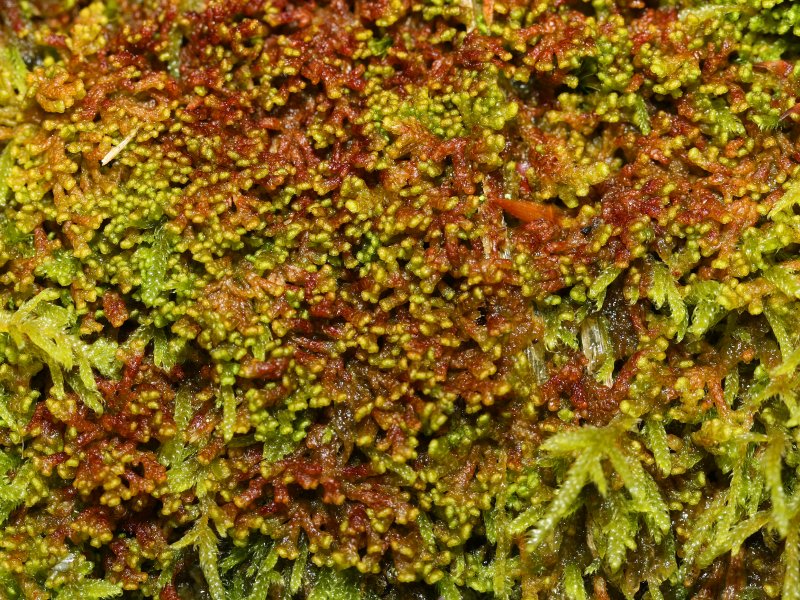
Ptilidium is a genus of leafy liverworts (division Marchantiophytina) and the sole member of the family Ptilidiaceae, placed in the order Ptilidiales within the class Jungermanniopsida. The genus contains only three species: Ptilidium californicum, Ptilidium ciliare, and Ptilidium pulcherrimum.
The name derives from the Greek ptilidion, meaning "small feather," a reference to the multiply and deeply divided leaves with fringed, ciliate edges that give the plants their distinctive feathery appearance. The combination of this "flossy" texture with a characteristic yellowish-brown or reddish-brown colouration makes Ptilidium one of the easier liverwort genera to identify in the field. Unlike most other leafy liverworts, the underleaves of Ptilidium are not substantially smaller than the lateral leaves, and all leaf cells bear bulging trigones — thickenings at the corners between cell walls — a feature distinguishing it from the superficially similar genera Blepharostoma and Trichocolea.
Plants grow in dense mats, with stems that are prostrate to ascending and once or twice pinnate in branching pattern. Leaves are incubous and deeply divided into three to five lobes, with the margins fringed by cilia. All species are dioicous, bearing antheridia and archegonia on separate plants; mature sporophytes develop within a large perianth with three distal folds. The three species can be told apart by the density of marginal cilia, depth of leaf lobing, width of leaf-lobe bases, and preferred substrate.
Molecular analysis places Ptilidium in an isolated lineage allied only to two East Asian endemic genera, indicating that it diverged early in the evolution of leafy liverworts and has few close relatives. The genus has a predominantly boreal distribution, growing abundantly in coniferous forests across Europe, Asia, and North America, with disjunct populations in New Zealand and Tierra del Fuego. In the northern hemisphere plants typically colonise tree bark; at the southern limits and in mountain districts of New Zealand they grow on rock. Ptilidium ciliare is particularly tolerant of desiccation and is ubiquitous across the Arctic, where it rarely produces spores and spreads largely by plant fragments.
Etymology
The genus name Ptilidium is derived from the Greek ptilidion, meaning "small feather." It refers to the multiply deeply divided leaves with fringed, ciliate margins that give the plants a conspicuously feathery texture — one of the most immediately recognisable features of the genus.
Distribution
Ptilidium has a boreal distribution, occurring in coniferous forests of Europe, Asia, and North America as well as in the Arctic, where P. ciliare is a common constituent of the ground flora. Disjunct populations exist in New Zealand (on mountain rocks) and Tierra del Fuego. At the temperate margins of its range the genus is restricted to higher elevations. The southern-hemisphere occurrences are believed to reflect long-distance dispersal of plant fragments rather than a Gondwanan relict origin, as modern molecular phylogenetics does not support the formerly proposed relationship with southern-hemisphere genera.
Ecology
Plants grow in dense mats on tree bark, soil, wood, or rock depending on species and region. P. ciliare is exceptionally desiccation-tolerant and dominates Arctic habitats, rarely fruiting and spreading mainly by detached plant fragments. P. pulcherrimum is characteristically a wood- and rock-dweller, while P. californicum has fewer marginal cilia and a more restricted Pacific distribution. The archegonia are terminal on main stems, and mature sporophytes are enclosed within a large, three-lobed perianth.
Taxonomy Notes
Ptilidium is the only genus in the monotypic family Ptilidiaceae and order Ptilidiales (class Jungermanniopsida, phylum Marchantiophytina). Molecular analysis places it in an isolated clade allied only to two East Asian endemics, contradicting an earlier hypothesis by Schuster (1984) that linked it to the predominantly southern-hemisphere genera Mastigophora and Dendromastigophora to explain its disjunct distribution. GBIF lists 2 accepted descendants; Wikipedia recognises three species (P. californicum, P. ciliare, P. pulcherrimum).










