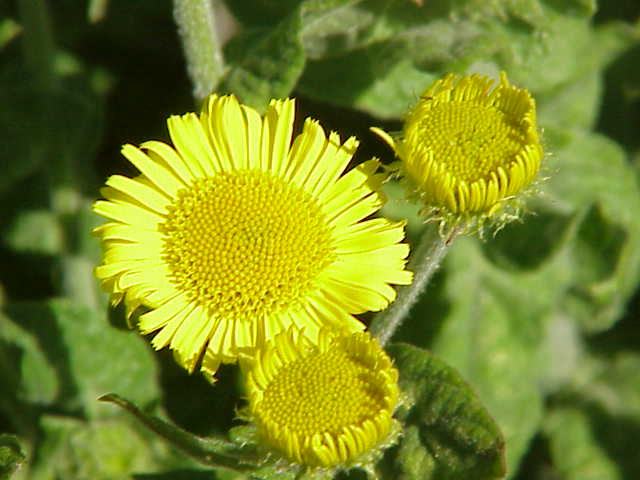
Pulicaria is a genus of about 80–100 flowering plants in the daisy family Asteraceae (tribe Inuleae), order Asterales. The genus was established by Joseph Gaertner in 1791. It is native to Europe, Asia, and Africa, with its highest diversity in the Mediterranean region, the Middle East, and sub-Saharan Africa. In North America the genus is not native but a few species have been introduced and are known by the common name false fleabane.
Plants in the genus are annual or perennial herbs, typically producing yellow flower heads with both ray florets and disc florets — the classic composite structure of the daisy family. The type and most familiar species, Pulicaria dysenterica (common fleabane), is a perennial that spreads by its roots to form dense patches, growing to about 60 cm tall. Its leaves are alternately arranged and clasp the stem; the stems contain a salty-astringent sap. The golden-yellow inflorescences consist of a central cluster of 40–100 disc florets ringed by 20–30 narrow ray florets, and the flower heads reflex when the plant sets seed.
Several synonymous generic names — including Francoeuria, Platychaete, and Strabonia — have been merged into Pulicaria following molecular and morphological revisions. The genus includes widely studied species such as Pulicaria dysenterica, long used in traditional medicine as a treatment for dysentery, and the name of that species reflects this history. The common name "fleabane" refers to the traditional practice of burning dried plants as an insect repellent.
Etymology
The genus name Pulicaria derives from the Latin pulex (flea), referring to the traditional use of dried plants — particularly P. dysenterica — as a fumigant to repel fleas and other insects. The same root gives rise to the English common name "fleabane."
Distribution
Pulicaria is native to Europe, Asia, and Africa, with its centre of diversity in the Mediterranean basin, the Middle East, and parts of sub-Saharan Africa. GBIF records the genus across a broad range including North Africa (Algeria, Morocco, Cape Verde), southern and central Europe (Baleares, Austria, Bulgaria, Baltic States), the Middle East and Central Asia (Afghanistan, Bangladesh), and Africa south of the Sahara (Benin, Botswana, Burkina Faso, Cameroon, South Africa). A small number of species have naturalised in the Azores and California as introductions.
Ecology
Species of Pulicaria occupy a wide range of habitats from semi-arid Mediterranean scrubland and rocky slopes to moist meadows, riverbanks, and disturbed ground. Pulicaria dysenterica is recorded as the primary larval food plant of the fleabane tortoise beetle (Cassida murraea) and at least four moth species (Apodia bifractella, Ptocheuusa paupella, Oidaematophorus lithodactyla, and Digitivalva pulicariae), illustrating the ecological role the genus plays as a host for specialised invertebrates.
Cultural Uses
Pulicaria dysenterica has a long history of medicinal use: it was employed in traditional European and Middle Eastern medicine as a remedy for dysentery (reflected in its species epithet) and for eye complaints. Dried plant material was also burned as a fumigant to repel fleas and other insects, the practice from which both the genus name and the English common name "fleabane" derive.
Taxonomy Notes
Pulicaria Gaertn. was described in 1791 in Fructus Seminumque Plantarum (2: 461). Subsequent taxonomic work has brought several formerly separate genera into synonymy, including Duchesnia Cass., Francoeuria Cass., Kiliana Sch.Bip. ex Hochst., Platychaete Boiss., Poloa DC., Pterochaete Boiss., Sclerostephane Chiov., Strabonia DC., and Tubilium Cass. The genus belongs to tribe Inuleae within Asteraceae.

