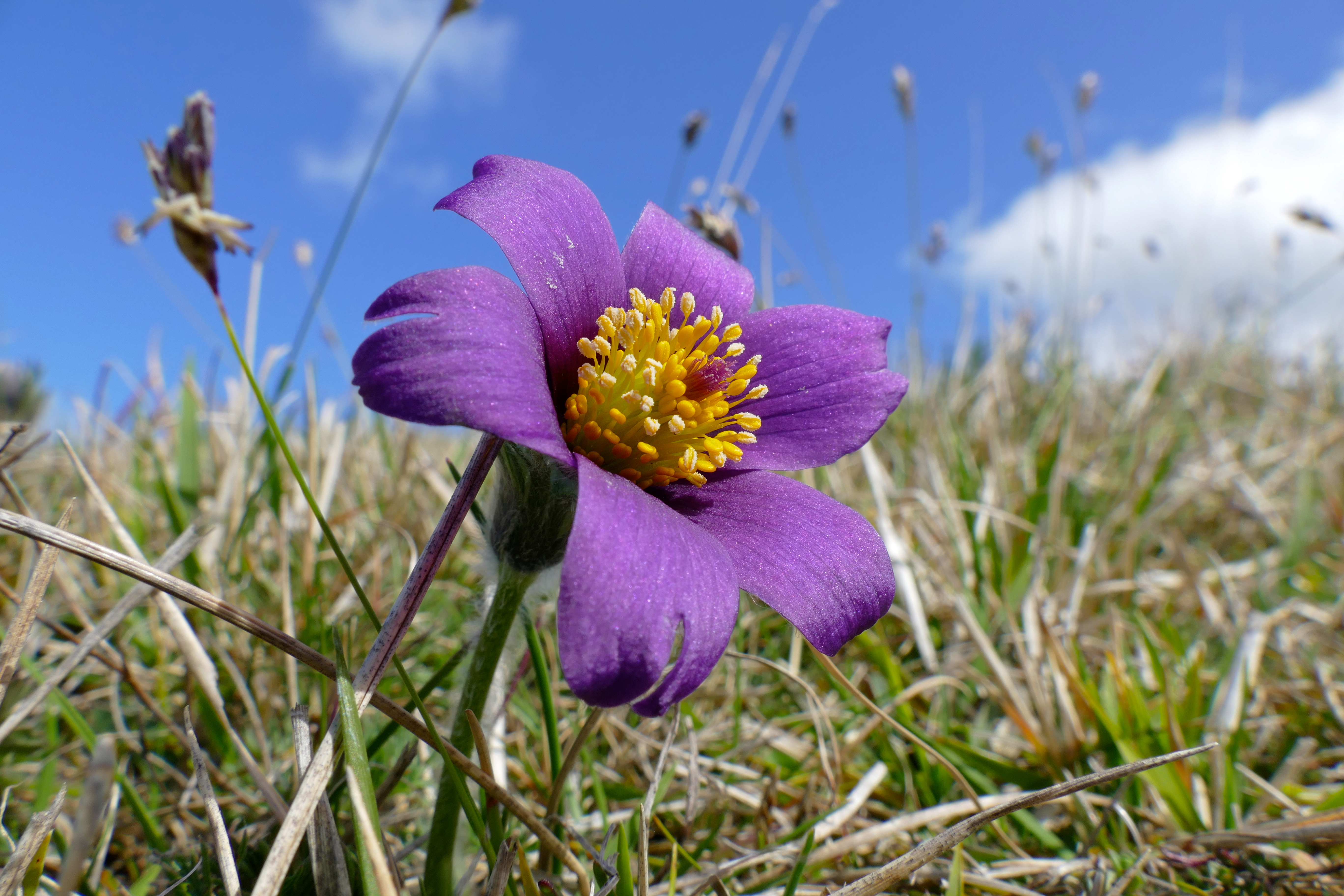
Pulsatilla Mill. is a genus of approximately 40–49 herbaceous perennial flowering plants in the family Ranunculaceae, native to meadows, prairies, and subalpine grasslands across the temperate and subarctic Northern Hemisphere — spanning North America, Europe, and Asia. Commonly called pasque flowers, these compact plants grow to around 20 cm tall and are immediately recognizable by their finely dissected, deeply lobed leaves and solitary, bell-shaped to cup-shaped flowers whose showy parts are petal-like sepals rather than true petals. After flowering, each flower develops into a distinctive plumed seed head, with long feathery awns on the achenes that aid wind dispersal — a character that also distinguishes Pulsatilla from the closely related genus Anemone.
The genus was formally described by Philip Miller in 1754, published in his Gardeners' Dictionary (ed. 4). Molecular phylogenetic studies support its recognition as a genus distinct from Anemone, and it is accepted as such by Plants of the World Online (Kew) and Flora of Korea, among others. Three generic synonyms are recorded: Anetilla, Miyakea, and Preonanthus.
Plants are fully hardy perennials, typically flowering in early spring (April–May), often while little else is in bloom. They thrive in well-drained, humus-rich, gritty soils in full sun, tolerating alkaline conditions, and are hardy to USDA zones 4–8. The deep, woody rootstock means established plants transplant poorly and are best left undisturbed. The genus is also noted as allelopathic — capable of inhibiting the growth of surrounding plants, particularly legumes.
Pulsatilla carries notable cultural weight: P. nuttalliana (prairie crocus) is the provincial flower of Manitoba, Canada and the state flower of South Dakota, USA, while P. vulgaris (European pasque flower) is the county flower of Hertfordshire and Cambridgeshire in England. Wild populations have declined substantially; a UK biodiversity action plan documents a 49% decline in wild P. vulgaris populations, and the genus is now extinct in the Netherlands.
Etymology
The name Pulsatilla is of Latin origin, derived from pulsare ("to beat" or "to strike"), likely referring to the way the flower heads and plumed seed heads move in the wind. The common English name "pasque flower" comes from the plant's spring flowering season, which coincides with Passover — from Biblical Hebrew פֶּסַח (pāsaḥ), via Old French Pasques (Easter/Passover). This seasonal association is also reflected in regional names across Europe.
Distribution
Pulsatilla is distributed across the temperate and subarctic Northern Hemisphere, with its native range described by POWO as the "Subalpine & Temp. Northern Hemisphere." GBIF records document its presence across more than 80 regions, including: Afghanistan, Alaska, Albania, Alberta, Austria, the Baltic States, Belarus, Belgium, British Columbia, Bulgaria, parts of Russia (Altay, Amur, Buryatiya, Central European Russia, Chita), California, Colorado, and multiple provinces of China (North-Central, South-Central, Southeast), among many others.
In Europe, the genus is represented by species such as P. vulgaris (western and central Europe), P. halleri, P. montana, P. rubra, P. alpina, and P. vernalis — the last being the county flower of Oppland, Norway. Ten taxa are recorded in Switzerland alone. The genus is now considered extinct in the Netherlands. In North America, P. nuttalliana (prairie crocus) is widespread across the Great Plains and western prairies. Across Asia, the range extends through Mongolia, Russia (Siberia), China, Korea, and Japan, where species occupy grassy slopes and low-mountain grasslands.
Taxonomy
Pulsatilla Mill. was formally published by Philip Miller in Gardeners' Dictionary, edition 4 (1754). The type species is P. vulgaris. Three generic synonyms are recognized: Anetilla Galushko, Miyakea Miyabe & Tatew., and Preonanthus Ehrh. The genus belongs to tribe Anemoneae, subfamily Ranunculoideae, family Ranunculaceae, order Ranunculales.
The circumscription of Pulsatilla has long been debated relative to Anemone — some treatments have subsumed Pulsatilla within Anemone as a section or subgenus. However, molecular phylogenetic evidence supports its recognition as a distinct genus, and this is the treatment followed by Plants of the World Online (Kew), Flora of Korea, and GBIF. POWO recognizes 49 accepted species; Wikipedia (as of March 2024) states approximately 40; GBIF records 158 total taxa when synonyms and infraspecific taxa are included.
Ecology
Pulsatilla species occupy open, sunny habitats — meadows, prairies, grasslands, and subalpine slopes. They are typically associated with well-drained, often shallow, alkaline or neutral soils and are characteristic plants of calcareous grasslands in Europe. Flowers are hermaphroditic and insect-pollinated, with the early spring bloom providing an important nectar source when few other flowers are available. The plumed achenes are adapted for wind dispersal.
The genus is notably allelopathic: established plants release compounds that inhibit the germination and growth of surrounding species, particularly legumes. Large individuals develop deep, woody rootstocks that anchor them firmly in the substrate and make transplanting very difficult. Habitat specificity and low dispersal ability — combined with the sensitivity of seeds to desiccation — make Pulsatilla populations slow to recolonize once lost from a site.
Cultivation
Pulsatilla species are cultivated primarily as ornamental rock garden and border perennials, valued for their early-spring flowers and decorative seed heads. They require full sun and sharply drained, humus-rich, gritty soil; heavy clay or waterlogged conditions are unsuitable. The genus tolerates alkaline soils and mildly acidic to neutral pH. Plants are hardy to USDA zones 4–8 (UK hardiness zone H6/zone 5) and require little maintenance once established. Because of their deep tap roots, Pulsatilla should be planted in their permanent position young and left undisturbed — division or transplanting of mature clumps is generally unsuccessful.
Propagation
Pulsatilla is propagated primarily from seed or root cuttings. Seed germinates most reliably when sown fresh immediately after harvest in early summer, typically within 2–3 weeks at ambient temperatures. Stored seed sown in late winter requires a longer germination period of 1–6 months at 15°C. Seeds should not be allowed to dry out before sowing. Root cuttings, approximately 4 cm in length, can be taken in early winter or during July/August and provide a vegetative method that preserves cultivar characteristics. Established plants have deep, woody rootstocks and do not divide well; disturbance of mature plants is generally avoided.
Conservation
Wild populations of Pulsatilla have declined significantly across parts of their European range. A UK biodiversity action plan specifically addresses P. vulgaris, which has experienced a documented 49% decline in wild populations, driven by habitat loss (particularly the loss of unimproved calcareous grassland), scrub encroachment, and reduced grazing. The genus is now considered extinct in the Netherlands. P. vulgaris is the county flower of both Hertfordshire and Cambridgeshire in England, reflecting its cultural importance and former wider distribution.
Cultural uses
Several Pulsatilla species carry official emblematic status: P. nuttalliana (prairie crocus) is the provincial flower of Manitoba, Canada and the state flower of South Dakota, USA; P. vulgaris is the county flower of Hertfordshire and Cambridgeshire, England; and P. vernalis is the county flower of Oppland, Norway.
Traditionally, members of the genus have been used in Native American medicine for centuries. Blackfoot peoples used preparations for inducing abortion and aiding childbirth. Medicinal applications documented in the ethnobotanical literature include treatment of reproductive disorders (premenstrual syndrome, epididymitis), use as a sedative, and treatment of cough. The root is recorded as anodyne, anti-inflammatory, antispasmodic, astringent, and sedative, with documented efficacy against bacterial and amoebic dysentery, nosebleeds, and hemorrhoids.
The plant also has limited edible use: young leaves and roots have been eaten cooked, mixed with other foods. However, all parts contain toxic compounds (including protoanemonin) when fresh; toxicity is dissipated by cooking or drying. Misuse of preparations can cause diarrhea, vomiting, convulsions, hypotension, and coma. The genus is contraindicated during pregnancy and lactation.

