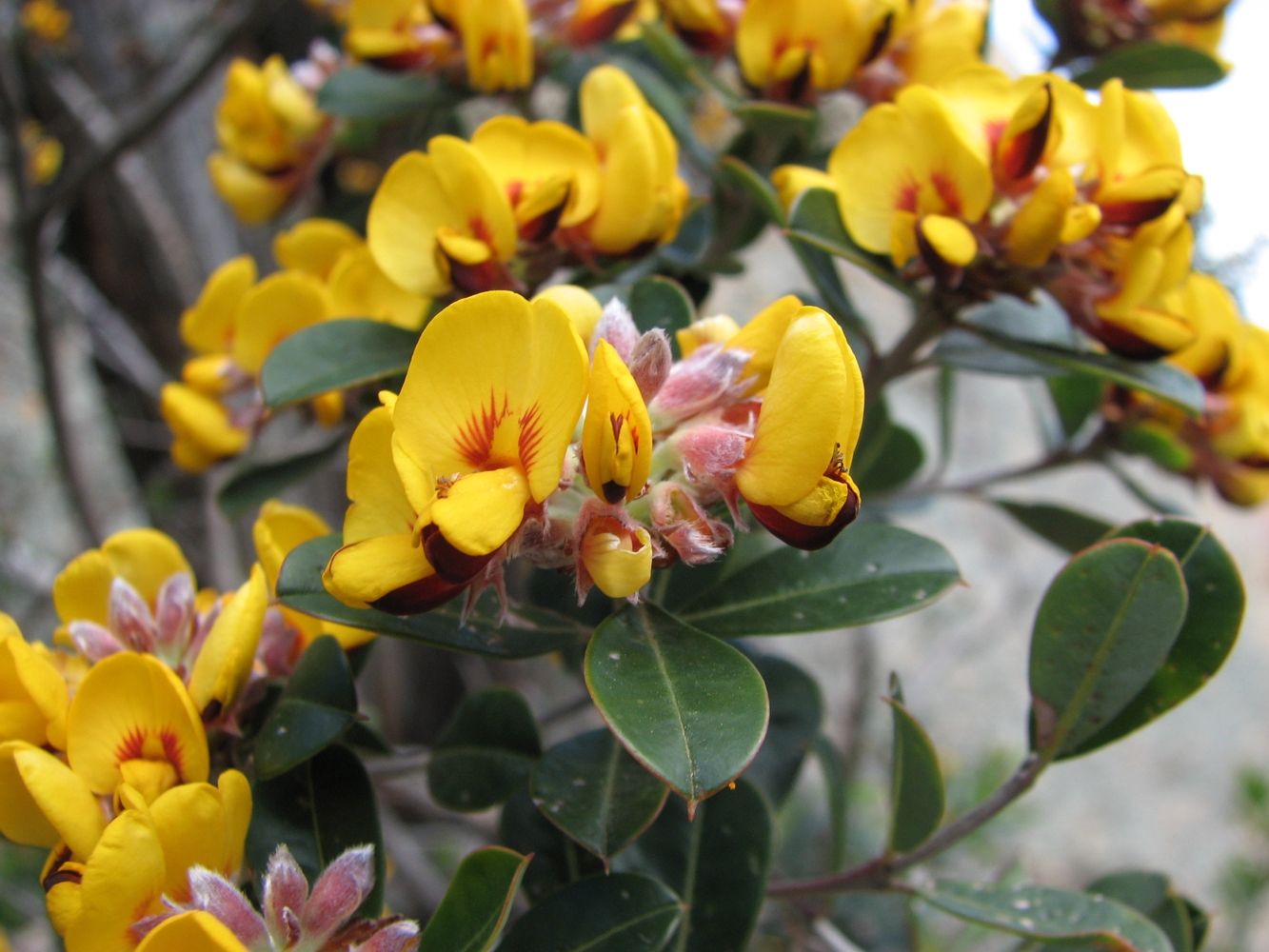
Pultenaea, commonly known as bush-peas or egg and bacon peas, is a genus of approximately 127 species of shrubs native to Australia. All species are endemic to the continent, occurring across every state and the Australian Capital Territory, though absent from the Northern Territory. The genus belongs to the family Fabaceae (subfamily Faboideae, clade Mirbelioids) and was formally described by James Edward Smith in 1794 in "A Specimen of the Botany of New Holland," with Pultenaea stipularis as the type species — first grown from New South Wales seed in Stockwell, England.
Plants are shrubs exhibiting erect to prostrate growth forms. Leaves are simple and alternately arranged, with papery stipules. The flowers are characteristic pea-shaped blooms in orange or yellow, with the standard petal equal to or slightly longer than the remaining petals; they are typically borne in leaf axils near the branch ends. The fruit is a small, egg-shaped pod with the persistent style base attached.
The genus underwent explosive diversification — a "starburst radiation" — during the late Miocene, driven by increasing aridity across the Australian continent. East-west endemism patterns within the genus reflect the Nullarbor Plain's development as a dispersal barrier, shifting rainfall boundaries, and historical marine incursions across South Australia and Victoria. Several species are considered recently extinct (notably P. elusa and P. maidenii), with altered fire regimes and grazing pressures implicated in their decline.
In 2024, Barrett et al. revised the genus, splitting it into five lineages. Pultenaea sensu stricto retains most species, concentrated in eastern Australia, while four newly recognised genera — Euchilus, Grievea, Jennata, and Loricobbia — represent endemic Western Australian taxa previously included in a broadly-defined Pultenaea.
Etymology
The genus name Pultenaea honours Richard Pulteney (1730–1801), an English surgeon, botanist, and biographer of Linnaeus. The genus was formally established by James Edward Smith in 1794 when he described Pultenaea stipularis — the type species — from a plant raised in Stockwell, England, grown from seed collected in New South Wales.
Distribution
Pultenaea species are found across all Australian states and the Australian Capital Territory. The genus is absent from the Northern Territory. Geographic patterns of endemism within the genus broadly follow an east-west axis: Pultenaea sensu stricto (the majority of species) is centred in eastern Australia, while several segregate genera recognised in 2024 are endemic to Western Australia. These distributional boundaries are attributed to the development of the Nullarbor Plain as an aridity barrier, shifting historical rainfall boundaries, and past marine incursions through South Australia and Victoria. The Atlas of Living Australia documents over 149,000 occurrence records for the genus.
Ecology
Pultenaea is thought to have undergone an explosive "starburst" radiation during the late Miocene, closely associated with increasing aridity across Australia. The pea-shaped flowers are typical of insect-pollinated legumes, and the genus is frequently associated with Australian heathland and dry sclerophyll vegetation. Altered fire regimes and grazing pressure have been linked to recent extinctions within the genus, including the loss of P. elusa and P. maidenii.
Taxonomy
Pultenaea Sm. was described in 1794 (Spec. Bot. New Holland: 35) and is currently placed in Fabaceae, subfamily Faboideae, clade Mirbelioids. The genus has long been understood as problematic in circumscription: molecular phylogenetic studies established it as paraphyletic with respect to several other mirbelioid genera. In a 2024 revision, Barrett et al. formally split the genus into five lineages. Pultenaea sensu stricto retains species centred in eastern Australia; Euchilus, Grievea, Jennata, and Loricobbia were elevated to genus rank for endemic Western Australian taxa formerly included in a broader Pultenaea. GBIF lists 206 descendant taxa under the current circumscription.
Cultivation
Several Pultenaea species are cultivated in Australian gardens, primarily for their prolific spring flower displays of orange and yellow pea-shaped blooms. The shrubs are noted as fast-growing and adaptable to diverse growing conditions. Registered horticultural cultivars include Pultenaea pedunculata 'Pyalong Gold', Pultenaea pedunculata 'Pyalong Pink', and the prostrate Pultenaea villosa 'Wallum Gold'.
Propagation
Pultenaea can be propagated by semi-mature cuttings or from seed. Seeds have a hard seed coat and require hot-water treatment prior to sowing to improve germination rates.










