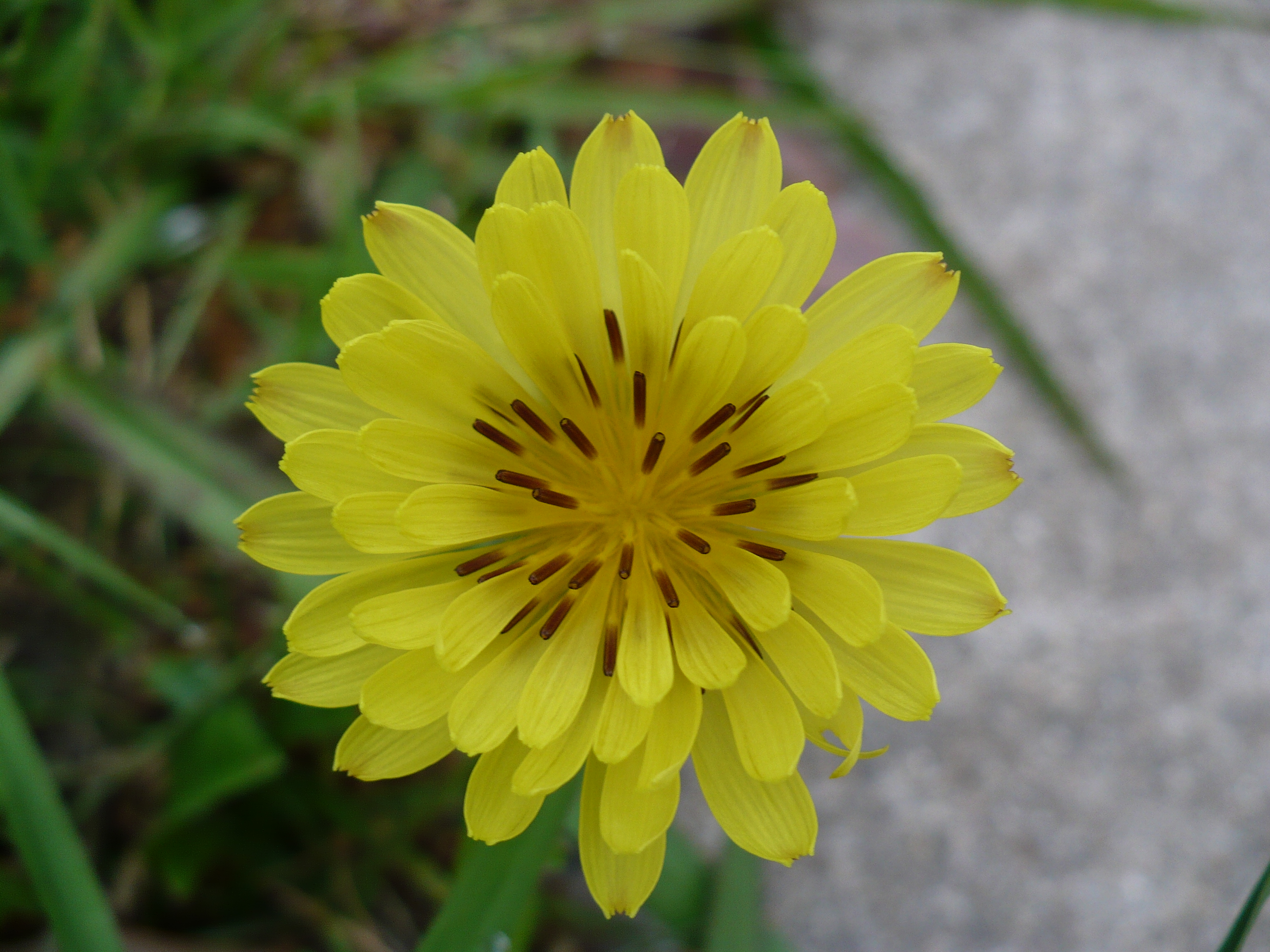
Pyrrhopappus, commonly known as desert-chicory, is a small genus of flowering plants in the daisy family (Asteraceae), placed in the tribe Cichorieae alongside familiar relatives such as chicory, dandelion, and lettuce. All four accepted species are native to North America, ranging from the southeastern and south-central United States and the Great Plains westward to Arizona and New Mexico, and south into northern and central Mexico.
Plants in the genus are annuals or perennials growing 5–100+ cm tall, arising from taproots or rhizomes; in P. grandiflorus the roots produce conspicuous tuberiform swellings. Stems are usually solitary, erect, and glabrous or lightly pilosulous. Leaves are basal or basal and cauline, with blades ranging from oblong or elliptic to lanceolate or linear, and margins that may be entire or dentate to pinnately lobed. The flower heads are borne singly or in loose corymbiform arrays, each with 20–150+ florets bearing bright yellow to whitish ligulate corollas — the characteristic "ray only" arrangement of tribe Cichorieae. The cylindric involucre carries 8–21+ linear phyllaries in approximately two series, which reflex in fruit. Ripe achenes (cypselae) are reddish brown to stramineous, fusiform, and topped by a fragile filiform beak; the pappus is double, with an outer coroniform ring of short whitish hairs and an inner ring of 80–120+ rufous to stramineous barbellulate bristles — the rusty-plumed pappus that gives the genus its name. The base chromosome number is x = 6.
Interspecific hybridization is reported as common within the genus, and close morphological similarities make some specimens difficult to assign to species. Some Mexican plants previously treated as P. multicaulis de Candolle may represent a species distinct from P. pauciflorus.
Etymology
The genus name Pyrrhopappus is derived from the Greek pyrrhos (flame-colored, red-orange) and pappos (grandfather's beard, referring to the pappus), alluding to the distinctive rufous to reddish-brown bristles that cap the mature achenes.
Distribution
Pyrrhopappus species occur across the eastern and south-central United States (including the Great Plains from Nebraska to Texas and the southeastern states), west to Arizona and New Mexico, and south into northern and central Mexico, including the states of Chihuahua, Coahuila, Durango, Nuevo León, Tamaulipas, San Luis Potosí, and Puebla.
Ecology
Species within Pyrrhopappus are notably prone to interspecific hybridization, a trait remarked upon by botanists studying both the biology and floristics of the group; morphological similarity between taxa frequently complicates identification of herbarium specimens.
Taxonomy Notes
The genus is placed in tribe Cichorieae, family Asteraceae. Some Mexican plants attributed to Pyrrhopappus multicaulis de Candolle may represent a taxon distinct from P. pauciflorus (see McVaugh 1984). Two African species formerly included — P. hochstetteri and P. humilis — have been transferred to Lactuca (L. inermis). GBIF currently recognizes 4 accepted species.










