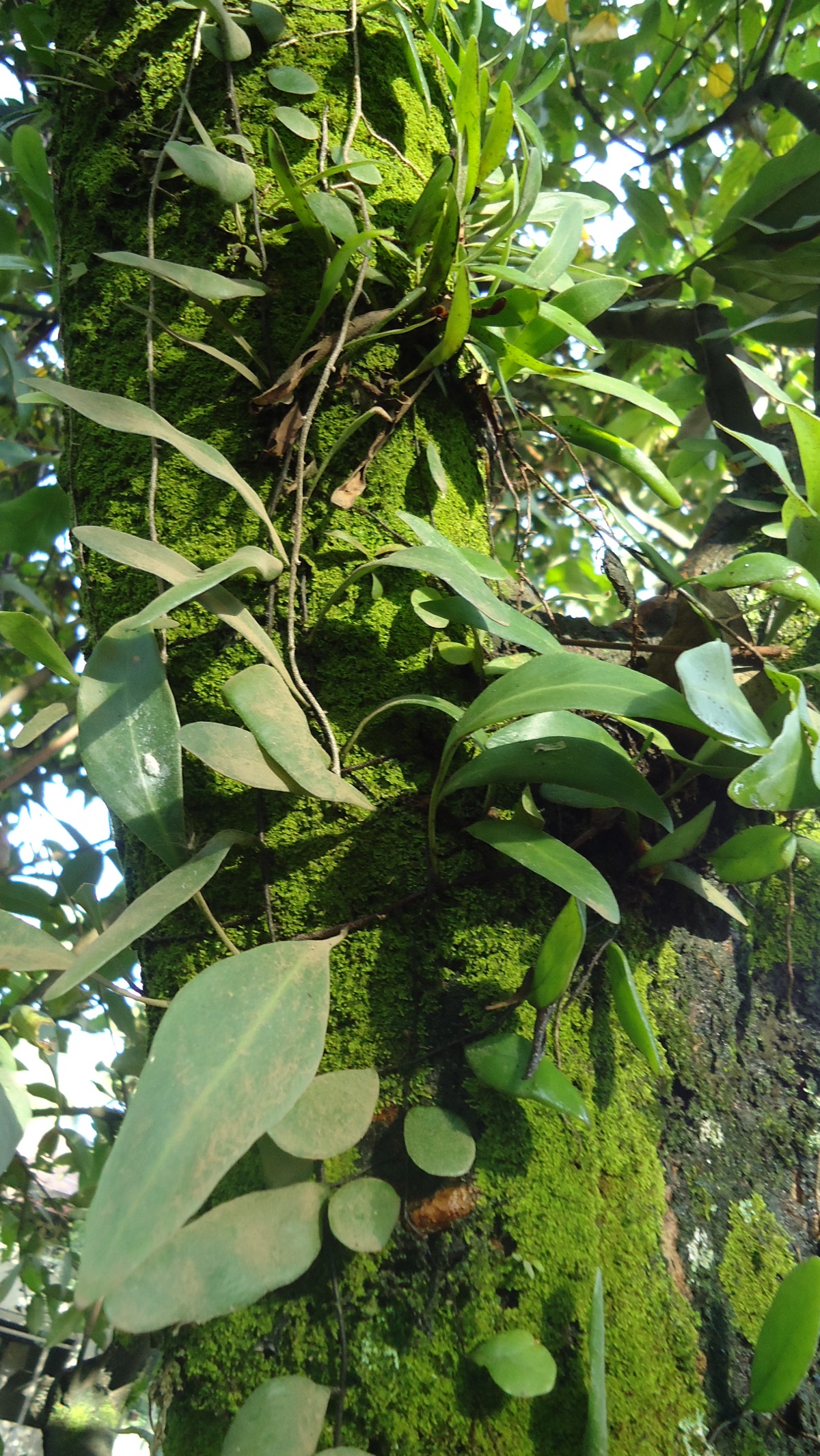
Pyrrosia, commonly known as felt ferns, is a genus of approximately 69–91 fern species (the exact count varies by authority) in the family Polypodiaceae, subfamily Platycerioideae. The genus was established by the French botanist Mirbel and first published in 1802, making it one of the earlier described polypod fern genera.
The most diagnostic feature of the genus is the presence of stellate (star-shaped) hairs that cover the fronds, giving plants a felt-like or woolly texture — the origin of their common name. These hairs occur on both frond surfaces in most species and vary in density and color across the genus.
The overwhelming majority of Pyrrosia species are epiphytic, clinging to tree bark or rock surfaces with their creeping rhizomes; a smaller number are facultatively terrestrial. Several species native to seasonally dry environments in Africa and Asia exhibit poikilohydry — a drought-tolerance strategy in which the fronds roll up and enter a dormant state during dry periods, then rehydrate and resume photosynthesis when moisture returns.
The genus ranges across tropical and subtropical regions from West Africa through the Indian Ocean islands to tropical Asia and out into the Pacific, as far east as Henderson Island, with its center of diversity in Southeast Asia and southern China. Four species are native to sub-Saharan Africa, and the genus has been introduced to the Windward Islands in the Caribbean. It favors seasonally moist evergreen coastal forests at low to mid elevations.
Etymology
The generic name Pyrrosia derives from the ancient Greek pyrrhos (πυρρός), meaning red or flame-colored. It references the reddish appearance of certain species, attributed either to reddish stellate hairs on the fronds or to the coloration of the sporangia massed on the leaf undersides. The genus was named and described by the French botanist Charles-François Brisseau de Mirbel, with the name first published in 1802 in the collaborative work Histoire naturelle des végétaux by Lamarck and Mirbel.
Distribution
Pyrrosia is native to a broad tropical and subtropical belt stretching from West and Central Africa (Cameroon, Uganda, Ethiopia, and south to eastern South Africa), through the islands of the western Indian Ocean, across southern and eastern Asia (from Mongolia and China through Southeast Asia, the Indian subcontinent, and the Malay Archipelago), and east into the Pacific — reaching as far as Henderson Island. The genus has also been introduced into the Windward Islands of the Caribbean.
The center of diversity is Southeast Asia and southern China. Of the roughly 51–69 accepted species, only four are native to sub-Saharan Africa; the rest are concentrated in tropical Asia. Within Africa, the range runs from Liberia in the west through Ethiopia and East Africa to KwaZulu-Natal and as far south as East London in the Eastern Cape of South Africa.
Ecology
Pyrrosia species are predominantly epiphytic ferns, colonizing the bark of trees or the surfaces of rocks with creeping, rhizomatous growth; a minority are terrestrial. In their African range they grow as low- to medium-height epiphytes in seasonally moist evergreen coastal forests, typically around 700 m elevation.
A functionally important trait in several species — especially those from seasonally dry habitats — is poikilohydry. Poikilohydrous species tolerate near-complete desiccation: the fronds roll up and enter a dormant state under drought conditions, then unfold and resume metabolic activity upon rehydration. This adaptation allows Pyrrosia to persist on exposed rock faces and in forest canopies where periodic water stress would kill most ferns.
Cultivation
Pyrrosia species suited to cultivation are grown as ornamental ferns, valued for their unusual felt-textured fronds and their tolerance of epiphytic growing conditions. They perform best in felt-layered wire hanging baskets or mounted on cork or tree-fern slabs, with a loose, humus-rich, moisture-retentive substrate. Light shade is preferred, as intense direct sun scorches the fronds. Plants require regular watering during the growing season and benefit from occasional balanced fertilization. In climates cooler than their tropical native range, frost protection is essential — most species are tender and should be kept above freezing.
Propagation
Pyrrosia is most reliably propagated by rhizome division. The rhizome is cut into sections and planted shallowly, with the growing apex left exposed at the substrate surface. Divisions establish readily under warm, humid conditions with indirect light. Spore propagation is also possible but slower, with spores germinating on a moist, sterile medium under humid conditions.
Taxonomy
Pyrrosia Mirb. is an accepted genus in the family Polypodiaceae (order Polypodiales), placed in the subfamily Platycerioideae. The authorship is attributed to Mirbel, published in Hist. Nat. Vég. Cl. Fam. 3: 471 (1802). POWO recognizes 69 accepted species, while GBIF records 91 descendant taxa — the discrepancy likely reflects the inclusion of infraspecific taxa and provisionally accepted names in the GBIF count.
The genus carries 16 synonyms reflecting a complex nomenclatural history, including the former genera Cyclophorus, Drymoglossum, Niphobolus, and Niphopsis. These names applied when the constituent species were treated as distinct genera; molecular phylogenetic work later consolidated them within a broadly circumscribed Pyrrosia. The IPNI identifier for the genus is urn:lsid:ipni.org:names:50426205-2.










