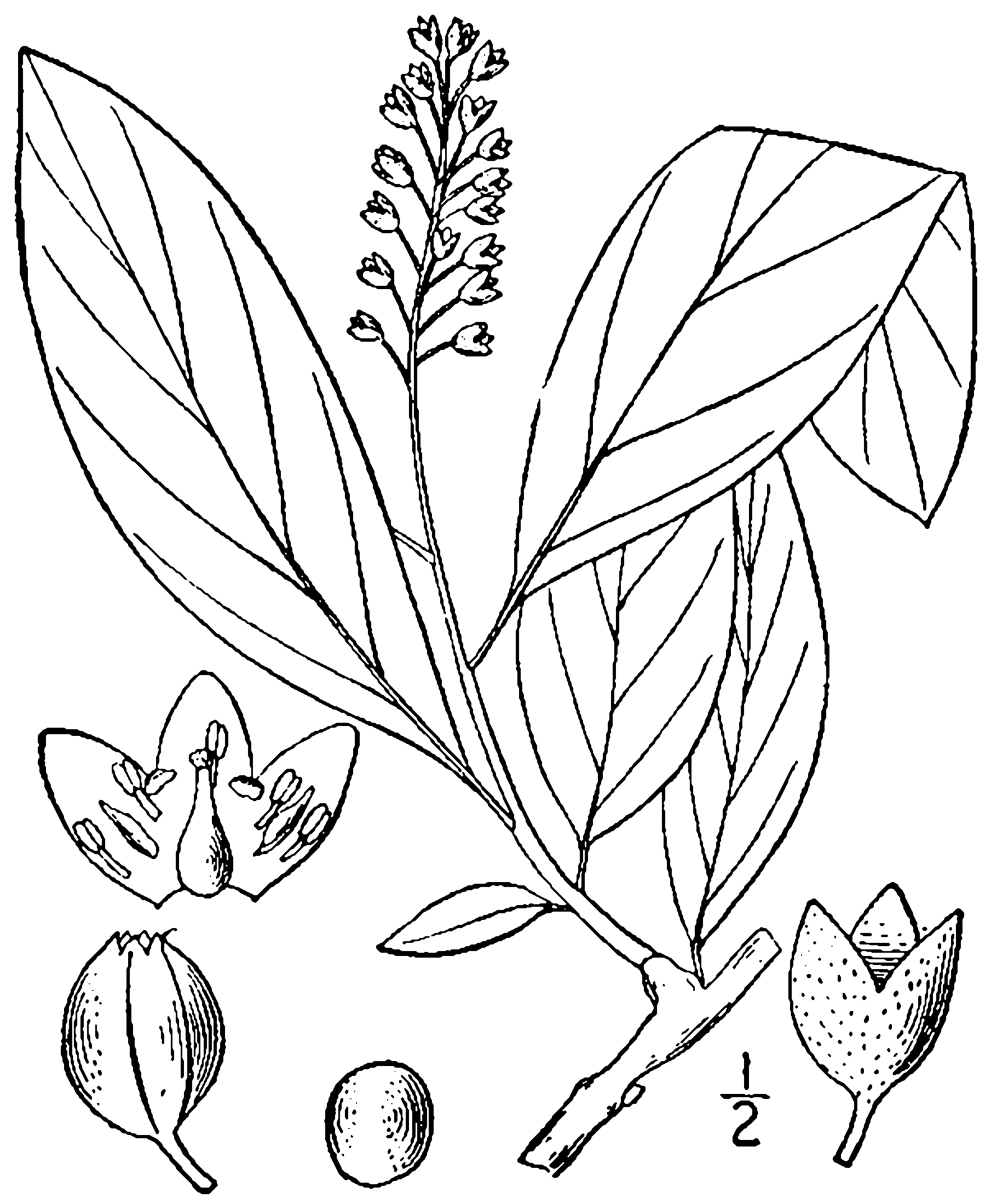
Pyrularia is a small genus of shrubs and small trees comprising just two species: Pyrularia pubera (buffalo nut or oil nut) of the eastern United States, and Pyrularia edulis of South and Southeast Asia, native to Bhutan, China, India, Myanmar, and Nepal. The genus belongs to the family Cervantesiaceae (formerly treated within the broader Santalaceae) in the order Santalales.
Both species are hemiparasites — they retain the capacity for photosynthesis but supplement their nutrition by parasitizing the root systems of neighboring plants. This root-haustorial parasitism is characteristic of the broader sandalwood alliance and places Pyrularia among a select group of woody hemiparasites in temperate and subtropical forests.
The genus was formally described in 1803 by the French botanist André Michaux. The name Pyrularia is derived from the Latin pyrus ("pear") combined with aria ("connecting"), a reference to the distinctive pear-shaped fruit produced by plants in the genus.
Etymology
The genus name Pyrularia is derived from the Latin pyrus (pear) and aria (connecting), alluding to the characteristic pear-shaped fruit. The genus was first formally named in 1803 by the French botanist André Michaux.
Distribution
Pyrularia pubera (buffalo nut) is native to the eastern United States, while Pyrularia edulis is native to a disjunct range in Asia spanning Bhutan, China, India, Myanmar, and Nepal. The two-species genus thus has a classic Eastern North America–Eastern Asia disjunct distribution pattern.
Ecology
Both species of Pyrularia are root hemiparasites: they photosynthesize but also form haustorial connections with the roots of surrounding trees and shrubs, extracting water and nutrients. This parasitic strategy is shared with other members of the order Santalales.










