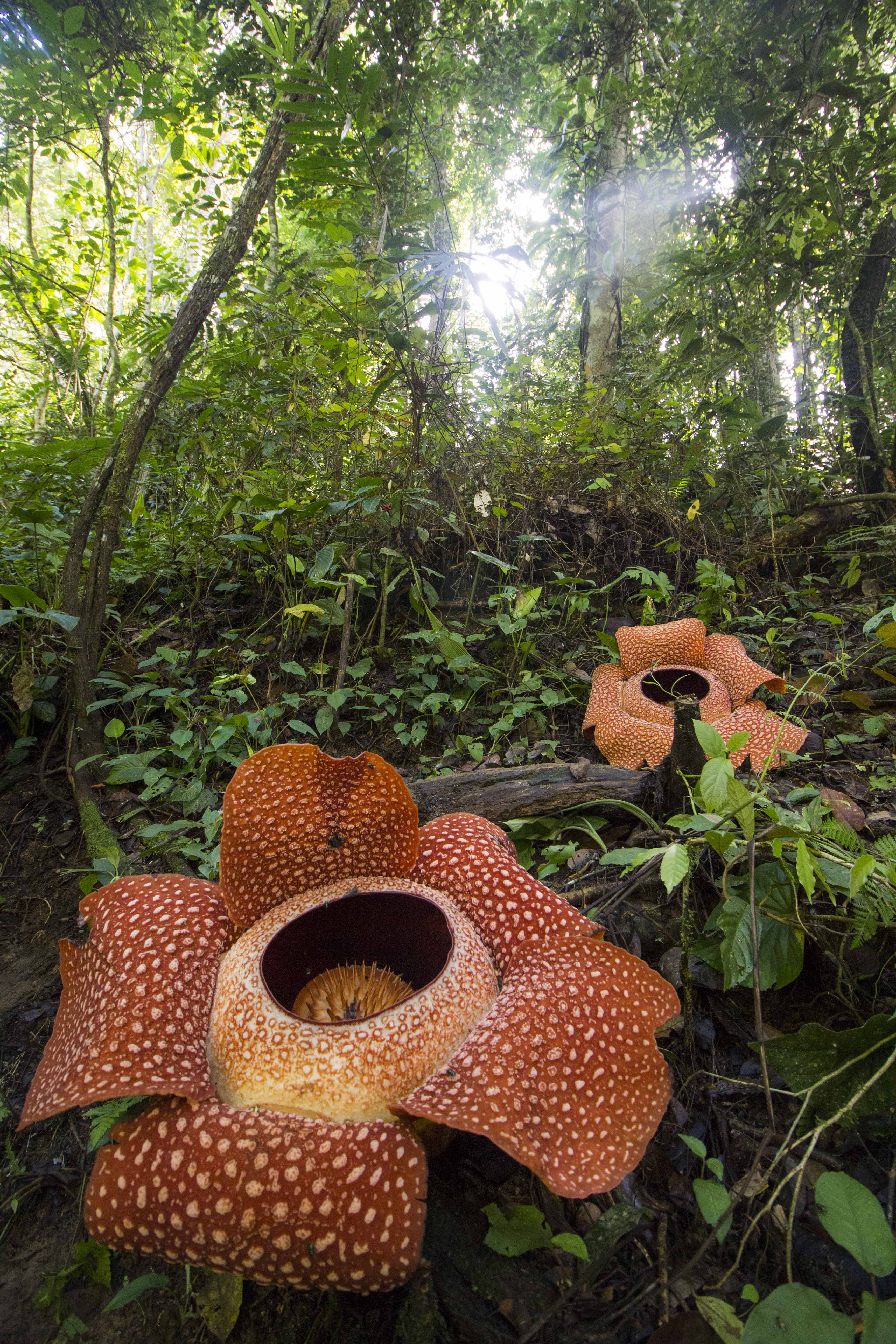
Rafflesia is a genus of holoparasitic flowering plants in the family Rafflesiaceae, order Malpighiales, native exclusively to the tropical forests of Southeast Asia. The genus comprises roughly 30–41 species, all entirely dependent on vines of the genus Tetrastigma (family Vitaceae) for water and nutrients. Rafflesia plants have no stems, leaves, roots, or chlorophyll: the entire vegetative body consists of thread-like filaments embedded within host tissue, and the only externally visible structure is the flower itself, which emerges directly from the vine or from the ground at its base.
The flowers are among the most extraordinary in the plant kingdom. Rafflesia arnoldii, the type species, produces the largest single flower of any known flowering plant — specimens exceeding 100 centimetres in diameter and weighing up to 10 kilograms have been recorded, with a 2020 Sumatran individual measured at 111 centimetres, the largest on record. The five-petalled (technically petaloid-tepal) flower is brick-red with pale wart-like protuberances and emits a powerful odour of decaying flesh, an adaptation that attracts carrion flies (Chrysomya megacephala, Sarcophaga haemorrhoidalis, Drosophila colorata) as pollinators. Most species are dioecious, though R. verrucosa and R. baletei are hermaphroditic.
Each Rafflesia species tends to be host-specific, associating with only one to three Tetrastigma species. Of the roughly 57 known Tetrastigma species, only about ten are confirmed hosts; T. tuberculatum is parasitised by at least 15 Rafflesia species. Seeds are tiny, packed into berries containing hundreds of thousands of seeds each, and are likely dispersed by ants exploiting minute elaiosomes, with forest mammals such as treeshrews also consuming the fruits.
Rafflesia is also notable scientifically for its extensive horizontal transfer of genes from host plant mitochondria — a phenomenon well documented in bacteria but rare among multicellular eukaryotes.
The genus was named in honour of Sir Stamford Raffles, who led the 1818 Bengkulu expedition during which Joseph Arnold became the first British person to observe a specimen. Robert Brown introduced the genus formally at the Linnean Society of London in 1820. Species are distributed across Sumatra, Java, Borneo, Peninsular Malaysia, Thailand, and the Philippine archipelago, where several endemic species are found on Mindanao, Luzon, and the Visayas.
Etymology
The genus name Rafflesia honours Sir Stamford Raffles, colonial administrator and founder of the British colony of Singapore, who led the 1818 expedition to Bengkulu, Sumatra, during which the flower was first brought to European scientific attention by Joseph Arnold. The common English name "stinking corpse lily" refers directly to the flower's odour. Regional vernacular names — Indonesian/Malay padma, pakma, and patma — derive from the Sanskrit पद्म (padma), meaning "lotus."
Distribution
All species of Rafflesia are restricted to the tropical forests of Southeast Asia, including Sumatra, Java, Borneo, Peninsular Malaysia, Thailand, and the Philippines (principally Mindanao, but also Luzon and the Visayas). The Philippine archipelago supports a particularly high concentration of endemic species, with several known from single mountain localities such as Mount Apo, Mount Candalaga, and Mount Kampalili.
Ecology
Rafflesia species are obligate holoparasites of Tetrastigma vines (Vitaceae), with no capacity for independent photosynthesis. Each species is typically restricted to one to three host Tetrastigma species. Pollination is achieved by carrion flies attracted to the flower's odour of rotting flesh. Gender ratios in populations are often strongly male-biased (up to 9:1 in R. lobata), and female flowers are thought to set fruit agamospermously in the absence of pollen donors. Seed dispersal likely involves ants (via elaiosomes) and mammals that consume the berry fruits. Established flowering sites may continue to produce blooms for decades, though individual buds are vulnerable to predation and physical damage by forest mammals including pigs, wild cats, deer, and banteng.
Conservation
All Rafflesia species are threatened by tropical deforestation and habitat degradation across their Southeast Asian range. Philippine endemics are particularly vulnerable given their narrow distributions, often confined to single mountain massifs. Research in Malaysia and Indonesia has demonstrated that propagation is possible by grafting infected Tetrastigma vines, a method pioneered at Bogor Botanical Garden in the 1850s; seed-based propagation was first achieved by Malaysian biologist Jamili Nais around 2000. The genus attracts ecotourism revenue in several range countries, providing an economic incentive for local habitat protection.
Cultural Uses
In Thailand, the buds and flowers of R. kerrii are consumed as a food delicacy and used in folk herbalism, where preparations are believed to act as a sexual stimulant and to relieve fever and backache. In the Philippines, flowers are also used in folk medicine and fed to swine. In Java, dried buds of R. zollingeriana are incorporated into jamu, the island's traditional herbal medicine system, typically in compound preparations associated with sexual vitality. Beyond medicinal uses, living Rafflesia specimens are significant ecotourism attractions throughout their range.
History
Western European knowledge of the genus dates to French surgeon Louis Deschamps, who encountered specimens in Java between 1791 and 1794; his notes and illustrations were confiscated by the British in 1798 and remained unpublished until 1861. The decisive discovery for Western science occurred in 1818, when a Malay servant in the employ of Joseph Arnold located a flowering plant in the Bengkulu rainforest of Sumatra during an expedition led by Stamford Raffles. Robert Brown presented the genus to the Linnean Society of London in June 1820, and the name was first validly published in the Annals of Philosophy in September 1820 under the editorship of Thomas Thomson (the chemist, not the botanist of the same name). Brown's formal scientific paper followed in late 1821.

