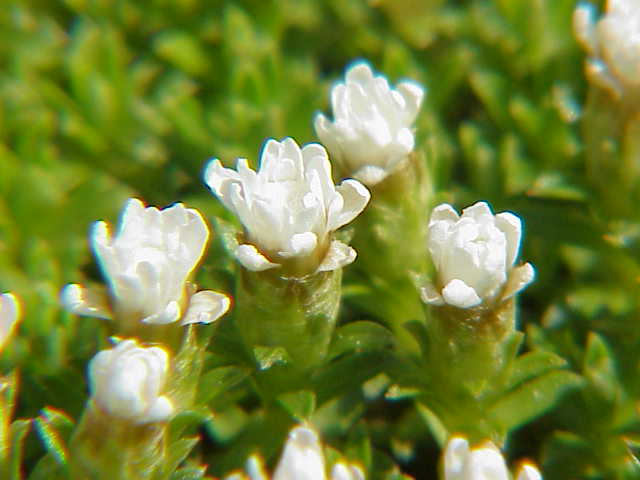
Raoulia is a genus of low-growing herbs and subshrubs in the family Asteraceae (tribe Gnaphalieae), order Asterales, endemic to New Zealand. The genus was formally described by Joseph Dalton Hooker and Édouard Raoul in Raoul's Choix de Plantes de la Nouvelle-Zélande (1846), and comprises approximately 23 accepted species.
Plants in the genus are characterised by a creeping, tufted, or cushion-forming growth habit, typically with very small, densely crowded leaves. The flower heads (capitula) are heterogamous and discoid, borne singly and sessile or subsessile at the tips of stems. Phyllaries are scarious to membranous, sometimes with radiate white tips, and receptacles are small and nude. Outer florets are pistillate and filiform; disk-florets are tubular and five-toothed. Achenes are oblong and range from glabrous to pubescent, with pappus hairs arranged in one to several series.
Many species inhabit alpine and subalpine zones, where they form extraordinarily dense, compact cushion masses — sometimes several metres across — with only the growing tips visible at the surface. The resemblance of these cushions to sheep grazing on a hillside earned the genus its popular name, vegetable sheep. Haastia pulvinaris, another cushion-forming Asteraceae of New Zealand, shares this nickname and grows in similar high-altitude environments. Some species, such as Raoulia beauverdii, extend to lowland and coastal habitats. Notable members include Raoulia australis, a widely cultivated mat-forming species, and Raoulia eximia, one of the most striking cushion-formers of the South Island high country.
Etymology
The genus name Raoulia honours Édouard Fiacre Louis Raoul (1815–1852), a French naval surgeon and botanist who collected plants in New Zealand and published Choix de Plantes de la Nouvelle-Zélande (1846), in which the genus was first described by Hooker and Raoul.
Distribution
Raoulia is entirely endemic to New Zealand, with all 23 species indigenous to the country. The majority of species occur in alpine and subalpine zones of both the North and South Islands, particularly in the Southern Alps. A few species, including Raoulia beauverdii, extend to lowland and coastal environments.
Ecology
Most Raoulia species are adapted to exposed, high-altitude environments, where they grow as dense cushions or flat mats that resist wind and cold. The cushion growth form is a recognised adaptation to alpine conditions, reducing heat loss and protecting inner tissues. Species typically root along creeping stems and form slow-expanding colonies. Some species extend to rocky coastal and lowland habitats.
Cultivation
Raoulia species are occasionally grown as rock garden plants. They are slow-spreading and form flat, silver-gray, moss-like mats reaching about 50 mm in height and spreading to around 300 mm. They prefer full sun to part shade and require regular watering. Frost hardiness varies by source: one account gives tolerance to −7 °C, another to 2 °C.










