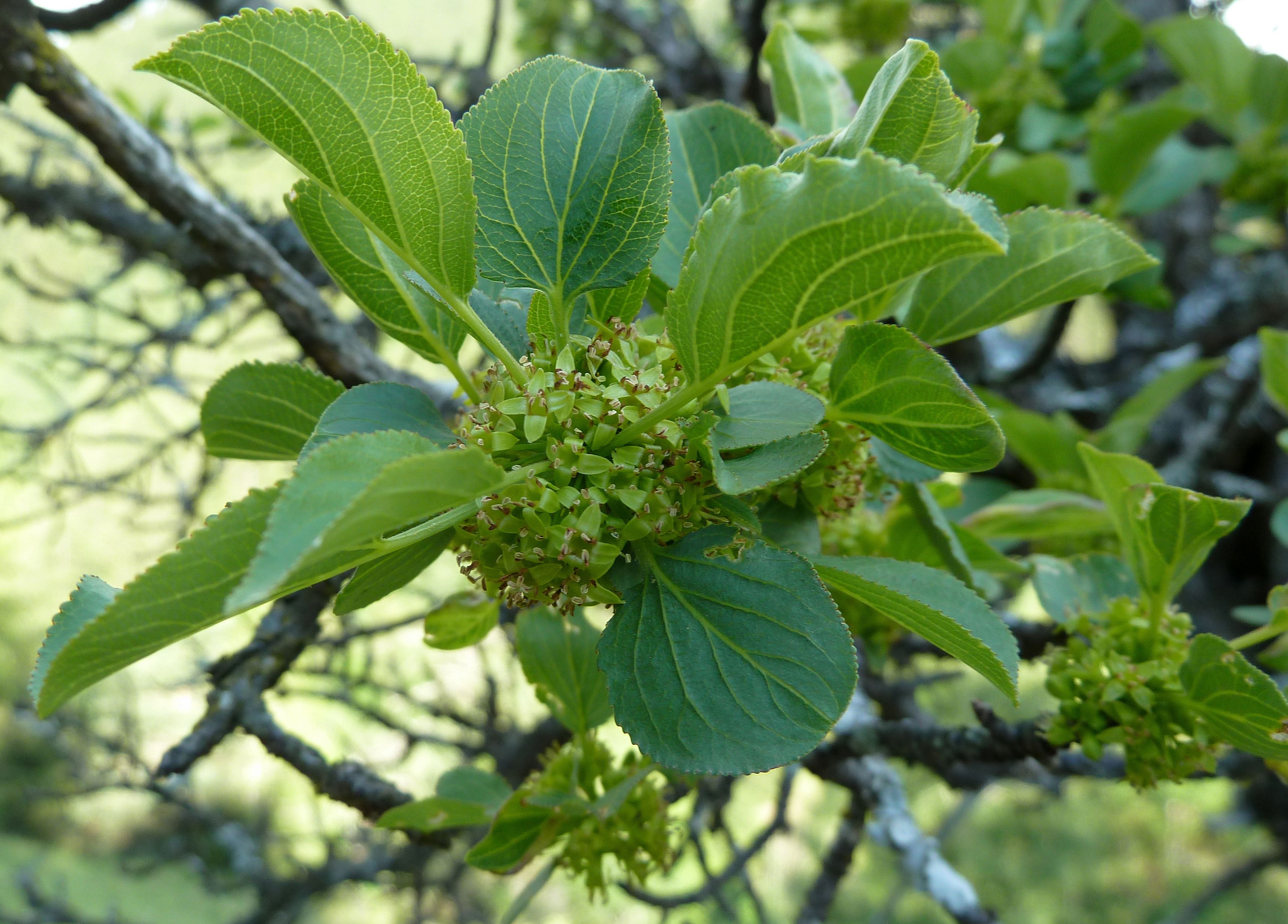
Rhamnus L. is a genus of around 140 accepted species of shrubs and small to medium-sized trees in the family Rhamnaceae (the buckthorn family), placed in the order Rosales. Plants range from 1 to 10 metres in height, rarely reaching 15 metres, and may be deciduous or, less commonly, evergreen. The stems are typically rigid, gray to brown, and in many species terminate in a distinctive woody spine — a feature that gives the genus its common name, buckthorn.
Leaves are simple, 3–15 cm long, arranged alternately or nearly oppositely, with characteristically upward-curving venation. The flowers are small and yellowish-green, typically unisexual with 4–5 sepals and petals, borne in axillary clusters. The fruit is a berry-like drupe, maturing red or black and containing 2–4 stones. Birds are frequently attracted to these fruits, giving buckthorns ecological value as a food source for wildlife.
The genus is distributed broadly across the temperate and subtropical Northern Hemisphere, with its centre of diversity in East Asia and North America; additional species occur in Europe, Central Asia, Africa, and parts of South America. Several species — notably R. cathartica (common buckthorn) and R. alaternus (Italian buckthorn) — have become invasive outside their native ranges, particularly in eastern North America and in Australasia respectively.
Rhamnus has a long record of human use. The fruits and bark of various species yield yellow and green dyes; R. utilis is the source of china green, historically used to color silk and wool. R. cathartica was employed as a purgative in 17th-century England, though its toxicity has made it obsolete for that purpose. R. prinoides, known as gesho in Ethiopia, is still used to bitter and flavor tej, the traditional honey mead.
Etymology
The genus name Rhamnus is derived from Greek and refers to various prickly or spiny shrubs. The common name "buckthorn" reflects the woody, thorn-like spines that terminate the twigs of many species. Before Linnaeus formalized the genus name in 1753, R. cathartica was known in pre-Linnaean literature as Spina Cervina (deer's thorn), further underscoring the association with spininess.
Distribution
Rhamnus is native to most of the Northern Hemisphere, with species found across North America, Europe, Central Asia, East Asia, and Africa, with a few outliers in South America. The genus reaches its greatest diversity in East Asia and North America. In Europe, species such as R. cathartica, R. alpina, R. pumila, and R. saxatilis are documented from Switzerland and the broader European flora. In North America, R. alnifolia (alder-leaf buckthorn) and R. crocea (hollyleaf buckthorn) are notable natives, with R. caroliniana occurring in the southeastern United States. Approximately 3 species are native to Arizona. The genus as a whole occupies a wide altitudinal range and tolerates varied soil types across this geographic span.
Ecology
Buckthorns occupy a range of habitats from forests and scrublands to rocky slopes and hedgerows. They are susceptible to leaf spots, rust, powdery mildew, aphids, and scales. Rhamnus cathartica serves as the primary overwintering host of the soybean aphid (Aphis glycines) and is the alternate host for the oat crown rust fungus Puccinia coronata — relationships with significant agricultural implications. The fleshy drupes are consumed by birds, making buckthorns important in seed dispersal networks and wildlife habitat.
Two species have become significant ecological invaders. R. cathartica is invasive across much of eastern North America — especially in Minnesota and Wisconsin — where it spreads rapidly through prolific self-seeding, forming dense seedling layers that suppress native understory vegetation and proving very difficult to eradicate once established. R. alaternus (Italian buckthorn) is invasive in New Zealand and coastal Australia. The larvae of several Lepidoptera species also feed on Rhamnus foliage.
Cultivation
Most Rhamnus species grow well in full sun to partial shade in average, medium-moisture, well-drained soils. They tolerate a range of soil textures including clay, loam, and sand, and prefer reasonably consistent moisture while coping with occasional dry periods. Buckthorns have historically been planted as hedges, privacy screens, and windbreaks. They offer moderate landscape value as barrier or border plants and are attractive to songbirds.
Propagation
Rhamnus can be propagated by seed, cuttings, and layering. Seeds are sown in spring or autumn in a cold frame. Vegetative options include half-ripe wood cuttings taken in July–August, mature wood cuttings in November–January, and root cuttings in winter. Layering young stems during winter is also effective. NCSU also recommends layering as a general propagation method for the genus.
Cultural Uses
Rhamnus has a diverse ethnobotanical and economic history. Several species yield valuable dyes: the fruits and bark produce yellow coloration, R. saxatilis (Avignon buckthorn) was the source of the historical trade dye known as Persian berries, and R. utilis produces china green, a bright green dye used to color silk and wool. Seeds of certain species are rich in protein and their oils have been used in lubricants, printing inks, and soap manufacturing.
In medicine, R. cathartica was a well-known purgative in 17th-century England but has been abandoned for therapeutic use due to its toxicity — the glycoside compounds found in flowers and fruit can cause nausea, vomiting, and diarrhea. In Ethiopia, R. prinoides (gesho, shiny-leaf buckthorn) remains in active use as a bittering and flavoring agent for tej, the traditional honey mead, playing a role analogous to hops in beer brewing.
Conservation
No global-level IUCN threat assessment was retrievable for the genus as a whole. At the regional scale, several European species (R. alpina, R. pumila, R. saxatilis) are tracked by national flora programs such as InfoFlora in Switzerland. Some species with narrow ranges — such as R. bermejoi and R. quitensis — are likely of conservation concern by virtue of their restricted distributions, though specific threat designations were not available in sources consulted. Conversely, R. cathartica is so successful outside its native range in North America that management efforts aim at control and eradication rather than protection.
Taxonomy Notes
Rhamnus was established by Linnaeus and published in Species Plantarum (1753, p. 193). It belongs to the family Rhamnaceae, order Rosales, class Magnoliopsida, phylum Tracheophyta. The number of recognized species varies by authority: GBIF lists 335 descendant taxa (including synonyms and infraspecific entities), while Wikipedia (as of October 2024) and NCSU cite approximately 140 accepted species, and SEINet gives approximately 125. This discrepancy reflects differing treatments of species boundaries and the ongoing generic reorganization of Rhamnaceae — several taxa formerly placed in related genera (e.g., Frangula) have at various times been included in or excluded from Rhamnus sensu lato.










