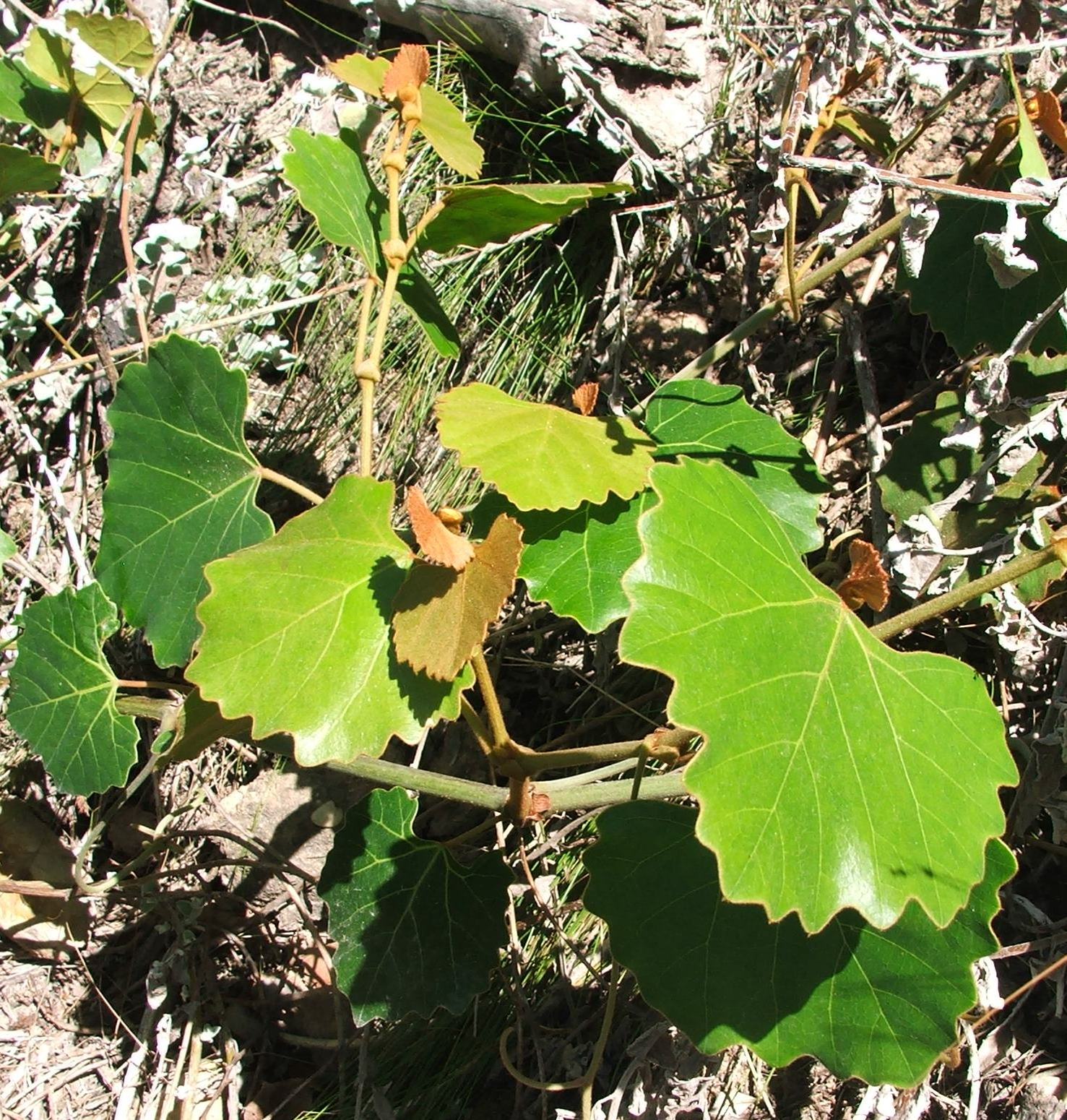
Rhoicissus is an Afrotropical genus of climbing and scrambling shrubs in the grape family Vitaceae (subfamily Vitoideae, order Vitales). Between nine and twenty-two species are currently accepted, all native to sub-Saharan Africa. Members of the genus are woody tendril-climbers that ascend into forest canopy or scramble over rocky slopes, and several species also grow from large underground tubers. Rhoicissus tomentosa, the Cape grape creeper, can produce stems exceeding 25 m in length from globose root tubers; it climbs by coiled tendrils and occasionally assumes a tree-like form 3–7 m tall. The genus is well represented in southern and eastern Africa, with species occurring in closed and fringing forest, montane rain-forest, and forest margins from near sea level to about 1,800 m elevation.
The genus has long been split by some authors into Rhoicissus sensu stricto and the related genus Cissus, and a number of species carry older synonyms under Cissus and Vitis (e.g. Rhoicissus tomentosa was formerly Cissus capensis). GBIF recognises the genus within Vitaceae, consistent with broader molecular phylogenies of the grape order.
Several species are cultivated as ornamental climbers for covering fences, trellises, and pergolas, and R. rhomboidea (natal vine) is widely grown as a houseplant in temperate regions. Fruits of multiple species are edible raw or cooked and have traditionally been used to make jelly. The leaves of R. tomentosa and R. tridentata serve as larval food for the silver striped hawkmoth (Hippotion celerio), highlighting the genus's ecological role in Afrotropical forest ecosystems.
Etymology
The name Rhoicissus is derived from the Greek rhoias (pomegranate or a plant with red juice) and kissos (ivy), referring to the ivy-like climbing habit and the reddish juice of the berries. The combination reflects the genus's placement in the grape family and its characteristic twining, tendril-borne growth.
Distribution
Rhoicissus is confined to sub-Saharan Africa (the Afrotropical realm). Species occur across southern and eastern Africa, with the centre of diversity in South Africa; individual species range into Malawi, Mozambique, Zimbabwe, and East Africa. Habitats include closed forest, fringing forest, montane rain-forest, and rocky scrub at elevations up to about 1,800 m.
Ecology
Members of Rhoicissus are woody tendril-climbers of forest and forest-edge habitats. R. tomentosa and R. tridentata are recorded larval host plants of the silver striped hawkmoth (Hippotion celerio). R. tomentosa grows in closed or fringing forest and montane rain-forest, often scrambling high into the canopy.
Cultivation
Several Rhoicissus species are grown as ornamental climbers, valued for their dense foliage as cover for fences and trellises. R. rhomboidea (natal vine) is a popular houseplant. R. tomentosa prefers roots in dappled to quite deep shade. Propagation is from seed.
Cultural Uses
Fruits of Rhoicissus tomentosa are edible raw or cooked; the purplish-black berries (~2 cm diameter, reddish pulp) are traditionally harvested from the wild and often made into jelly. Young leaves and shoots are also eaten cooked.










