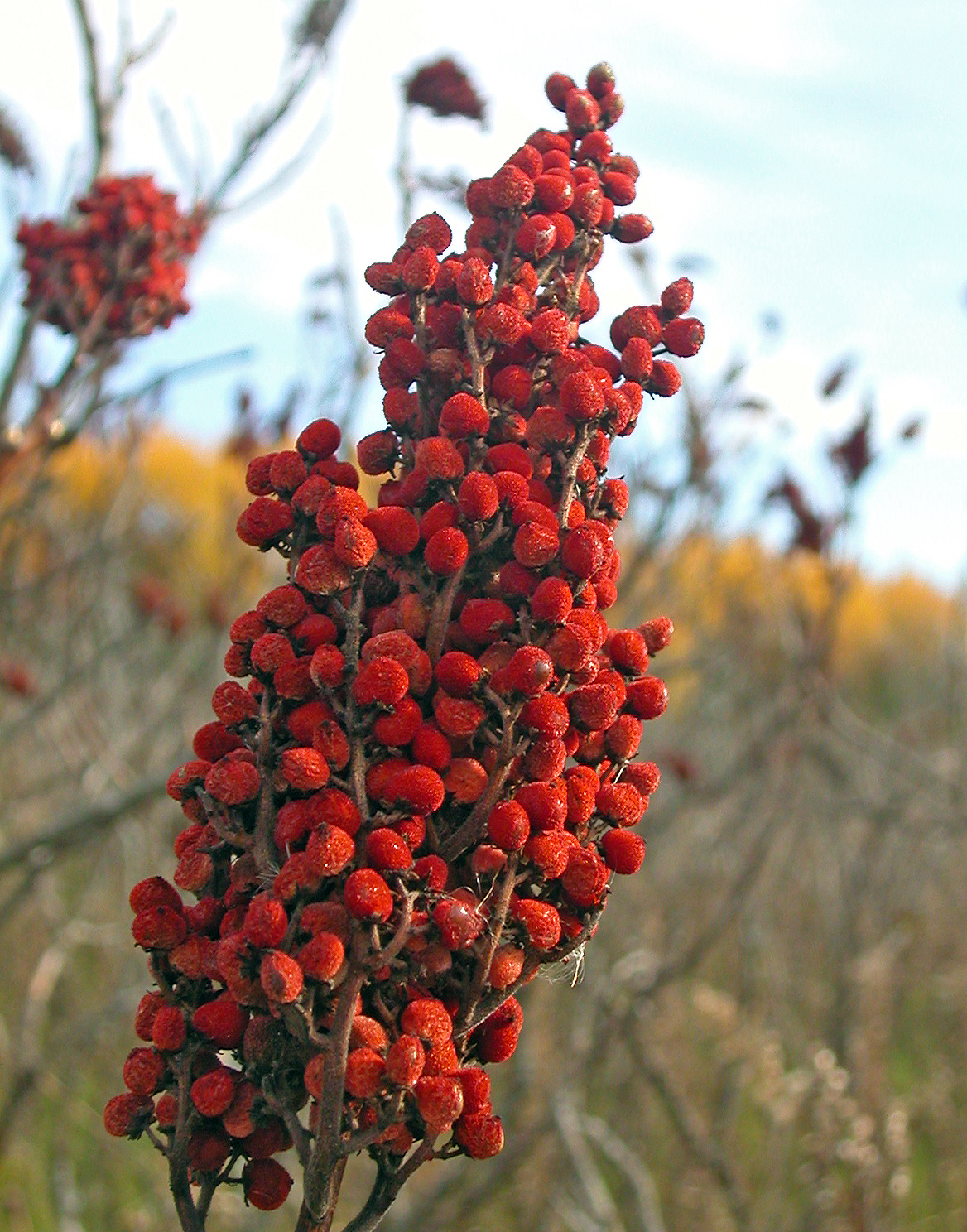
Rhus L. (Anacardiaceae), commonly known as sumac, is a genus of approximately 54 accepted species of dioecious shrubs and small trees distributed across subtropical and temperate regions of Asia, North Africa, southern Europe, Australia, the Pacific, and North America. Plants typically reach 1–10 metres in height and bear pinnately compound leaves, though some species have trifoliate or simple leaves. Small flowers are borne in dense panicles 5–30 cm long, and the genus is recognizable by its dense terminal clusters of small reddish drupes — often called "sumac bobs" — which distinguish true sumacs from their poisonous relatives in the genus Toxicodendron, which produce white drupes.
The genus was formally described by Linnaeus in Species Plantarum (1753) and placed in the family Anacardiaceae, order Sapindales. Taxonomically, Rhus has undergone significant revision: what was historically a broad genus of over 250 species has been substantially reorganised, with Cotinus, Toxicodendron, and Searsia (among others) removed to their own genera. Current treatments recognize two subgenera — Rhus (~10 species) and Lobadium (~25 species) — though molecular phylogenetic work indicates both subgenera lack strict monophyly. GBIF records 183 descendant taxa under the accepted genus.
Sumacs are plants of open, dry, often rocky or disturbed habitats. Many species spread aggressively by rhizomes, forming extensive clonal colonies. Cultivation is straightforward: they prefer well-drained soils in full sun, tolerate most soil types, and are drought tolerant once established, surviving temperatures as low as approximately −20°C. Propagation is by fresh seed (cold-frame sown), stratified stored seed, or half-ripe cuttings in summer.
Etymology
The common name "sumac" entered English via Old French sumac (13th century), from Medieval Latin sumach, which in turn derives from Arabic summāq, itself tracing back to Syriac summāqa meaning "red" — a reference to the characteristic red fruit clusters. The genus name Rhus is drawn from Ancient Greek rhous, the classical term for the plant applied specifically to the type species R. coriaria; the deeper etymology of the Greek word is not established.
Distribution
Species of Rhus occupy subtropical and temperate regions on nearly every continent except Antarctica and South America, with diversity centres in Asia, North Africa, southern Europe, Australia, the Pacific islands, and North America. The genus spans approximately 150–183 taxa (source-dependent counts) distributed across these regions. In the southwestern United States, notable representatives include R. aromatica, R. glabra, R. microphylla, R. lanceolata, R. kearneyi, and R. emoryi. The ancestral range of R. coriaria, the culinary sumac, extends from southern Europe through West Asia, where it grows on dry hillsides and rocky limestone slopes up to 1,300 metres elevation.
Ecology
Sumacs inhabit open, dry, and often disturbed environments — rocky hillsides, scrublands, forest margins, and roadsides. Many species are rhizomatous and form large clonal colonies after disturbance or fire. The leaves contain volatile oils (including pinene and camphene) as well as high concentrations of tannins in bark and leaves. Fruits are small, reddish drupes that are consumed by birds and mammals, facilitating seed dispersal. True Rhus species produce red drupes and lack urushiol; they are non-toxic and should not be confused with the closely related Toxicodendron species (poison ivy, poison oak, poison sumac), which produce white or cream drupes and cause severe contact dermatitis via urushiol.
Cultivation
Sumacs are adaptable garden shrubs suited to full sun and free-draining soils of most types. They tolerate drought once established and are cold-hardy to approximately −20°C. Flowering occurs on wood at least three years old. Plants spread readily by root suckers and can colonise adjacent ground; pruning roots can control spread. They are valued in the landscape for bold compound foliage, showy fruit clusters, and often spectacular autumn colour.
Propagation
Seeds sown fresh into cold frames germinate readily. Stored seed requires a two-stage stratification: warm stratification at approximately 15°C for 2–3 months, followed by cold stratification for a further 2–3 months. Half-ripe cuttings taken in July or August are another viable method. Many species also spread naturally by rhizomes, and division of rooted suckers is a practical approach for garden propagation.
Cultural & Economic Uses
Rhus species have been economically and culturally important across multiple civilisations. The most prominent culinary use is the dried and ground fruit of R. coriaria, which yields a tangy, deep-crimson spice central to Middle Eastern, Arab, and Eastern cuisines. The spice's tart flavour derives from high malic acid content and is a key component of the za'atar blend, a garnish on hummus and mezze, and an ingredient in Palestinian musakhan and Syrian Kubah Sumakieh. In North America, the tart red berries of several species were steeped to make a refreshing "sumac-ade" beverage by indigenous peoples.
Tanning and dyeing represent another major use: the leaves and bark of sumac species — especially R. coriaria — are rich in pyrogallol-type tannins and have been used for centuries to produce flexible, lightweight leather including the fine moroccan leather of North Africa. Wet sumac dust acts as a powerful purple dye. Medicinally, sumac appears in medieval texts as a treatment for various ailments; modern research indicates that dietary sumac may reduce blood pressure as an adjunctive treatment in hypertensive patients. In Persian tradition, dried sumac fruit is placed on the Haft-sin table at Nowruz as one of the seven symbolic items. Native American peoples used the hollow stems of some sumac species for pipe-making, and dried sumac bobs serve as fuel in bee smokers.
Taxonomy
Rhus was formally described by Linnaeus in Species Plantarum (1753, p. 265) and has long been the nominal genus for a diverse assemblage of plants in Anacardiaceae. The genus historically encompassed over 250 species, but successive segregations have dramatically narrowed its scope: Cotinus (smoke trees), Toxicodendron (poison ivy and allies), and the large African genus Searsia were all removed, along with several smaller segregate genera. Synonym genera now absorbed into Rhus include Lobadium Raf. (1819), Festania Raf. (1840), Duckera F.A.Barkley (1942), Neostyphonia Shafer (1908), and Pocophorum Neck. (1790). Contemporary classifications recognise approximately 54 accepted species divided between subgenus Rhus (~10 species) and subgenus Lobadium (~25 species), though molecular phylogenetic analyses indicate neither subgenus is strictly monophyletic.










