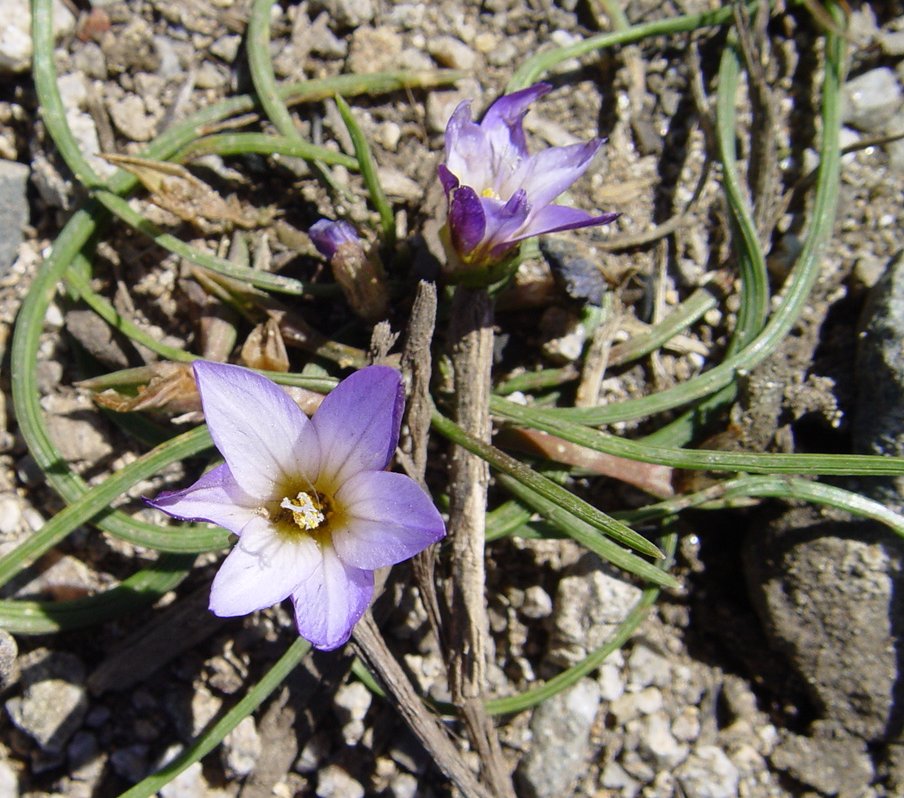
Romulea is a genus of about 170–270 perennial cormous herbs in the iris family (Iridaceae), subfamily Crocoideae, tribe Croceae. The genus was described by Italian botanist Giovanni Francesco Maratti in 1772 and takes its name from Romulus, the legendary founder of Rome, an allusion to the abundance of one species in the Roman countryside. The type species is Romulea bulbocodium. Romulea is a conserved name, and several older generic names — including Trichonema Ker Gawl., Spatalanthus Sweet, Bulbocodium Gronov., and Ilmu Adans. — are treated as synonyms.
Plants in the genus produce flowers from underground corms and bear capsule fruits containing numerous brown, globose seeds. The genus is commonly known as "sand crocuses" in English, owing to the superficial resemblance of the flowers to true crocuses (genus Crocus), though the two are only distantly related within the monocots.
The primary centre of diversity lies in the Cape Floristic Region of South Africa, with additional species distributed across the Mediterranean basin, North Africa, the Arabian Peninsula, and eastern Africa. Several species have naturalised far outside their native ranges: Romulea rosea in particular has become an abundant weed in Australia, Chile, and parts of western Europe, accounting for the large number of GBIF occurrences recorded in Australia (~28,000 of roughly 74,000 global records).
Etymology
The genus name Romulea was coined by the Italian botanist Giovanni Francesco Maratti in 1772, in his work Pl. Romul. Saturn. (page 13). It honours Romulus, the mythological founder of Rome, with the name alluding to the conspicuous abundance of one of the genus's species in the Roman countryside. The name has been formally conserved (nomen conservandum) to maintain stability against older competing names.
Distribution
The genus is native across a broad arc from Europe and the Mediterranean basin (including its islands) through North Africa (Morocco, Algeria), the Arabian Peninsula, and sub-Saharan Africa, with the greatest species diversity concentrated in the Cape Floristic Region of South Africa. GBIF occurrence data shows about 8,500 records from South Africa and approximately 74,000 records globally.
Several species have established themselves outside their native ranges. Romulea rosea is a widespread introduced weed in Australia (approximately 28,000 GBIF records), Chile, and parts of France. Romulea flava is also naturalised in Australia. These introductions are primarily attributed to accidental transport of corms with soil and agricultural material.
Taxonomy
Romulea belongs to the family Iridaceae, placed within subfamily Crocoideae and tribe Croceae. The genus was established by Maratti (1772) with Romulea bulbocodium (L.) Sebast. & Mauri as the type species. Several earlier generic names are now treated as synonyms: Trichonema Ker Gawl., Spatalanthus Sweet, Bulbocodium Gronov., Bulbocodium Ludw. ex Kuntze, and Ilmu Adans. Species counts differ by source: Wikipedia records over 170 accepted species while the GBIF backbone lists approximately 270 descendant taxa, likely reflecting inclusion of infraspecific taxa and provisional records.










