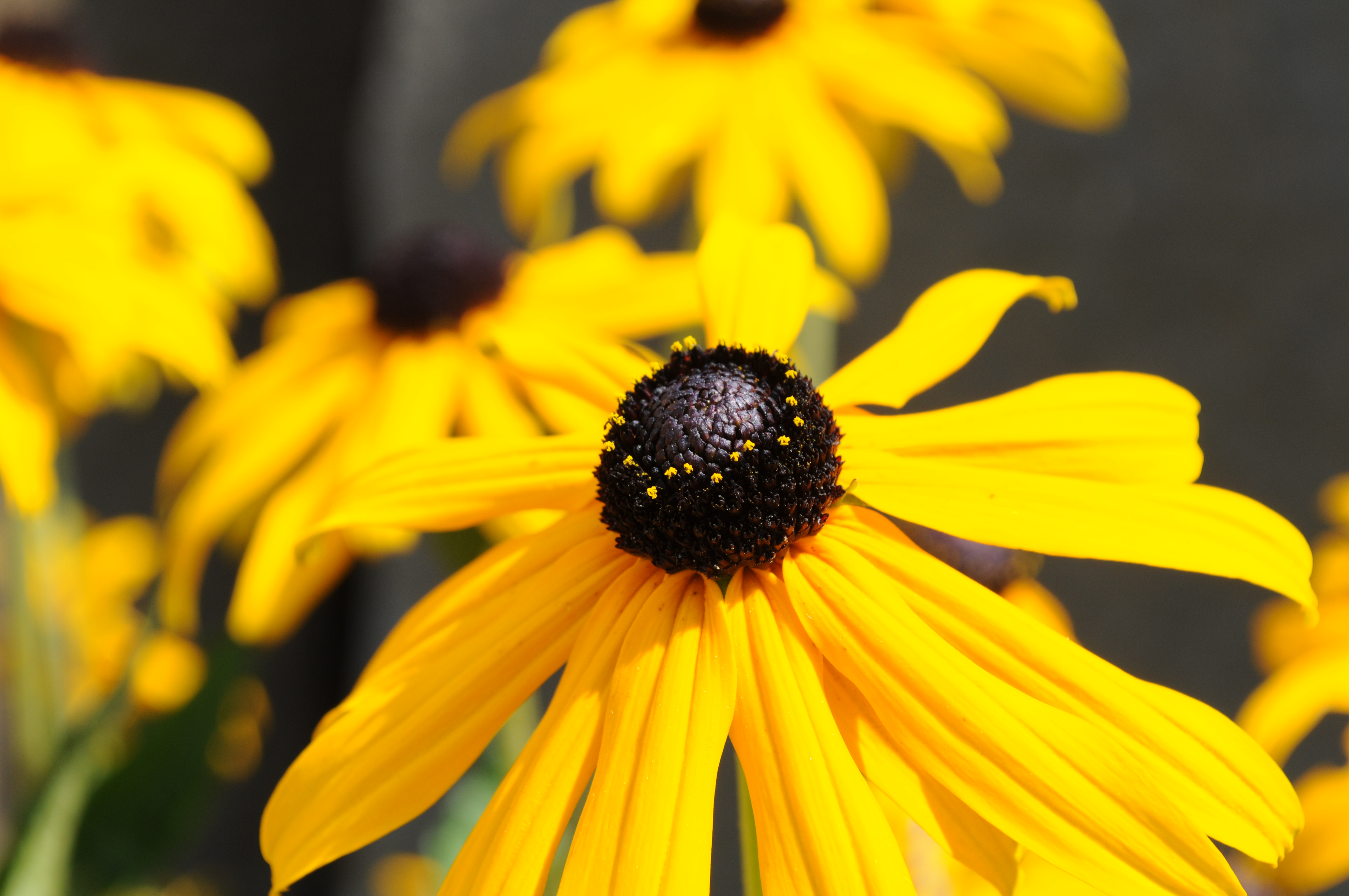
Rudbeckia is a genus of roughly 31 accepted flowering plant species in the family Asteraceae, commonly known as coneflowers and black-eyed-susans. Native exclusively to North America, species range across the continent from eastern Canada and the eastern United States to California and the Pacific Northwest. Most members are herbaceous perennials, though some function as annuals or biennials, growing between 0.5 and 3 metres tall with a typically erect to spreading habit and a rapid growth rate.
The genus is recognized by its distinctive daisy-like composite flower heads: conspicuous yellow or orange ray florets surround a prominent, raised central disc of smaller tubular flowers in shades of black, brown, or green — the dark disc giving rise to the name "black-eyed susan" for the most familiar species, Rudbeckia hirta. Flower heads typically measure 1–3 inches across and carry 7–20 ray petals. Blooming runs throughout summer, generally from July to October. Foliage is simple and green, arranged spirally, with margins either entire or deeply lobed; stems may be smooth or hairy depending on species.
Rudbeckias tolerate a wide range of conditions: full sun to partial shade, clay to sandy soils, acid to neutral pH, and moist to occasionally dry drainage. They are considered low-maintenance plants, reliably hardy across USDA zones 4a–10b, and are notably resistant to deer and rabbit browsing. The genus spreads freely by self-seeding and is widely used in prairie restoration, naturalized meadow plantings, and ornamental gardens. An abundance of Rudbeckia in a landscape is considered an indicator of rangeland health.
Etymology
The genus name Rudbeckia was bestowed by Carl Linnaeus to honor two Swedish naturalists at Uppsala University: Olof Rudbeck the Elder (1630–1702) and his son Olof Rudbeck the Younger (1660–1740). The elder Rudbeck is credited with discovering the lymphatic system and founding Sweden's first botanical garden. Linnaeus expressed the dedication with characteristic flourish, writing that "the Rudbeckia will preserve your glorious name" and drawing parallels between the plant's noble qualities and Rudbeck's character. The genus was formally published by Linnaeus, with the author citation abbreviated to "L."
Distribution
All Rudbeckia species are native to North America. The genus spans a broad latitudinal and longitudinal range: eastern species such as R. hirta and R. laciniata extend from eastern Canada southward through the United States, while western representatives include R. californica (California), R. klamathensis (Klamath region), and R. alpicola (Washington state). R. missouriensis occupies central prairie zones. Outside its native range, Rudbeckia occasionally escapes cultivation in Europe — R. hirta and R. laciniata are documented as naturalized in Switzerland, and the genus is recorded as a garden escape in Britain. The IUCN Global Invasive Species Database does not list Rudbeckia as invasive at genus level.
Ecology
Rudbeckia species support a range of wildlife. The plants act as larval host plants for caterpillars of certain Lepidoptera, including the cabbage moth and dot moth, and their open disc flowers attract bees, hoverflies, and other pollinators. Seeds are favored by birds in naturalized settings.
The genus is ecologically adaptable: species tolerate full sun to partial shade, perform in clay, loam, or sandy soils of acid to neutral pH, and persist in dry to moist drainage regimes. Rudbeckias spread freely by self-seeding, enabling them to naturalize in meadows and prairie-edge habitats. An abundance of these plants is regarded as an indicator of rangeland health. Plants are resistant to browsing by deer and rabbits.
Cultivation
Rudbeckia species are widely grown ornamental perennials valued for their long summer blooming season and tolerance of difficult conditions. They thrive in full sun but accept partial shade (2–6 hours), and perform across USDA hardiness zones 4a–10b, surviving temperatures to approximately −25°C. Soil requirements are minimal: clay, loam, and sandy soils all suit the genus, across acid to neutral pH ranges, with good to moderate drainage. Plants are considered low maintenance and spread by self-seeding, making them well suited to prairie restoration plantings, cottage gardens, and naturalized areas. They are reliably deer and rabbit resistant.
The most widely grown cultivars derive from R. fulgida (orange coneflower), R. hirta (black-eyed Susan), R. laciniata (cutleaf coneflower), and R. sullivantii 'Goldsturm', which remains one of the best-selling perennial cultivars in temperate horticulture. R. maxima, R. subtomentosa, and R. triloba are also established garden plants with strong ecological value.
Cultural Uses
Indigenous North Americans used Rudbeckia medicinally. Root infusions were prepared to treat colds, dropsy, and intestinal worms in children; the same infusion was applied externally as a wash for sores and snakebite wounds. Root ooze was used as eardrops. No edible food uses are recorded for the genus. Caution is warranted around livestock: Rudbeckia has been reported as potentially toxic to cattle, sheep, and pigs.
Taxonomy
Rudbeckia L. is placed in the family Asteraceae, subfamily Asteroideae, tribe Heliantheae, order Asterales. The type species is Rudbeckia hirta. GBIF records 98 descendant taxa for the genus, while approximately 31 are considered fully accepted species as of recent checklists. Several genera formerly treated separately are now synonymized under Rudbeckia: Centrocarpha D.Don, Dracontopsis Lem., Dracopis (Cass.) Cass., Obeliscotheca Vaill. ex Adans., and Peramibus Raf. The genus Dracopis, which shares the vernacular name "coneflower," is treated as a partial synonym by GBIF. Species boundaries within the genus have been subject to ongoing revision, reflecting the morphological diversity across the roughly 31 accepted species.
Propagation
Rudbeckia is most commonly propagated from seed. Seeds should be sown in April under glass with only a light covering of compost; germination typically occurs within two weeks. Direct outdoor sowing is also possible. Established clumps can be divided in spring or autumn, which is the preferred method for maintaining named cultivars. Plants self-seed prolifically in suitable conditions, and seedlings can be transplanted when large enough to handle.

