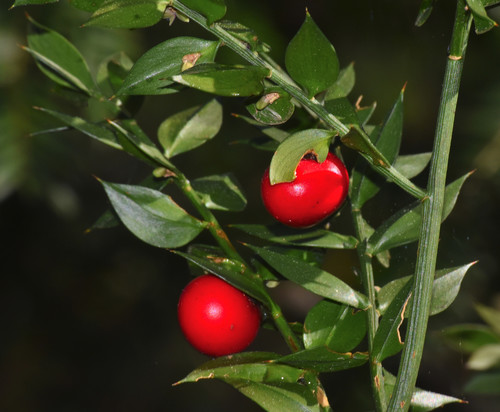
Ruscus is a small genus of six species of evergreen, shrub-like perennial plants in the family Asparagaceae (subfamily Convallarioideae), commonly known as butcher's-broom. The genus is placed in the order Liliales and belongs to the monocot class Liliopsida. It was formerly classified in the family Liliaceae under older systems, and the family Ruscaceae under intermediate classifications, before being subsumed into Asparagaceae under the APG III system.
Plants are compact and woody-based, growing to approximately 1 metre tall. One of their most distinctive features is the cladode — a flattened, leaf-like structure that is actually modified stem tissue (also called a phylloclade). These cladodes, 2–18 cm long, are the main photosynthetic organs; the true leaves are reduced to minute, scale-like structures with no photosynthetic function. Flowers are small, white with a dark-violet centre, and are produced directly on the surface of the cladodes — an unusual and immediately recognisable trait. The fruit is a bright red berry, 5–10 mm in diameter. Some species are monoecious (male and female flowers on the same plant), while others are dioecious. Plants spread both by seed and by underground rhizomes, and can colonise substantial patches of ground.
The genus is native to western and southern Europe (including the Azores and Macaronesia), northwestern Africa, and southwestern Asia east to the Caucasus. The best-known member is Ruscus aculeatus, which has spiny-tipped cladodes and bright red berries, and has a long history of medicinal and commercial use. Ruscus hypophyllum is widely used in the cut-flower trade as a long-lasting foliage element. The rhizomes of several species have been used medicinally since antiquity for conditions including haemorrhoids, urinary tract disorders, and as a diuretic, with references found in Dioscorides and Pliny the Elder.
Etymology
The name Ruscus is the classical Latin name for the butcher's-broom plant, used by Roman authors including Pliny the Elder and Dioscorides. The common name "butcher's-broom" derives from the historical practice of butchers using bunches of the stiff, spiny-tipped stems to scrub and clean their chopping blocks.
Distribution
Ruscus is native to western and southern Europe (including the Azores and Macaronesia), northwestern Africa, and southwestern Asia east to the Caucasus. Individual species have more restricted ranges: R. aculeatus occurs across much of Europe and the Azores; R. streptophyllus is endemic to Madeira; R. colchicus is restricted to the Caucasus region; and R. hyrcanus is an endemic relict confined to the Talish Mountains of Azerbaijan, where it is protected in Hirkan National Park.
Cultural Uses
Butcher's-broom species have been used medicinally since antiquity. The earliest references appear in ancient Greek sources; Dioscorides' De Materia Medica (1st century AD) describes at least three Ruscus taxa used as laxatives and diuretics. Pliny the Elder noted their application for varicose veins. European herbals of the 16th and 17th centuries, including the herbal of Simon Syreński (1613) and the work of Comenius, recommended preparations from the rhizome for urinary retention, kidney stones, and menstrual irregularities. Ruscus hypophyllum is commercially harvested as a long-lasting cut foliage in the floral trade. Note that the attractive red berries of R. aculeatus are mildly toxic and have caused accidental poisoning cases in children.
History
The genus has been documented in European botany since classical antiquity. Dioscorides described multiple Ruscus species in the 1st century AD, and Pliny the Elder wrote of their medicinal properties. The genus was long placed in Liliaceae, then moved to the segregate family Ruscaceae, before being incorporated into Asparagaceae under the APG III system. Its distinctive cladode morphology has made it of ongoing botanical interest as an example of stem-derived photosynthetic organs.

