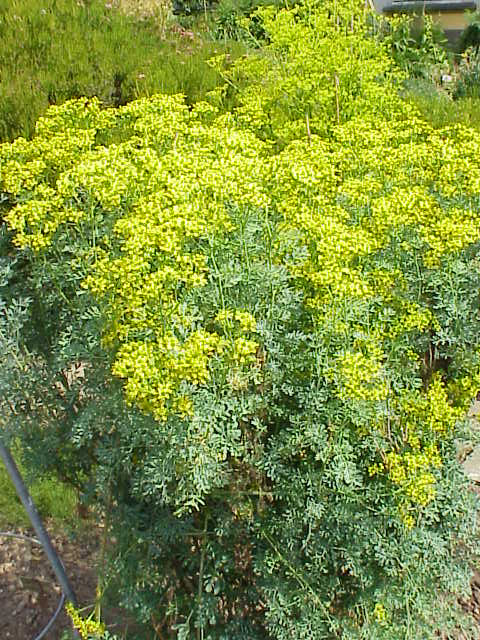
Ruta, commonly known as rue, is a genus of strongly scented evergreen subshrubs in the family Rutaceae (order Sapindales), comprising about ten accepted species. Plants typically reach 20–60 cm in height and are native to the Mediterranean region, Macaronesia, and southwest Asia, where they grow in warm, dry habitats. The genus has been recognised since antiquity, and the name Ruta is the classical Latin term for the plant.
The leaves are bipinnate or tripinnate with a feathery, finely divided appearance, typically green to strongly glaucous blue-green in colour, and emit a penetrating, pungent aroma when bruised — a characteristic that has made rue one of the most recognisable herbs of the Mediterranean world. Flowers are yellow, with 4–5 petals, approximately 1 cm across, and are borne in branched clusters (cymes). The fruit is a 4–5-lobed capsule containing numerous seeds.
The most widely known species is Ruta graveolens (common rue or herb-of-grace), a woody perennial shrub long cultivated as a culinary and medicinal herb and as an ornamental for its striking bluish foliage. Ruta chalepensis (fringed rue) is also widespread and the two species are frequently confused in scientific literature. Other species such as Ruta corsica, Ruta pinnata, and Ruta microcarpa have more restricted distributions, the latter two being endemic to the Canary Islands and Corsica respectively.
Rue contains a range of biologically active compounds, including furanocoumarins such as psoralen, which can cause severe photodermatitis upon skin contact with sunlight. Extracts are also mutagenic and hepatotoxic in large doses, and the plant acts as an abortifacient; it should be strictly avoided by pregnant women. Despite its toxicity at high doses, rue has been used medicinally for centuries — as an antispasmodic, for eye complaints, as an insect repellent, and in various cultural and spiritual traditions across the Mediterranean and among Sephardic Jewish communities.
Etymology
The genus name Ruta is the classical Latin name for rue, inherited directly from ancient usage. The most familiar species, Ruta graveolens, takes its specific epithet from the Latin graveolens ("strong-smelling"), referring to the plant's intensely pungent foliage.
Distribution
Ruta is native to the Mediterranean region, Macaronesia (including the Canary Islands and Madeira), and southwest Asia. Species such as Ruta graveolens and Ruta chalepensis have been widely cultivated and naturalised beyond their native ranges. Several species have narrow endemism: Ruta microcarpa is restricted to the Canary Islands, and Ruta corsica to Corsica.
Cultivation
Ruta graveolens is the species most commonly grown in gardens, valued for its striking glaucous blue-green foliage and tolerance of hot, dry soils. It is cultivated as an ornamental subshrub, a culinary herb (used sparingly due to its toxicity), an insect repellent, and an incense plant. Gardeners should handle rue with caution, as contact with the sap followed by sun exposure can cause blistering phytophotodermatitis.
Cultural Uses
Rue has been used medicinally since antiquity, with recorded applications including treatment of eyestrain, use as an antispasmodic and sedative, and (controversially) as an abortifacient. In Sephardic Jewish tradition, ruda is believed to protect against the evil eye and is used in religious contexts, including during Yom Kippur to revive fasting worshippers, and in bridal ceremonies. It is also the subject of the centuries-old Ladino ballad "Una Matica de Ruda", celebrating the plant's symbolic association with love and protection.

