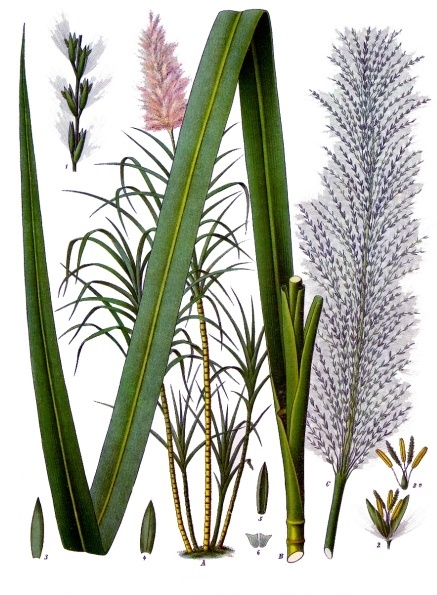
Saccharum is a genus of tall perennial grasses in the family Poaceae (order Poales), placed within the broomsedge tribe Andropogoneae. The genus is perhaps best known for encompassing the sugarcanes — species whose stout, jointed, fibrous stalks are rich in sucrose and typically reach 2 to 6 metres (6–19 ft) in height. Because all sugarcane species interbreed freely, the major commercial cultivars grown worldwide are complex hybrids rather than pure species.
Beyond the economically critical sugarcanes, Saccharum comprises a broader range of tall perennial grasses distributed across tropical, subtropical, and warm temperate regions of Africa, Eurasia, Australia, the Americas, and numerous oceanic islands. Several species have been cultivated and have naturalized far outside their native ranges, often becoming conspicuous components of disturbed or agricultural landscapes. Saccharum officinarum, originating from New Guinea, is the primary species underlying modern sugar production and has been carried to virtually every warm region on Earth.
Taxonomic boundaries within and around Saccharum have been the subject of ongoing revision. Plants of the World Online has transferred a number of formerly included taxa — such as Saccharum ravennae and several others — to the segregate genus Tripidium, and others to Lasiorhachis, reflecting modern molecular circumscription of Andropogoneae genera.
Distribution
Saccharum is widespread across tropical, subtropical, and warm temperate regions of Africa, Eurasia, Australia, the Americas, and oceanic islands. Saccharum officinarum, native to New Guinea, has been introduced and naturalized throughout virtually all warm regions of the world through sugar cultivation. Other species occur naturally from the southeastern United States and South America to the Himalayas, China, and Southeast Asia.
Cultivation
Saccharum officinarum and its commercial hybrid derivatives are among the world's most economically important crops, cultivated extensively in tropical and subtropical regions for sucrose extraction. Modern commercial sugarcane cultivars are complex interspecific hybrids, bred for high sugar yield, disease resistance, and adaptability. Some ornamental species, including Saccharum ravennae (now placed in Tripidium by some authorities), are grown as large perennial grasses in garden and landscape settings in temperate climates.
History
Sugarcane (Saccharum officinarum) was first cultivated in New Guinea, with domestication estimated to have occurred thousands of years ago. From there it spread across South and Southeast Asia before reaching the Middle East and Mediterranean regions. European colonization of the Americas drove a massive expansion of sugarcane cultivation in the Caribbean, Brazil, and beyond, with profound social and economic consequences. The genus name Saccharum derives from the Greek and Latin words for sugar (sakkharon / saccharum), reflecting the crop's ancient identification with sweetness.
Taxonomy Notes
Saccharum belongs to the tribe Andropogoneae within the grass family Poaceae (order Poales, class Liliopsida). The circumscription of the genus has been revised substantially: Plants of the World Online has transferred former Saccharum species such as Saccharum ravennae to the genus Tripidium, and others (including S. hildebrandtii and S. perrieri) to Lasiorhachis, based on molecular phylogenetics. All remaining Saccharum species interbreed, blurring species boundaries among the sugarcanes in particular.










