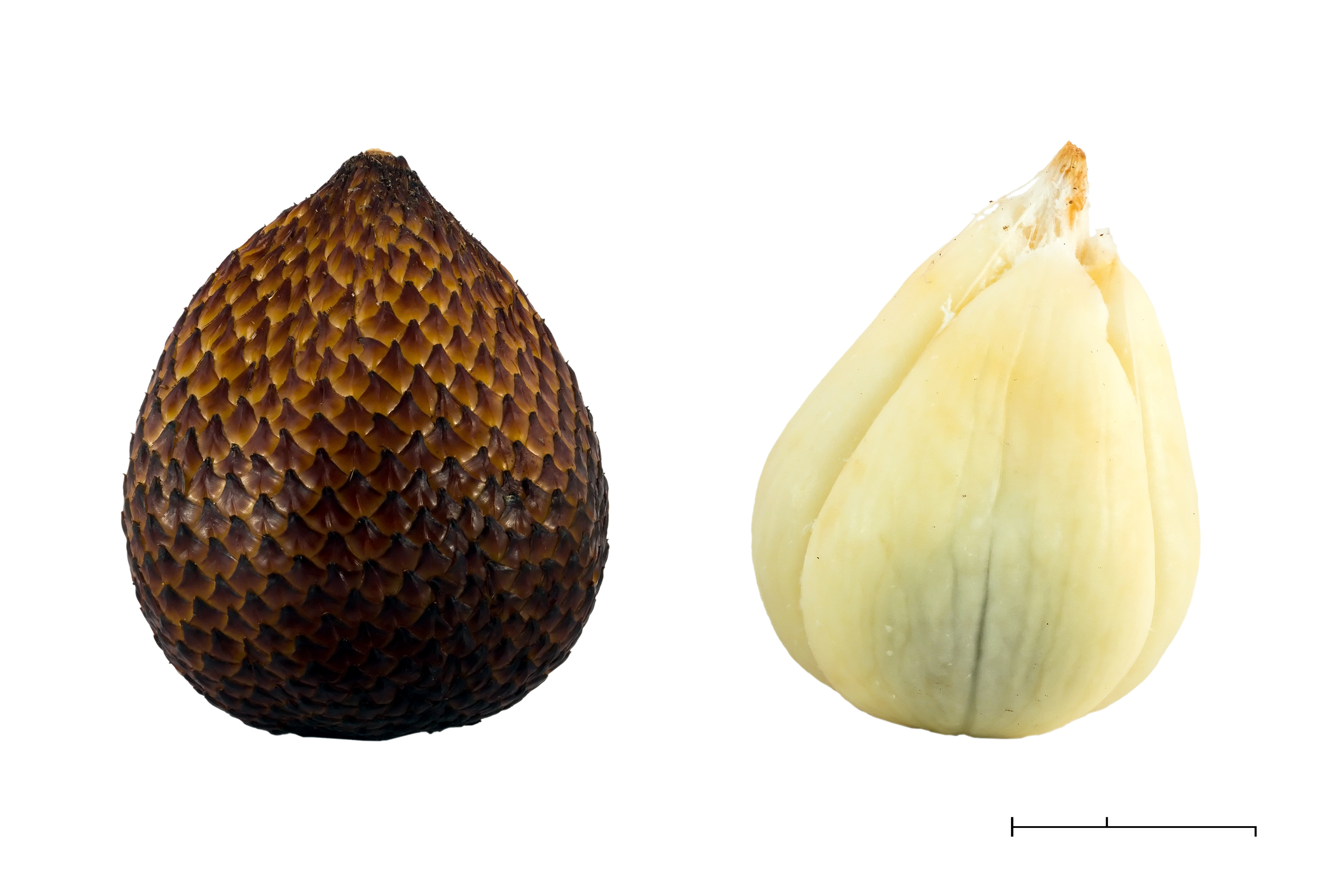
Salacca is a genus of approximately 20 species of palms in the family Arecaceae (order Arecales), native to Southeast Asia and the eastern Himalayas. First described by Reinwardt, the genus is characterized by its very short or essentially stemless habit, with arching leaves reaching 6–8 metres in length. The leaf petioles are armed with sharp spines — a defining feature across nearly all species — and the leaves are typically pinnate with numerous leaflets, though S. magnifica is notable for bearing undivided, fan-like fronds.
Plants are dioecious (separate male and female individuals), with Salak Bali being a rare self-fertile exception. Pollination is carried out by weevils of the family Curculionidae. The fruit develop in dense clusters at the base of the plant and are distinctive: they are covered in overlapping reddish-brown scales that give the skin a texture strikingly similar to that of a snake, earning the most famous member its common name — snake fruit. Beneath the scaly skin lies a firm white or pale yellow pulp surrounding one or two large, inedible seeds.
Salacca zalacca, known as salak or snake fruit, is the most widely cultivated species, grown commercially across Java, Sumatra, and Bali for its edible fruit, which has a mildly acidic, crisp flavour. Other edible species are grown at a local level throughout the region. The genus ranges from Yunnan province in southern China through Myanmar, Thailand, Malaysia, Borneo, Sumatra, Java, and the Philippines, with several species also found in northeastern India (Assam, Arunachal Pradesh) and Bhutan.
Etymology
The genus name Salacca derives from the Malay vernacular name salak, used for the fruit of Salacca zalacca. The genus was described by the Dutch botanist Caspar Georg Carl Reinwardt in the early nineteenth century.
Distribution
Salacca is native to Southeast Asia and the eastern Himalayas, with species occurring across Borneo, Sumatra, Java, peninsular Malaysia, Thailand, Myanmar, Kalimantan, Sarawak, Sabah, the Philippines, and Yunnan (China), as well as Assam, Bhutan, and Arunachal Pradesh in South Asia. S. zalacca has been widely introduced and is naturalized in Bali, Lombok, Timor, Maluku, the Philippines, and Sulawesi.
Ecology
Species of Salacca typically grow in humid tropical lowland and foothill forests, often in moist or seasonally waterlogged soils. They are dioecious and rely on Curculionidae weevils for pollination. The spiny, clustering growth habit provides structural defence, and the large fruiting clusters at ground level make the fruit accessible to terrestrial frugivores.
Cultivation
Salacca zalacca is cultivated commercially throughout Java, Sumatra, and Bali for its edible snake fruit, and is grown on a smaller scale across much of insular Southeast Asia. Plants require a warm, humid tropical climate and well-drained but moisture-retentive soils. They are propagated from seed or by division of offshoots; seed germination can be slow. Commercial orchards manage the dioecious nature by maintaining a ratio of male to female plants or, in the case of Salak Bali, by growing the parthenocarpic cultivar. Other species such as S. wallichiana are occasionally cultivated locally for fruit.
Cultural Uses
The fruit of Salacca zalacca (salak or snake fruit) is widely eaten fresh across Indonesia and Thailand and is also processed into preserves, vinegar, wine, and dried snacks. It holds cultural significance in Balinese Hindu offerings and is a recognized commercial export crop of Indonesia. Several other species in the genus produce edible fruit consumed by local communities across Borneo, Sumatra, and mainland Southeast Asia.










