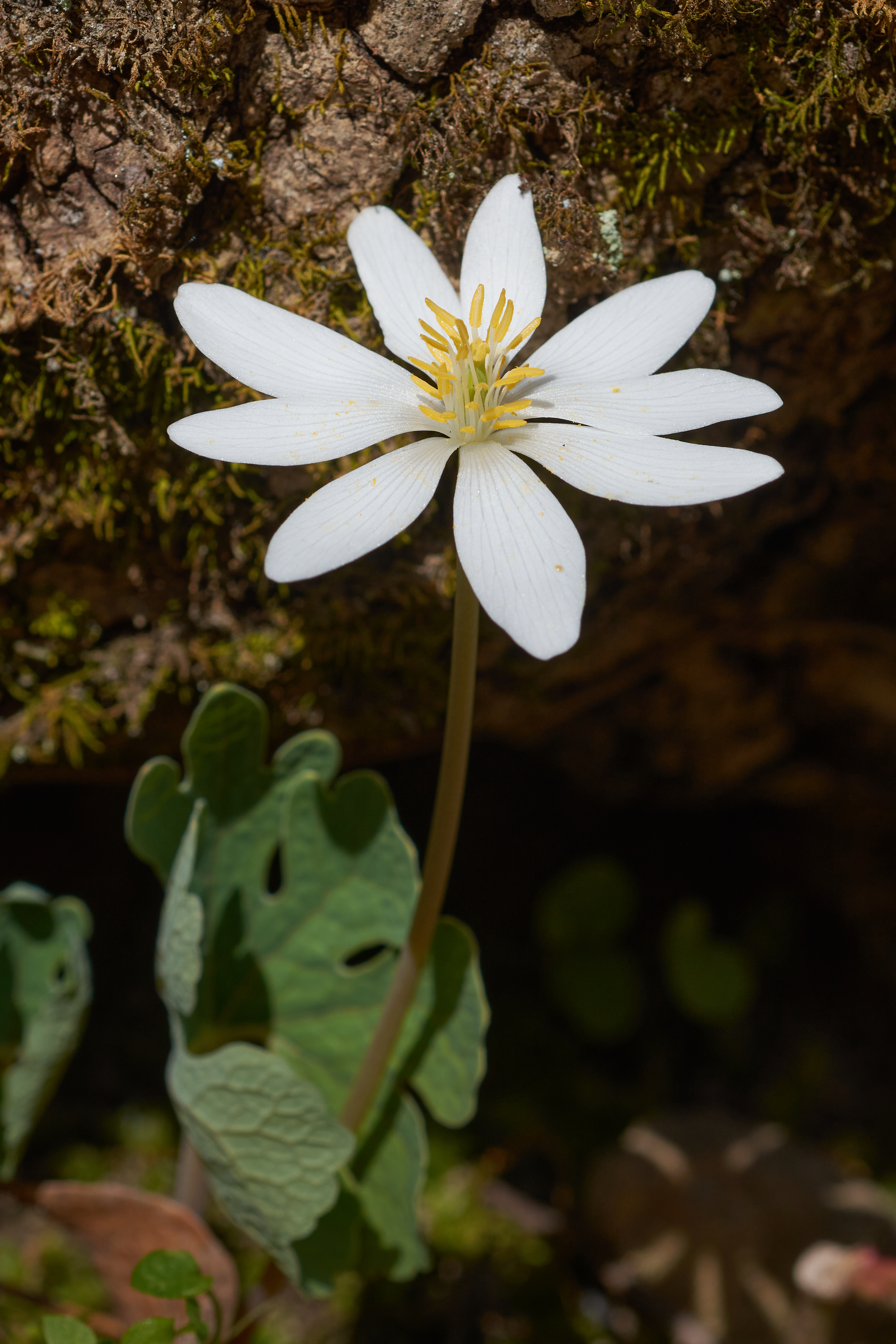
Sanguinaria is a monotypic genus in the poppy family Papaveraceae, order Ranunculales, containing a single species: Sanguinaria canadensis, commonly known as bloodroot. It is most closely related to Eomecon of eastern Asia, reflecting an ancient trans-Pacific disjunction within the family.
Bloodroot is a perennial herbaceous plant that grows 20–50 cm tall from a branching reddish rhizome. The rhizome exudes a distinctive bright orange-red sap — the source of the genus name — and expands over time to form spreading colonies. Plants bear a single large basal leaf up to 25 cm across with five to seven lobes, and each emerging flower stem is clasped by the leaf as it pushes through the ground. Flowers appear from March to May, opening before the leaves fully unfurl, and consist of 8–12 delicate white petals surrounding many yellow stamens. Petals are shed within a day or two of pollination, making the bloom season brief, though the double-flowered cultivar 'Plena' holds its flowers considerably longer and has received the Royal Horticultural Society's Award of Garden Merit.
Bloodroot is a spring ephemeral, going dormant in mid to late summer after seeds have ripened. Seeds are round and black to orange-red, each bearing a white elaiosome that attracts ants, which disperse them to new sites (myrmecochory). The plant is valued as an early-season ornamental in woodland gardens, but all parts contain benzylisoquinoline alkaloids, principally the toxin sanguinarine, which is escharotic and toxic to animal cells.
Etymology
The genus name Sanguinaria derives from the Latin sanguinarius, meaning "bloody," a direct reference to the vivid orange-red sap that flows from the cut rhizome and stems. The sole species epithet canadensis means "of Canada," reflecting part of its native range.
Distribution
Sanguinaria canadensis is native to eastern North America, ranging from Nova Scotia south to Florida and west to the Great Lakes region and the Mississippi embayment. It grows in moist to dry deciduous woods, thickets, floodplains, and slopes near streams, and is rarely found in disturbed habitats.
Ecology
Bloodroot relies on ants for seed dispersal — a strategy called myrmecochory — through fleshy elaiosomes attached to each seed. Flowers offer pollen but no nectar, attracting sweat bees, cuckoo bees, small carpenter bees, bee flies, and mining bees, with Andrena (mining bees) serving as the most effective pollinators. The bitter, toxic leaves and rhizomes are largely avoided by mammalian herbivores.
Cultivation
Sanguinaria canadensis is grown as a woodland ornamental, prized for its early-season white flowers. The double-flowered form (S. canadensis f. multiplex 'Plena') is particularly sought after for its fuller blooms and longer display, and holds the RHS Award of Garden Merit. Plants thrive in moist, humus-rich soil in dappled shade, conditions that mirror their native woodland habitat.
Cultural Uses
Native Americans historically used bloodroot as an emetic, respiratory aid, and for various other medicinal purposes. The alkaloid sanguinarine has been investigated in laboratory settings for potential anti-cancer properties, but clinical studies are lacking and use is not recommended due to significant off-target toxicity, tissue destruction (eschar formation), and the risk of permanent scarring.

