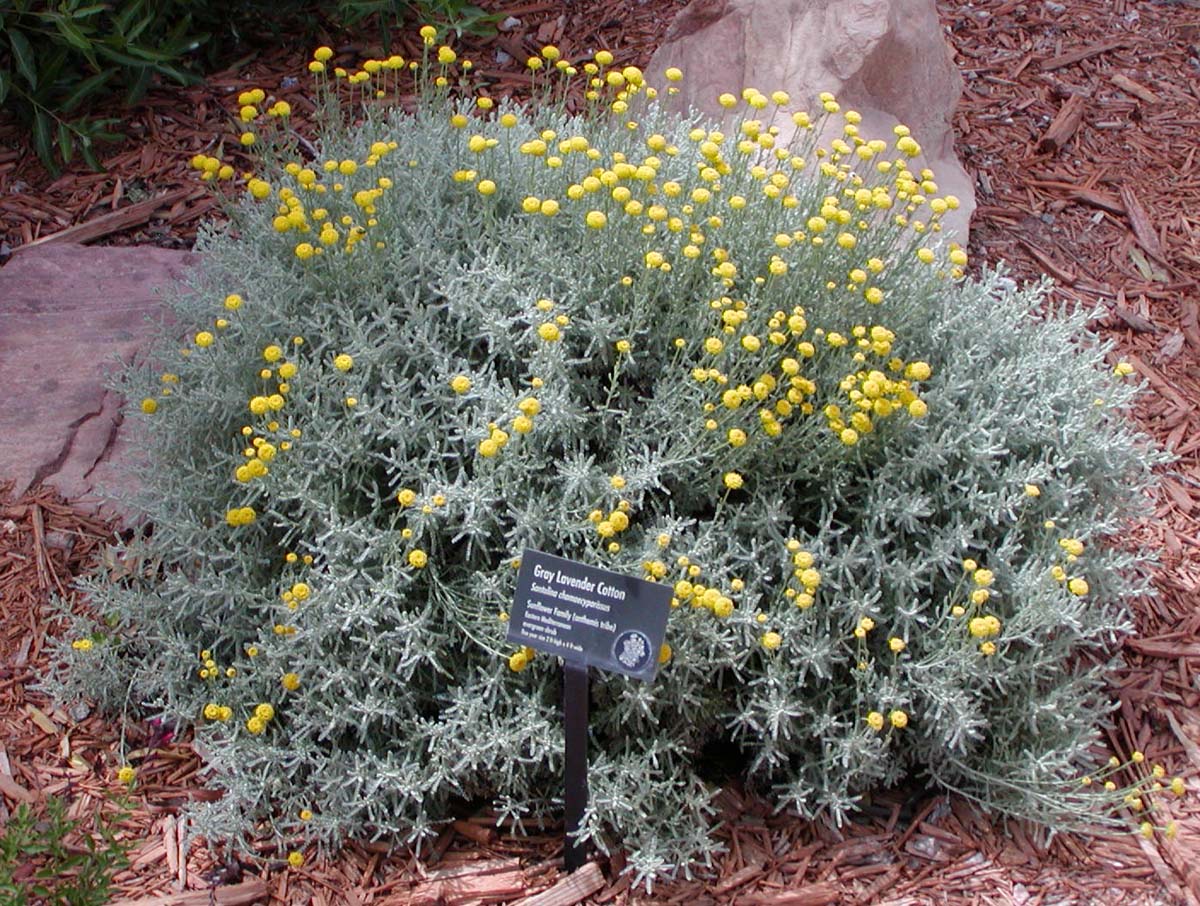
Santolina is a genus of small evergreen shrubs in the chamomile tribe (Anthemideae) of the sunflower family (Asteraceae). The genus comprises roughly 15–20 species, centered on the western Mediterranean basin — the Iberian Peninsula, southern France, Italy, and North Africa — with a few species reaching the Balearic Islands, Corsica, and the British Isles.
Plants are compact and aromatic, typically 10–60 cm tall. Leaves vary from simple and minute to pinnate and finely divided, and are frequently covered in dense silvery-grey hairs that give many species their characteristic woolly texture. The composite flowerheads are borne singly on slender stems held 10–25 cm above the foliage, forming dense, globose capitula 1–2 cm in diameter in yellow or white; unlike many relatives in Asteraceae, Santolina flowerheads lack ray florets entirely. The most widely grown species, Santolina chamaecyparissus (cotton lavender), is valued for its silvery foliage and tolerance of dry, poor soils.
Santolina species serve as food plants for several specialist Lepidoptera, including Bucculatrix santolinella and the case-bearers Coleophora involucrella and C. santolinella, both of which feed exclusively on the genus.
Etymology
The genus name Santolina is of uncertain but ancient origin; it is believed to derive from the Latin sanctum linum (“holy flax”) or possibly from a corruption of Santolina as used in medieval herbalism. The species epithet of the best-known species, chamaecyparissus, comes from the Greek chamai (“on the ground”) and kyparissos (“cypress”), referring to the low-growing, cypress-like foliage.
Distribution
Santolina is primarily a western Mediterranean genus, with most species native to the Iberian Peninsula, southern France, Italy, North Africa (Algeria, Morocco, Tunisia), Corsica, and the Balearic Islands. A few species extend further — Santolina virens is recorded from France, Spain, the UK, Germany, Abruzzo (Italy), and Ukraine; Santolina chamaecyparissus ranges from Spain to Ireland and Turkey, and has become occasionally naturalized in Britain.
Ecology
Santolina species grow on dry ground, stony banks, and rocky slopes, typically on calcareous (chalk or limestone) soils in full sun. They are adapted to the hot, dry Mediterranean summer climate and are notably drought tolerant once established. They thrive in nutrient-poor, well-drained conditions and cannot tolerate waterlogged soils or shade. Plants tolerate maritime exposure and perform well in coastal gardens.
Cultivation
Santolinas are easy, low-maintenance shrubs suited to borders, rock gardens, ground cover, hedging, and coastal plantings. They require full sun and well-drained, preferably sandy or chalky soil; they strongly dislike wet conditions around the roots. Most species are hardy to approximately −15 °C in well-drained soil (UK hardiness zone H5). Plants can be clipped hard in spring to keep a compact, mounded form, though cutting back prevents that season’s flowering since flowers are produced on two-year-old wood. They are notably resistant to honey fungus. Santolina chamaecyparissus is a popular cultivar with several named varieties, and makes an effective low hedge or edging plant.
Cultural Uses
Santolina chamaecyparissus has a long history of use as a medicinal and household herb in Mediterranean Europe. The leaves and flowering tops have antispasmodic, vermifuge, and disinfectant properties; the plant was traditionally used as a vermifuge for children and to treat digestive complaints and menstrual irregularities. Crushed leaves applied to insect stings ease pain, and topical application was said to encourage wound healing. The strongly aromatic foliage was also used as a moth repellent in linen cupboards — a use reflected in the common name “lavender cotton.” Santolina rosmarinifolia is known as “holy flax.”










