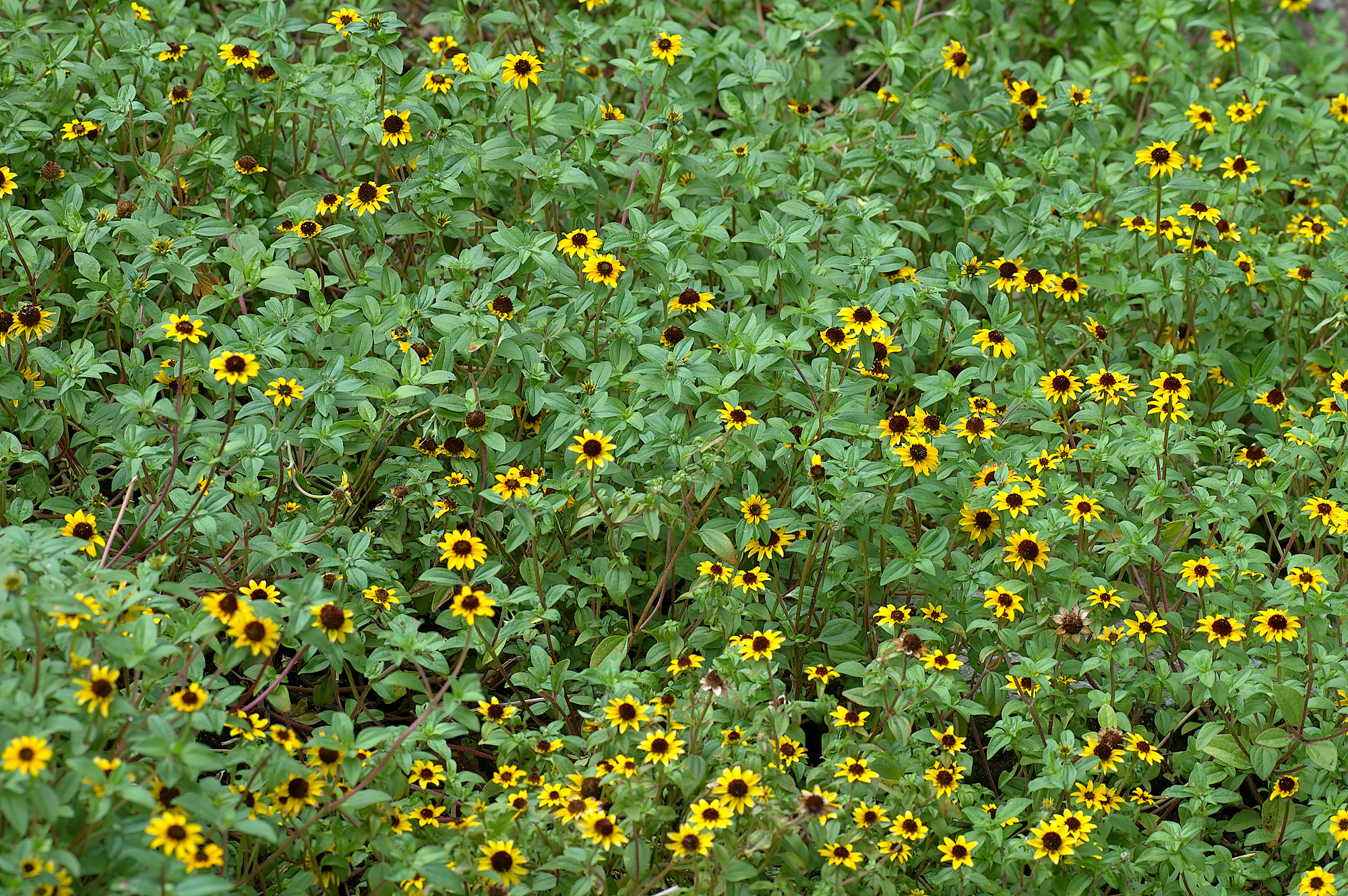
Sanvitalia, commonly known as creeping zinnias, is a small genus of annual and perennial flowering plants in the daisy family Asteraceae, order Asterales. The genus comprises around six species of low-growing, mat-forming herbs with bright, daisy-like flower heads that bear yellow to orange ray florets surrounding a dark central disc — an appearance that closely resembles miniature zinnias, hence the common name.
The genus is centred in Mexico, where the majority of species are endemic or native, with its range extending into Central America, parts of South America (Bolivia, Paraguay, Argentina), and the southwestern United States. Sanvitalia procumbens, the Mexican creeping zinnia, is the most widely known species in cultivation and has become naturalized across scattered locations in Europe, East Asia, South America, and the United States. Sanvitalia abertii (Abert's creeping zinnia) is native to Sonora, Mexico and the southwestern United States. Sanvitalia ocymoides, the yellow creeping zinnia, occurs in Tamaulipas, Nuevo León, and Texas.
Sanvitalia procumbens is widely grown as a low-maintenance ornamental ground cover and container plant, valued for its long flowering season, heat and drought tolerance, and suitability for hanging baskets and border edging. Note that "Sanvitalia speciosa," a name common in the horticultural trade, is not a validly published species name; many plants sold under that name are not true Sanvitalia but are most likely Melampodium.
Etymology
The genus name Sanvitalia honours the Italian noble family Sanvitale; it was published by Lamarck. The common name "creeping zinnia" refers to the genus's prostrate, spreading growth habit and the visual similarity of its flower heads to those of true zinnias (Zinnia, also in Asteraceae).
Distribution
Sanvitalia is native primarily to Mexico, occurring across many states from Chihuahua in the north to Chiapas in the south. A few species extend into Central America, Bolivia, Paraguay, and Argentina, and Sanvitalia abertii reaches the southwestern United States (California, Nevada, Arizona, New Mexico, Texas). Sanvitalia procumbens has been widely introduced and is naturalized in parts of Europe, East Asia, South America, and the United States.
Cultivation
Sanvitalia procumbens and its cultivars are popular warm-season annuals grown as ground covers, in hanging baskets, and along border edges. They thrive in full sun and well-drained soil, tolerating heat and moderate drought once established. Plants bloom prolifically from late spring through autumn with minimal deadheading required.










