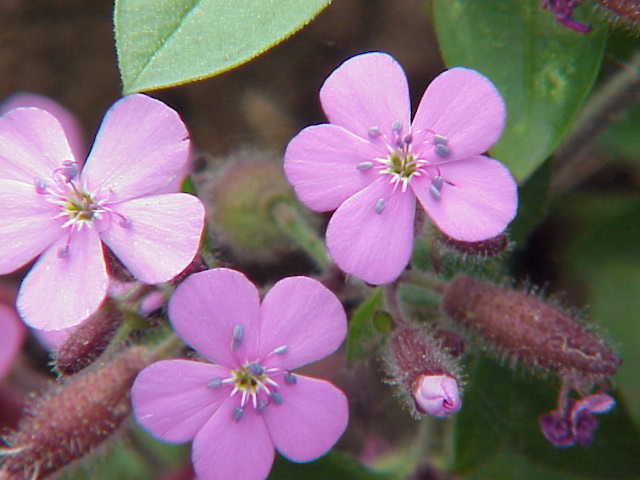
Saponaria, commonly known as soapworts, is a genus of flowering plants in the family Caryophyllaceae, order Caryophyllales, first formally described by Linnaeus in 1753. The genus comprises 30 to 40 species—Plants of the World Online accepts 39—of herbaceous perennials and annuals, some with woody bases, distributed across Eurasia and the Mediterranean region.
The flowers are abundant and five-petalled, typically borne in shades of pink or white. Saponaria is closely related to Silene, from which it is distinguished by having only two styles (rather than three or five), and to Gypsophila, from which it differs by its cylindrical rather than bell-shaped calyx.
The most familiar species is common soapwort (S. officinalis), native to Eurasia and now naturalised across much of the world as an introduced species—frequently a weed—and occasionally cultivated as an ornamental. The genus takes its name from the Latin sapo ("soap"), reflecting the saponin-rich sap found throughout the group; soaking the leaves in water yields a mild liquid soap that has been used for centuries, including for the conservation of delicate antique tapestries.
Etymology
The genus name Saponaria derives from the Latin sapo, meaning "soap," combined with the suffix -aria, meaning "pertaining to." The name reflects the longstanding use of at least one species, S. officinalis (common soapwort), to produce soap from its saponin-rich leaves.
Distribution
The genus Saponaria is native to Eurasia, with its centre of diversity in the Mediterranean region and western Asia. S. officinalis, the most widespread species, has been introduced to much of the rest of the world, where it frequently naturalises and can behave as a weed.
Ecology
Saponaria species serve as larval host plants for certain moths, including Lychnis and Coleophora saponariella, the latter being exclusive to the genus. The plants contain saponins, which may deter some herbivores.
Cultural Uses
Saponaria plants contain saponins that produce a gentle lather when the leaves are soaked in water. This natural liquid soap has been used since antiquity as a cleansing agent, and conservators still use it today to wash fragile antique tapestries and textiles where harsher detergents would cause damage.










