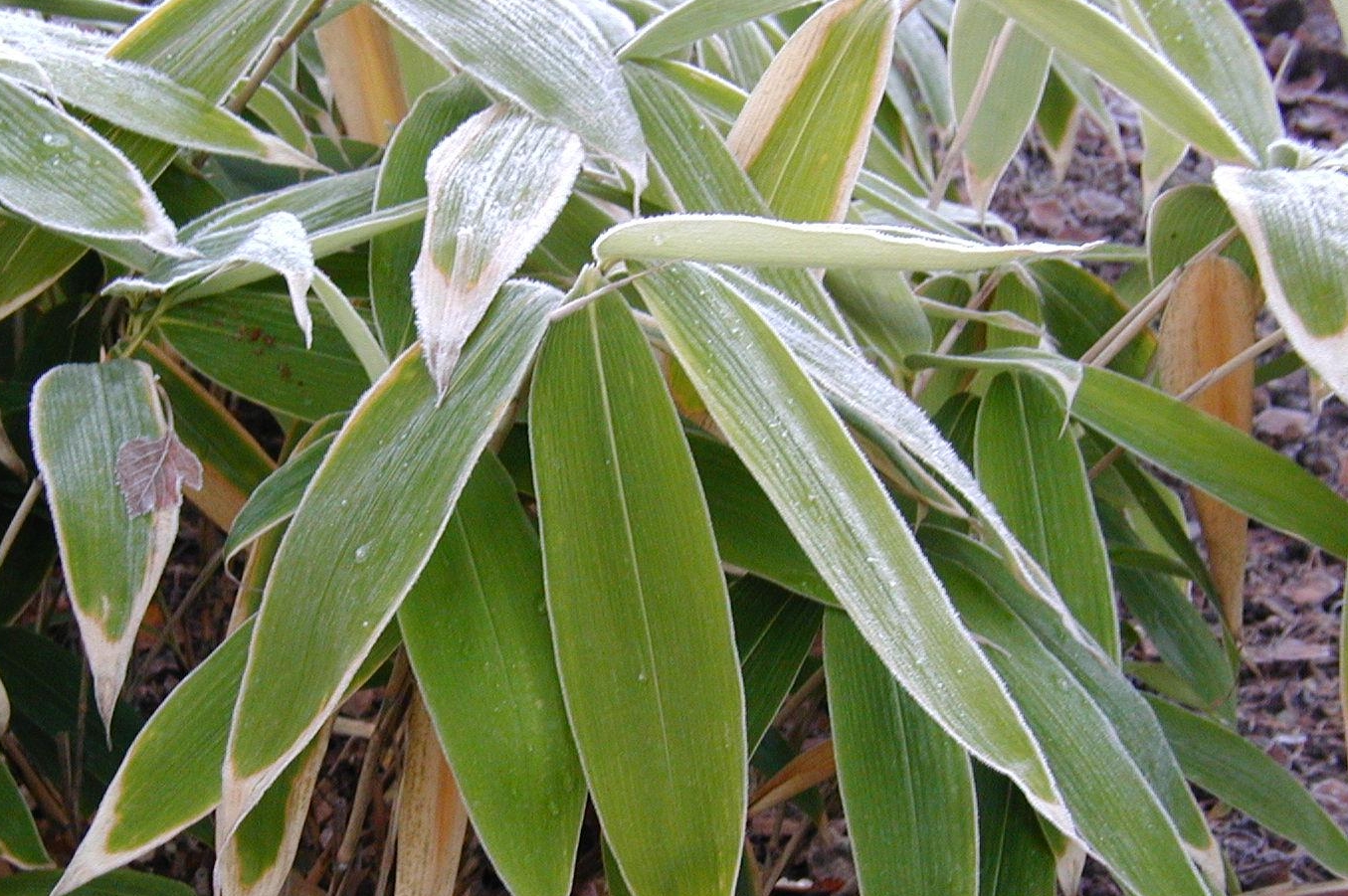
Sasa is a genus of dwarf bamboos belonging to the grass family Poaceae, placed within the order Poales. It comprises around 39–42 accepted species, depending on authority, and is closely related to the genera Sasamorpha and Sasaella. The genus was first formally described by Japanese botanists Tomitaro Makino and Keita Shibata, published in the Botanical Magazine in 1901.
Plants in this genus are characteristically short and shrub-like, typically reaching between 30 cm and 2 m in height — well below the stature of most bamboo genera — with culms rarely exceeding 1 cm in diameter. The rhizomes are leptomorph (running and branched), enabling plants to spread vigorously and form dense, often extensive stands. A distinctive feature of the genus is that each culm node bears only a single branch, often of comparable diameter to the culm itself. The culm sheaths are papery to leathery and highly persistent. Leaves are notably large and wide in proportion to the culm — broader than those of most bamboo genera — giving rise to the common name "broadleaf bamboo." When flowering, Sasa produces loose panicles with 4 to 8 florets per spikelet, with 6 stamens and 3 stigmas per floret; as with most bamboos, individual plants flower infrequently.
All species are native to temperate and subtropical Asia. Japan hosts the greatest diversity, and Sasa species cover approximately 50% of Japan's mountainous regions. Together with the related genus Sasamorpha, Sasa holds the distinction of containing the northernmost-distributed bamboo species in the world, with several species native to Sakhalin and the Kuril Islands in the Russian Far East. In South Korea, Sasa palmata blankets about 76% of the northern slopes of Hallasan on Jeju Island.
The genus name Sasa derives from the Japanese word sasa (笹 / ササ), the everyday term for small-statured bamboo grass in Japan. The genus contains an exceptionally high proportion of synonyms: of nearly 790 recorded names, roughly 92% are considered synonyms.
Etymology
The genus name Sasa is taken directly from the Japanese word sasa (笹 / ササ), the traditional Japanese term for small-statured bamboo grass, used in Japan to distinguish these low-growing species from taller bamboo. The genus was formally named by Japanese botanists Tomitaro Makino and Keita Shibata in 1901.
Distribution
Sasa is native to eastern Asia, ranging from Sakhalin and the Kuril Islands in the Russian Far East south through Japan, Korea, and into southeastern China (Guangxi, Guangdong, Hong Kong, and Hainan). Japan holds the majority of species, and Sasa vegetation covers approximately 50% of Japan's mountainous zones. Several species — including S. cernua, S. kurilensis, and S. senanensis — represent the world's northernmost-distributed bamboo, growing in subarctic and subalpine conditions.
Ecology
Sasa species form dense, spreading stands via long running rhizomes, often dominating the understory of temperate and subalpine forests. In Japan, sasa grasslands are a significant ecological feature of mountainous regions, and on Jeju Island (South Korea) Sasa palmata covers approximately 76% of the northern slopes of Hallasan. Some species, such as Sasa chartacea, are adapted to subalpine or subarctic biomes, while others (S. hainanensis) occupy subtropical environments.
Cultivation
Sasa species entered Western horticulture during the 19th-century era of plant hunting: Sasa veitchii was introduced to Britain in 1879 and S. palmata around 1889; both remain widely grown in the UK alongside S. tsuboiana. Species have also been cultivated in France, Ireland, Czech Republic, Slovakia, and New Zealand. Sasa palmata is prized for its exceptionally large leaves (rivalled among temperate bamboos only by Indocalamus tessellatus) and frost hardiness to at least −15 °C. Sasa veitchii is notable for developing ornamental, pale bleached margins on its leaves in response to winter cold. Because Sasa rhizomes are vigorously running, containment via root barriers or large planters is recommended, especially in fertile, moisture-retentive soil in partial shade.










