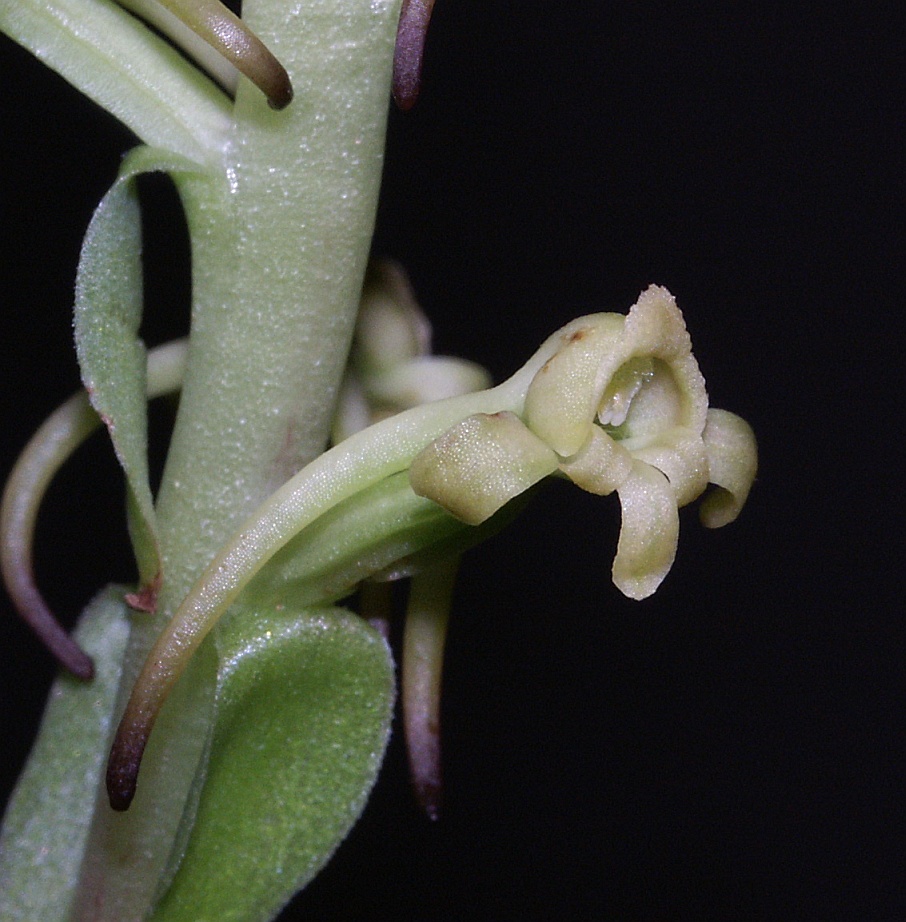
Satyrium is a genus of terrestrial orchids in the family Orchidaceae, comprising 91 accepted species. The genus was formally described by the Swedish botanist Olof Swartz and published in Kongl. Vetensk. Acad. Nya Handl. 21: 214 (1800). It belongs to the subfamily Orchidoideae, tribe Orchideae, and subtribe Orchidinae.
The great majority of Satyrium species occur in sub-Saharan Africa and Madagascar, where the genus is one of the most diverse groups of terrestrial orchids on the continent. Four species extend into Asia, primarily in India and Sri Lanka, and one species (S. nepalense) ranges into the eastern Himalayas and southern China. The genus was noted as extinct in Mauritius.
Plants grow as deciduous geophytes with annually replaced underground tubers, typically reaching 14–70 cm in height. Flowering season varies widely across the genus, tracking regional rainfall patterns, with different species flowering in spring, summer, or winter. Many species produce strongly or sweetly scented flowers, and some rely on deceptive pollination strategies — most notably S. pumilum, which mimics carrion to attract pollinating flies.
Classification has been refined substantially through molecular work. A 2015 phylogenetic study (Chase et al.) repositioned the genus from the former subtribe Satyriinae — where it sat alongside Pachites — into the broader subtribe Orchidinae within tribe Orchideae. Historical treatments had included unrelated helmet-flowered orchids such as Aceras, Chamorchis, and Platanthera in Satyrium, but molecular evidence clearly separates these lineages. The genus is represented by two natural hybrids (S. × fibeckii and S. × guthriei), and hybridization among species has complicated phylogenetic resolution from organellar DNA markers.
Distribution
Satyrium is predominantly an African genus. The overwhelming majority of its 91 accepted species are native to tropical and southern Africa, with a secondary centre of diversity in Madagascar and the western Indian Ocean islands. POWO records native occurrence across more than 40 geographic regions spanning Angola to Zimbabwe and across the eastern African highlands. The genus is recorded as extinct in Mauritius.
Four species extend beyond Africa into Asia, mainly on the Indian subcontinent through to southern central China. Satyrium nepalense is the best-documented Asian representative, with a range extending through the Himalayas into Arunachal Pradesh and Yunnan Province. Herbarium specimens in the SEINet network document occurrence across multiple Asian collections.
Ecology
Satyrium species occupy a wide range of habitats in their African heartland, including rocky sandy soils, damp sandstone slopes, moist or marshy grassland, and coastal fynbos. They are deciduous geophytes that die back seasonally, with growth and flowering timed to local rainfall regimes — some species being winter-growing and others summer-growing.
Pollination biology is notably diverse within the genus. Many species attract pollinators through genuine floral rewards (including scent and nectar), but deceptive strategies also occur. Satyrium pumilum is documented as a carrion mimic, producing olfactory cues that attract carrion-frequenting flies as pollinators without providing any reward. The genus as a whole has been the subject of extensive pollination-ecology research, with hybridization between species occurring where ranges overlap, a factor that complicates phylogenetic studies based on organellar DNA.
Cultural uses
Satyrium nepalense, the primary Asian representative of the genus, is documented in traditional medicine among communities in Arunachal Pradesh (northeastern India), where it is used to treat tuberculosis and other ailments. Ethnobotanical studies (Bhatnagar et al. 2017) have evaluated the species for antimycobacterial, leishmanicidal, and antibacterial activity, reflecting its significance in Himalayan ethnomedicine. More broadly, terrestrial African orchid tubers, including those of Satyrium species, are part of the traditional wild-food and medicinal-plant knowledge systems of communities across southern Africa, though species-level documentation for the genus as a whole remains limited.
Taxonomy notes
Satyrium Sw. was described by Olof Swartz in 1800 (Kongl. Vetensk. Acad. Nya Handl. 21: 214). The genus carries the IPNI identifier urn:lsid:ipni.org:names:331281-2. Four nomenclatural synonyms are recognized: Diplecthrum Pers. and Hipporkis Thouars (homotypic), and Aviceps Lindl. and Satyridium Lindl. (heterotypic).
Current placement is in subfamily Orchidoideae, tribe Orchideae, subtribe Orchidinae. A 2015 molecular phylogenetic study by Chase and colleagues (Botanical Journal of the Linnean Society 177(2):151–174) reorganized tribal circumscriptions, moving Satyrium from its former position in subtribe Satyriinae (alongside Pachites) into the expanded Orchidinae. Earlier botanical literature had incorrectly grouped unrelated helmet-flowered genera — including Aceras, Chamorchis, and Platanthera — within Satyrium, but these are now placed in separate lineages far removed from the true Satyrium clade.
Hybridization between species in the genus is known to occur, and this has complicated resolution of the molecular phylogeny, particularly when studies rely on mitochondrial or chloroplast DNA sequences. GBIF backbone taxonomy records a primary accepted entry of Satyrium Sw. (1800), with a secondary historical entry of Satyrium L. (1753) representing pre-Swartzian nomenclatural history.
Propagation
Satyrium species are geophytes that produce annually replaced underground tubers. Each growing season the old tuber is progressively depleted as it fuels leaf and stem growth, while a new replacement tuber forms alongside it. This cycle of tuber replacement is the plant's primary mechanism of vegetative persistence and is an important consideration for any cultivation or ex-situ propagation attempt. Flowering season varies considerably across the genus, coordinated with species-specific rainfall cues rather than a fixed calendar period.

