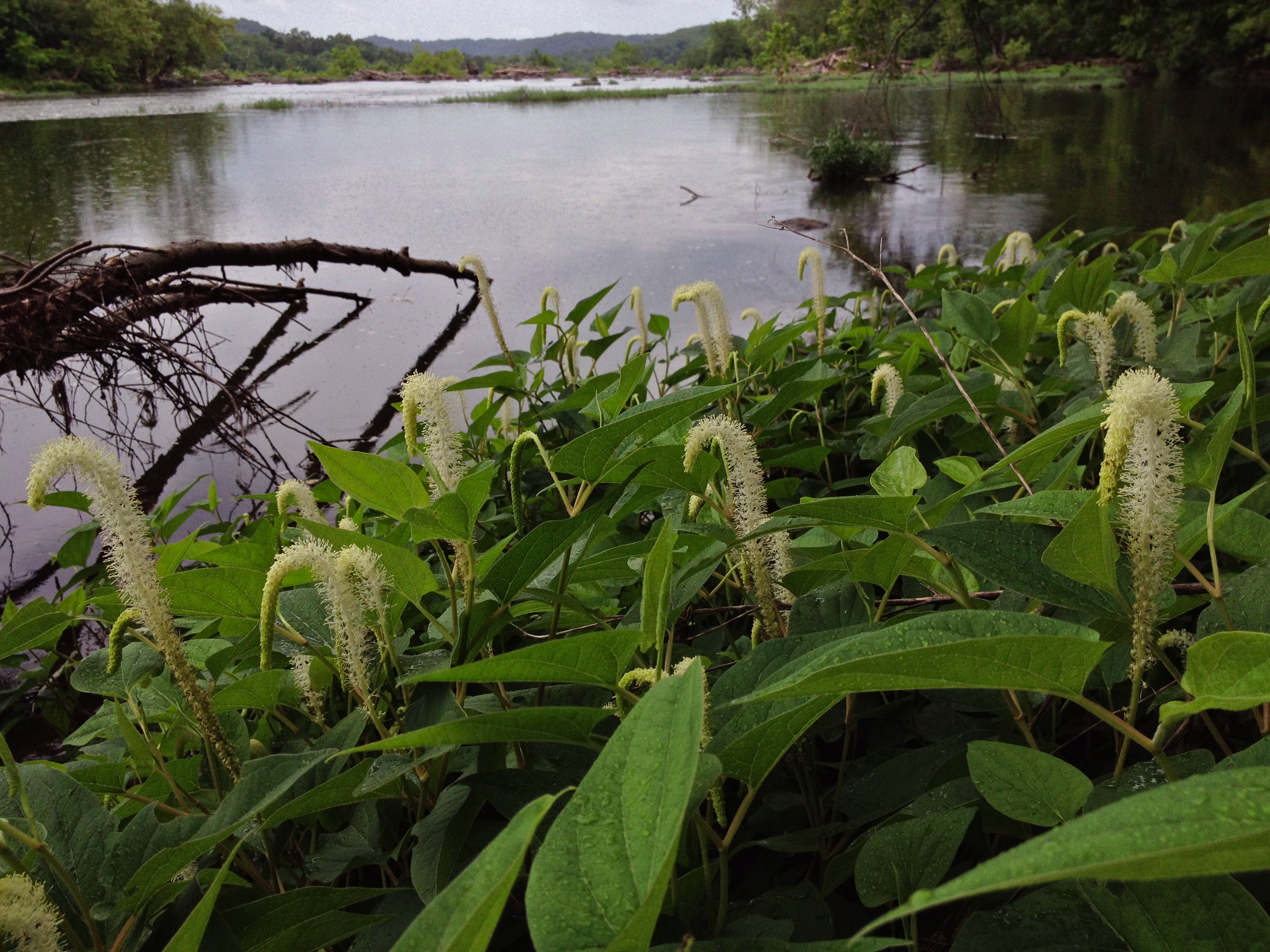
Saururus is a small genus of aquatic and wetland perennial herbs in the family Saururaceae, placed within the order Piperales. It contains just two living species: Saururus cernuus, native to eastern North America, and Saururus chinensis, native to eastern and southeastern Asia. The genus has an ancient lineage, with fossil representatives documented from the Eocene and Miocene of Europe and North America.
Plants in this genus are rhizomatous herbaceous perennials that grow in wet or semi-aquatic habitats — marshes, stream margins, lake edges, and flooded ground. They reach 0.6 to 1 metre in height and bear alternate, heart-shaped to ovate-lanceolate leaves. The defining feature of the genus is its slender, arching spike inflorescence densely set with small white flowers; as the flowers mature and turn brown, the spike takes on the curved, tapering appearance that gives the plants their common name, lizard's tail.
Saururus cernuus (North American lizard's tail) extends from Ontario south through the southeastern United States and is notable for its vigorous rhizomes, which can spread laterally up to 3 metres and make the plant competitive in wetland habitats. Saururus chinensis (Asian lizard's tail) occupies a broad range across China, Japan, Korea, the Philippines, and Vietnam, growing in similarly low and damp conditions. Both species have documented histories of use in traditional medicine, with Indigenous North American peoples employing S. cernuus roots as poultices and fever remedies, and Asian practitioners using S. chinensis for inflammatory conditions.
Etymology
The genus name Saururus derives from the Greek sauros ("lizard") and oura ("tail"), a reference to the slender, drooping flower spike that curves and darkens as it matures. The common name lizard's tail captures the same image. The epithet of the North American species, cernuus, is Latin for "drooping" or "nodding," further describing the characteristic inflorescence.
Distribution
Saururus cernuus is found in freshwater wetlands across eastern North America, from Ontario, Canada, south through the mid-Atlantic states to Florida and the southeastern United States, typically in marshes and along shallow stream and lake margins. Saururus chinensis occupies a broad range in eastern and southeastern Asia, including China (mainland, Hainan, Qinghai), Japan, Korea, the Philippines, the Ryukyu Islands, Taiwan, and Vietnam. The two species together give the genus a disjunct intercontinental distribution across North America and Asia.
Ecology
Both species inhabit freshwater wetlands and require consistently wet to waterlogged soils. Saururus cernuus tolerates partial shade cast by larger trees and can establish in shallow standing water. Its dense rhizome network allows it to compete strongly for below-ground resources and it can form large colonies. North American beaver (Castor canadensis) is a significant herbivore: in areas of beaver activity, lizard's tail abundance has been reduced by as much as 45%. The flowers and fruits also support a diverse beetle community, including at least three longhorn beetle species documented mating on S. cernuus. Overgrazing by livestock may cause toxicity.
Cultural Uses
Saururus cernuus has a well-documented history of medicinal use among Indigenous North American peoples. The Cherokee and Choctaw peoples mashed the roots into a poultice applied to relieve inflammation of the breasts and back. The Seminole used the plant as an antirheumatic and to soothe fevers and body aches. Early settlers also adopted the plant for similar purposes. Rhizomes of S. cernuus are sold by native plant nurseries for wetland restoration projects. In Asia, Saururus chinensis has been used in traditional medicine to treat inflammatory conditions including edema, gonorrhea, and asthma.
Taxonomy Notes
Saururus belongs to the family Saururaceae within the order Piperales (angiosperms). The genus has two accepted extant species. A synonym for the North American species is Saururus cernuus f. submersus Glück. The fossil record extends the genus back to at least the Eocene: †Saururus tuckerae is known from flowers, leaves, and pollen from the Ypresian Eocene Okanagan Highlands Princeton Chert site, and †Saururus bilobatus has been described from middle Miocene strata in central Jutland, Denmark, suggesting a once-broader Holarctic distribution.

