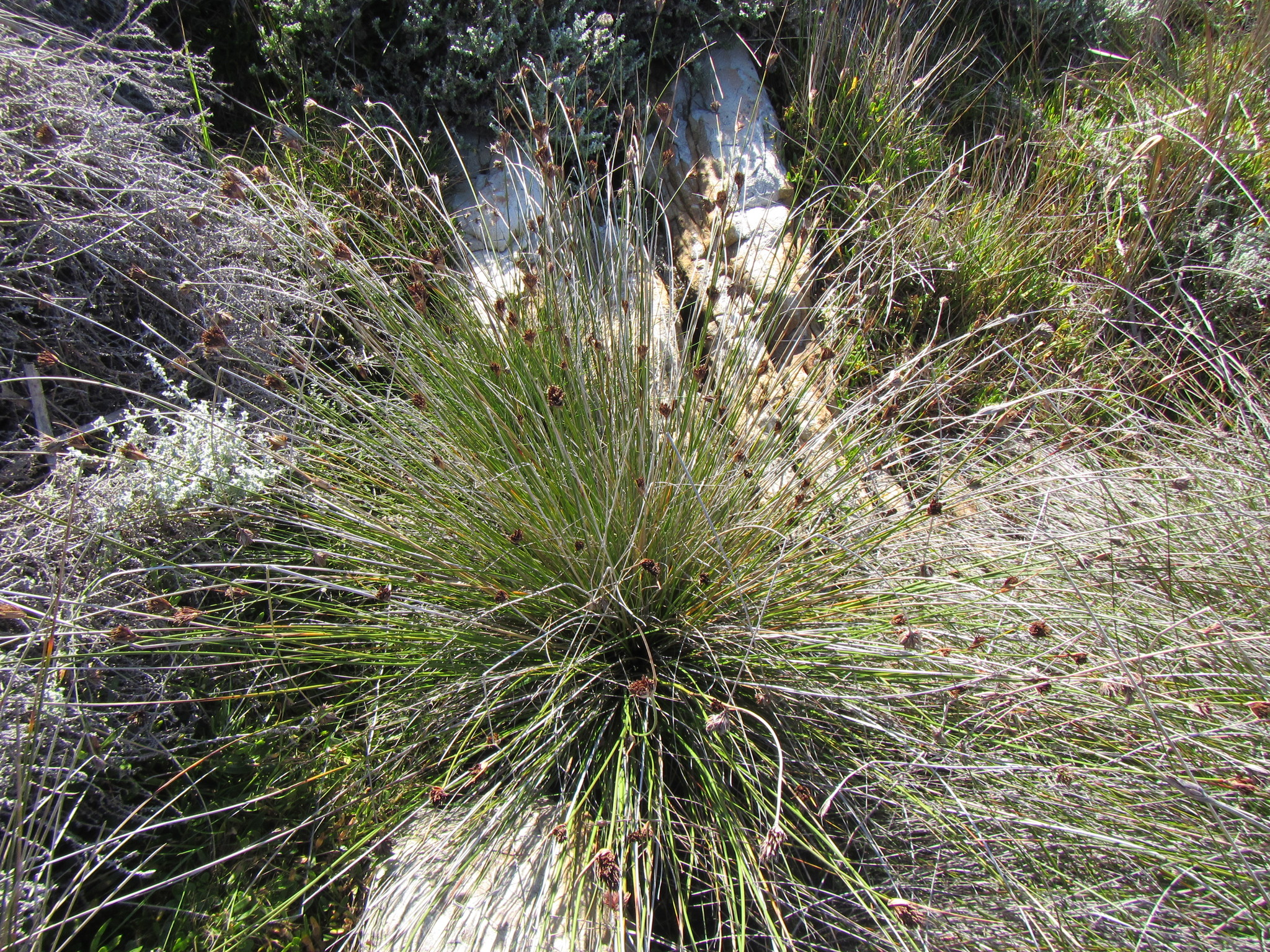
Schoenus is a genus of grass-like flowering plants in the sedge family (Cyperaceae), commonly known as bog-rushes (and as veldrushes in South Africa). The genus was established by Carl Linnaeus in Species Plantarum in 1753 and sits within the tribe Schoeneae of order Poales. Around 155 species are currently accepted in Plants of the World Online, although GBIF lists 258 descendant taxa once subspecies, varieties and synonymised names are counted.
Members of the genus are perennial, tufted (cespitose) herbs with creeping rhizomes. The culms are usually terete — round in cross-section — though some species have angular or flattened stems, and they typically branch in their upper portion. Basal leaves are normally well developed, but in some species they are reduced to sheaths. Inflorescences carry characteristically dark spikelets with small bisexual flowers, the feature that gives many species their common reference to "black" or "brown" bog-rush.
Schoenus is a predominantly southern-hemisphere ("austral") genus, with its centres of diversity in Australia (roughly 70 species) and South Africa (around 44 species). A smaller number of species reach Southeast Asia, while only a handful occur natively in Europe, North Africa, the Americas and the southern tip of South America. The black bog-rush (Schoenus nigricans) is an exception: it has a near-cosmopolitan distribution and is the species most botanists encounter outside the Australasian–African core. Schoenus antarcticus, by contrast, is restricted to the cool, wet "Magellanic moorlands" of Tierra del Fuego.
Across this range, Schoenus species are strongly associated with wet or seasonally wet, low-nutrient habitats — peatlands, moorlands, calcareous fens, heathlands and the species-rich kwongan vegetation of southwestern Australia. The genus has recently been recircumscribed: since 2017, taxonomic work has folded twenty-four species formerly placed in Tetraria and Epischoenus into Schoenus, and several new species have been described, including the narrowly endemic S. inconspicuus on the outskirts of Cape Town.
Etymology
The genus name Schoenus is a Latinisation of the Greek schoinos, meaning "rush," "reed," or "cord." The same word lent its name to the ancient Egyptian, Greek and Roman schoenus — a unit of length notionally measured by a knotted rush-fibre rope. Linnaeus chose the name in 1753 when he formally established the genus in Species Plantarum.
Distribution
Schoenus is a predominantly austral (southern-hemisphere) genus. The two great centres of diversity are Australia, where roughly seventy species occur and the genus is widespread across Western Australia, South Australia, the Northern Territory, Queensland and New South Wales, and South Africa with about forty-four species. A smaller radiation extends into Southeast Asia. Outside the austral zone the genus is sparsely represented: two species in Europe (both also recorded in Switzerland — S. nigricans and S. ferrugineus), one in North Africa, and a thin scattering through the Americas, including S. antarcticus in Tierra del Fuego. Schoenus nigricans itself is essentially cosmopolitan, occurring on most continents.
Ecology
Schoenus species are almost invariably plants of wet, low-nutrient ground. They are characteristic components of peatlands and moorlands worldwide, of calcareous fens in Europe, and of the kwongan heathlands and seasonally wet flats of southwestern Australia. Schoenus antarcticus helps define the "Magellanic moorland" of hyperhumid southern Patagonia, while in Switzerland the genus is treated alongside the Nanocyperion alliance of specialised wetland communities. Specific epithets recorded in Australian floras — fluitans (floating, aquatic), ericetorum (of heaths) — point to the same suite of wet, oligotrophic habitats.
Taxonomy notes
Schoenus L. was published by Linnaeus in Species Plantarum 1: 42 on 1 May 1753 and is placed in tribe Schoeneae of the Cyperaceae. GBIF treats the genus as accepted and records 258 descendant taxa, while Plants of the World Online accepts around 155 species. The circumscription of Schoenus has changed substantially since 2017: phylogenetic work has folded twenty-four species formerly placed in Tetraria and Epischoenus into Schoenus, and several new species have been described. Generic synonyms now subsumed include Cyclocampe, Epischoenus, Gymnochaeta, Helothrix, Isoschoenus, Lepidospora, Lophocarpus, Melanoschoenos, Neolophocarpus and Streblidia.










