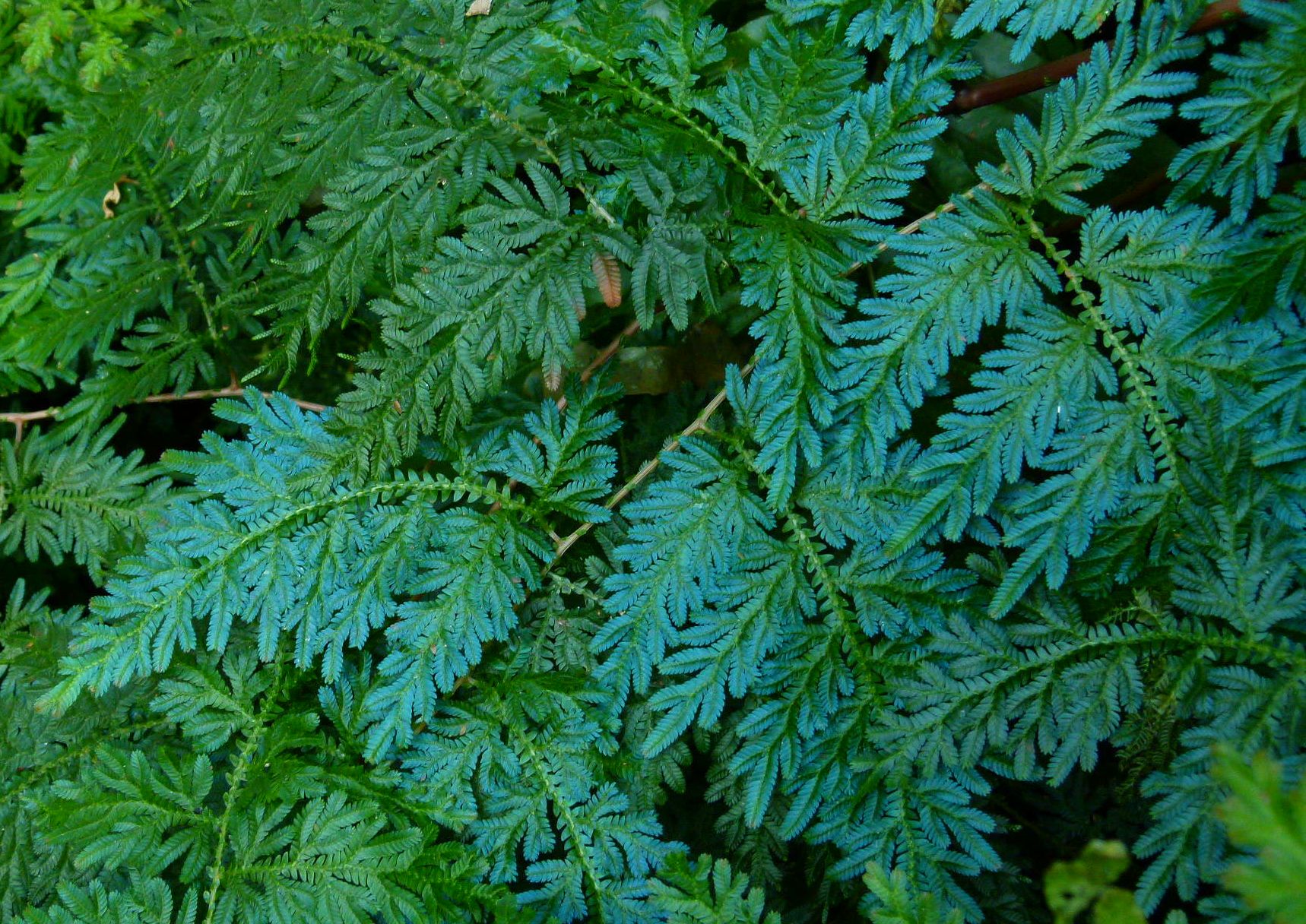
Selaginella is the sole surviving genus of the family Selaginellaceae and the order Selaginellales, a deeply ancient lineage within the lycophytes (class Lycopodiopsida). The plants are usually small and moss-like, with creeping, sub-erect, or fully erect stems clothed in tiny scale-like leaves called microphylls. A defining feature, easy to see only with a hand lens, is the ligule — a small flap of tissue at the base of every leaf — which separates Selaginella and its relatives from the superficially similar club mosses in genus Lycopodium. Common names reflect that resemblance: spikemosses, lesser clubmosses, and, for a handful of desert species, "resurrection plants."
The genus is unusual among lycophytes in being heterosporous, producing two distinct kinds of spores — large megaspores that develop into female gametophytes and tiny microspores that yield male ones — both housed in specialised sporangia along compact strobili. Internally the stems show a polystelic protostele with diarch, exarch xylem, and the chloroplasts of most species are reduced in number and gene content compared to flowering plants. Around 70% of species are shade-adapted with monoplastidic cells, while others tolerate full sun and severe drought.
The genus is essentially cosmopolitan but its centre of diversity is the tropics, where Selaginella forms feathery carpets on humid forest floors, mossy rocks, and even tree trunks; a few species reach arctic-alpine habitats in both hemispheres, and others occupy seasonally dry deserts. Plants of the World Online accepts roughly 747 species, while GBIF's backbone records over a thousand descendant taxa once subspecies and synonyms are counted. Selaginella has been treated as a single, very large genus for two centuries, but a 2023 proposal would subdivide it into 19 segregate genera (Afroselaginella, Bryodesma, Lycopodina and others), and POWO already lists 25 such names as synonyms.
For gardeners the genus is best known through tropical species grown as terrarium plants and shade-house ground covers — golden clubmoss (Selaginella kraussiana), frosty fern (S. martensii), peacock moss (S. uncinata), and the iridescent S. willdenowii. For scientists the headline species are S. moellendorffii, the first non-seed vascular plant to have its genome sequenced (Banks et al., 2011, Science), and S. lepidophylla, the Chihuahuan Desert "resurrection plant" whose ability to survive 95% moisture loss has made it a flagship for desiccation-tolerance research.
Etymology
The genus name Selaginella was established by the French botanist Ambroise Marie François Joseph Palisot de Beauvois in 1804, published in the Magasin Encyclopédique (volume 9, page 478). It was originally erected as a monotypic genus to accommodate Selaginella selaginoides, and the name itself is a diminutive form of Selago, an older name once applied to certain club mosses. Because the name had a complicated nomenclatural history, it was later formally conserved (nom. cons.) under the International Code of Nomenclature.
Distribution
Selaginella is essentially cosmopolitan in its native range, occurring across all major continents and biogeographic regions, with by far the greatest species diversity in the tropics. A handful of species push into arctic-alpine zones in both the Northern and Southern Hemispheres, while others are restricted to deserts or seasonally dry forests. Plants of the World Online records the genus as native almost everywhere plants grow, and as introduced in the Chatham Islands, the Netherlands, both islands of New Zealand, and Norfolk Island. POWO also notes the genus as locally extinct in Hungary.
Ecology
Selaginella species occupy a remarkable spread of habitats — humid tropical forest floors, mossy rocks, tree trunks, alpine bogs and dry deserts. Most species are shade lovers; about 70% are monoplastidic, with a single large chloroplast per cell, and their plastid genome has lost roughly two-thirds of the tRNA genes typical of other land plants, with those functions taken over by the nuclear genome. A subset of species, exemplified by Selaginella lepidophylla and S. tamariscina, are poikilohydric "resurrection plants": they survive losing up to 95% of their water by curling into tight brown balls, then re-green and unfurl within hours of rehydration. This tolerance is underwritten by accumulation of trehalose and betaines, sugars that stabilise membranes and proteins through dehydration.
Cultivation
Several tropical Selaginella species are popular as houseplants, terrarium plants, and shade-house ground covers, with golden clubmoss (S. kraussiana), frosty fern (S. martensii), peacock moss (S. uncinata), S. erythropus, S. braunii and the curiosity S. lepidophylla all commercially available. As a group they prefer moist, humus-rich soil in light shade and dislike drying out; PFAF notes tolerance of sandy, loamy and clay soils across mildly acid, neutral and basic pH. The temperate-climate species are far less common in cultivation than the tropical ones, which is why most container culture targets a warm, humid microclimate.
Propagation
Selaginella is propagated either by spores — the natural route, given its heterosporous reproduction — or, in horticulture, by simple division and stem cuttings, since the creeping stems readily root at their nodes when laid on moist medium.
Cultural Uses
The most widely known cultural use of the genus centres on Selaginella lepidophylla, the Chihuahuan Desert "resurrection plant," which is sold worldwide as a dried, bare-root novelty that visibly revives when placed in water; Spanish missionaries adopted it as a teaching symbol of resurrection, and it features in folk traditions ranging from family heirlooms to santería rituals. In Mexico the same plant is brewed as a tea for colds and sore throat and used as a diuretic and aid in childbirth. Across East Asia, Selaginella tamariscina has a long history in traditional medicine: the whole plant is regarded as astringent and haemostatic and is decocted to treat traumatic bleeding, pulmonary complaints and gastro-intestinal bleeding, with young shoots occasionally cooked as food. In India, S. bryopteris is venerated as Sanjeevani Booti, a plant of legendary restorative power.
History
The Selaginellaceae lineage has an exceptionally deep fossil record, with recognisable ancestors stretching back more than 300 million years to the Late Carboniferous, when arborescent lycopsids dominated coal-swamp forests. The modern genus was named by Palisot de Beauvois in 1804. Two centuries later it became a touchstone for plant evolutionary genomics: Selaginella moellendorffii, native to the moist forest floors of subtropical Asia, was the first non-seed vascular plant to have its genome sequenced — a roughly 100 Mb genome among the smallest known in plants — by the U.S. DOE Joint Genome Institute, with the landmark paper appearing in Banks et al., 2011, Science. The data confirmed that the lycophyte lineage diverged from other vascular plants roughly 400 million years ago and that surprisingly few new genes were needed for the shift from gametophyte- to sporophyte-dominated life cycles.
Taxonomy Notes
Selaginella P.Beauv. is the only living genus in family Selaginellaceae and order Selaginellales, within class Lycopodiopsida (phylum Tracheophyta). The name is conserved (nom. cons.). Plants of the World Online currently accepts about 747 species; the GBIF backbone records over 1,000 descendant taxa once infraspecific names and synonyms are counted. POWO lists 25 generic names as synonyms (including Afroselaginella, Bryodesma and Lycopodina), and a 2023 phylogenetic proposal would split the traditional genus into 19 separate genera — a treatment not yet universally adopted. The lineage is unusual in showing no evidence of whole-genome duplication, in contrast to almost all flowering-plant clades.
Conservation
At the genus level Selaginella has not been formally assessed by the IUCN, and the Global Invasive Species Database holds no genus-level record. POWO does note that the genus is regionally extinct in Hungary and introduced in the Chatham Islands, the Netherlands, New Zealand and Norfolk Island. Among well-studied species, the iconic resurrection plant S. lepidophylla is not currently considered threatened.










