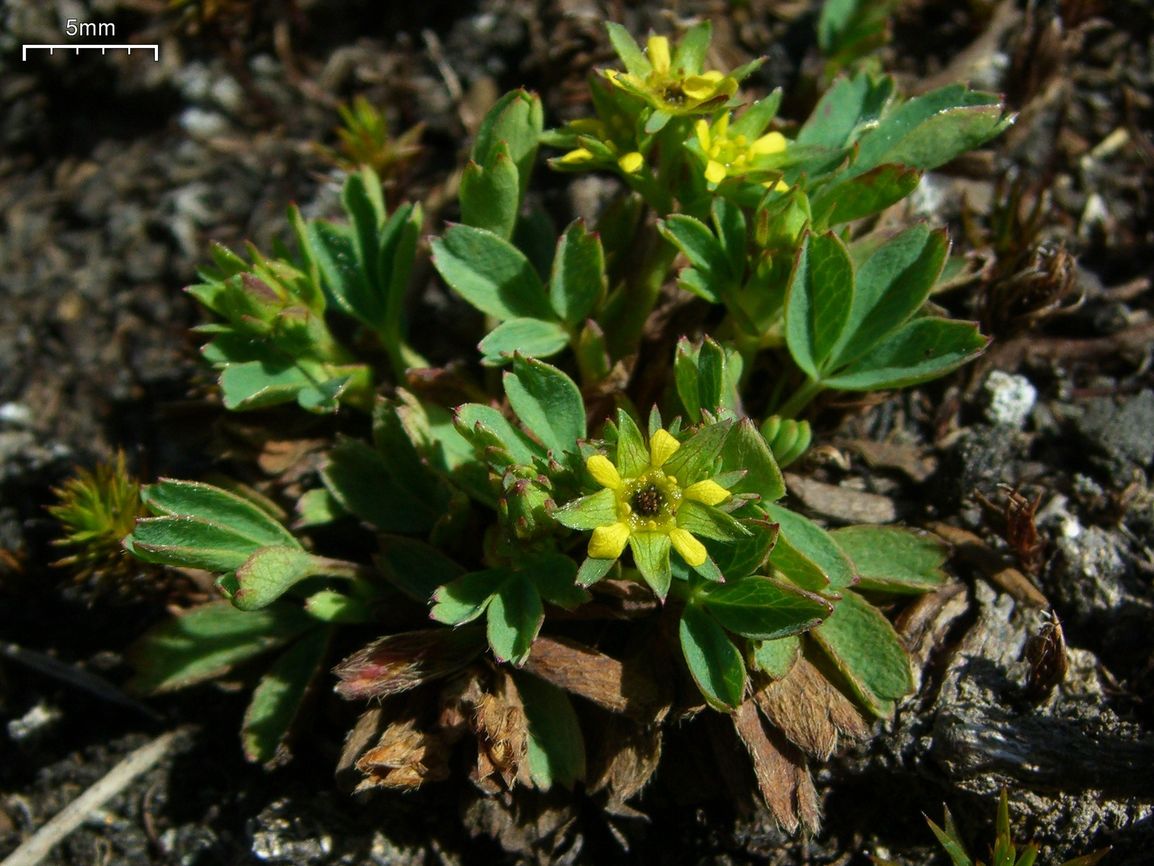
Sibbaldia is a genus of small flowering plants in the family Rosaceae (order Rosales), placed within the subfamily Rosoideae. The genus has a circumpolar distribution, spanning arctic and alpine regions across the Northern Hemisphere, including the high Arctic. Plants in this genus are typically low-growing perennial herbs adapted to cold, exposed habitats at high elevations and high latitudes.
The type species is Sibbaldia procumbens, a widespread mat-forming plant of montane and arctic tundra. The genus was first formally described in 1753 and was named in honour of Robert Sibbald (1641–1722), a Scottish physician and antiquary.
Taxonomic understanding of the genus has shifted significantly: morphological and genetic studies revealed that Sibbaldia as historically circumscribed was polyphyletic. As a result, several species have been synonymized or reassigned to related genera including Sibbaldianthe, Chamaecallis, and Potentilla. As of early 2024, Plants of the World Online recognises around 13 accepted species.
Etymology
The genus name Sibbaldia commemorates Robert Sibbald (1641–1722), a Scottish physician, naturalist, and antiquary who was a pioneering figure in Scottish natural history. The genus was first described by Linnaeus in 1753.
Distribution
Sibbaldia has a circumpolar distribution across arctic and alpine zones of the Northern Hemisphere, including the high Arctic. Species occur in cold montane and tundra environments across Eurasia and North America.
Taxonomy Notes
Morphological and genetic studies demonstrated that the traditional circumscription of Sibbaldia was polyphyletic. This has led to the reassignment of numerous former species to related genera: Sibbaldianthe, Chamaecallis, and Potentilla. The genus is placed in the subfamily Rosoideae of the family Rosaceae (order Rosales).










