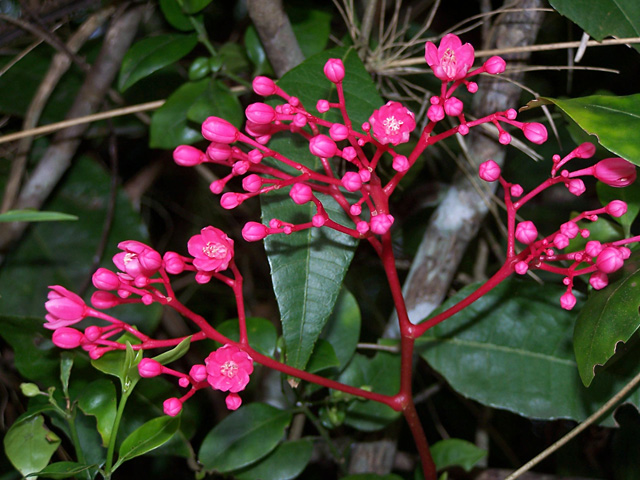
Simarouba is a genus of trees and shrubs in the family Simaroubaceae (order Sapindales), native to the neotropical region of the Americas. The genus comprises a small number of species distributed across continental Central and South America, with several endemics restricted to the Caribbean islands.
Plants in this genus are characterised by compound leaves bearing between 1 and 12 pairs of alternate pinnate leaflets. They are dioecious — individual plants bear only male or female flowers — with small unisexual flowers roughly 1 cm long arranged in large panicles. Each flower has 4–6 sepals and petals and 8–12 stamens. The fruit is a carpophore carrying up to five drupaceous mericarps.
Taxonomically, Simarouba has been placed in subtribe Simaroubina alongside Simaba and Quassia. A 2007 molecular study using three chloroplastic genes and one nuclear gene found its closest relatives to be Pierreodendron and Simaba.
The genus has a notable economic history. French explorers first documented it in 1713, and by the early 18th century its bark was being exported to Europe to treat dysentery. Indigenous peoples of the neotropics have long used bark preparations as medicinal teas. Today, Simarouba glauca — known in India as Lakshmi Taru — is cultivated for edible seed oil and timber, while Simarouba amara produces a bright, lightweight wood valued in European markets for fine furniture and veneers.
Distribution
Simarouba is native to the neotropics. The continental species — S. amara, S. glauca, and S. versicolor — range from Central America (with S. glauca extending as far south as Panama) through South America. Three species (S. berteroana, S. laevis, and S. tulae) are endemic to the Caribbean islands.
Ecology
The ailanthus webworm moth (Atteva aurea) is a documented pest of Simarouba. Continental species can co-occur and are sometimes confused in areas of overlapping distribution; S. glauca and S. versicolor are distinguishable by leaf tomentum — S. glauca lacks leaf trichomes while S. versicolor has densely tomentose leaves.
Cultural Uses
The bark of Simarouba species has been used by indigenous Neotropical peoples as a medicinal tea to treat a range of ailments. Historically, bark was exported to France between 1718 and 1725 to combat a dysentery epidemic. Simarouba amara is commercially harvested for its bright, lightweight timber, sought after in European markets for fine furniture and veneers. Simarouba glauca (Lakshmi Taru) is cultivated in India for edible oil produced from its seeds and is also valued for timber.
History
The genus was first documented by French explorers in 1713. Within a decade, bark exports to France were underway, used medicinally against dysentery outbreaks (1718–1725). Formal taxonomic separation of species within the genus was carried out in 1944 by Adolf Engler and Arthur Cronquist, primarily on the basis of floral morphology and leaf structure.
Taxonomy Notes
Simarouba is placed in subtribe Simaroubina (family Simaroubaceae, order Sapindales) alongside Simaba and Quassia. A 1995 phylogenetic analysis based on the rubisco large subunit suggested closest affinity with Leitneria and Ailanthus, but a more comprehensive 2007 study using three chloroplastic and one nuclear gene resolved the genus as most closely related to Pierreodendron and Simaba.










