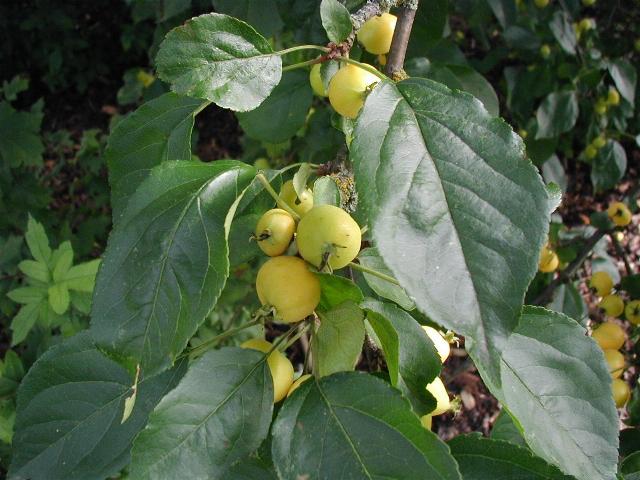
Sinomalus is a small genus of flowering trees in the family Rosaceae, proposed in 2018 by the British botanist Keith Rushforth as a segregate of the broader genus Malus (crabapples). The genus was published in the journal Phytologia (volume 100, issue 4) and encompasses species characterised by small, cherry-like pomes and a wide geographic distribution spanning temperate Asia and western North America.
The two best-known members are Sinomalus baccata (Siberian crabapple), native to Russia, Mongolia, China, Korea, and the Himalayan foothills, and Sinomalus fusca (Oregon crabapple), native to the Pacific coast of North America from Alaska to northwestern California. Both are deciduous trees reaching 10–14 metres in height, bearing fragrant white flowers in spring and clusters of small round or oval pomes in autumn.
Most major taxonomic databases, including the GBIF backbone, continue to treat Sinomalus names as synonyms of the corresponding Malus species, reflecting that Rushforth's circumscription has not been widely adopted. The genus thus occupies an unsettled position in apple-tribe systematics and its recognition remains a matter of ongoing taxonomic debate within Rosaceae.
Etymology
The name Sinomalus combines the Latin prefix Sino- (meaning "Chinese" or "of China", from the Late Latin Sinae) with Malus, the classical Latin name for apple trees. The compound name therefore means roughly "Chinese apple" or "Chinese Malus", reflecting the East Asian centre of diversity of the species originally placed here.
Distribution
Species placed in Sinomalus span two widely separated regions: Sinomalus baccata (Siberian crabapple) is native to Russia, Mongolia, China, Korea, Bhutan, India, and Nepal, occurring in mixed forests on hilly slopes up to 1,500 m elevation; Sinomalus fusca (Oregon crabapple) is native to the Pacific coast of North America from Alaska through British Columbia to northwestern California, growing in the Cascade Range and Pacific Coast Ranges.
Ecology
Sinomalus baccata grows in temperate mixed forests on hilly slopes, tolerating cold continental climates and considered one of the most frost-hardy crabapple taxa. Sinomalus fusca occupies wetter maritime habitats — riparian corridors, estuarine margins, and poorly drained lowland forest — alongside red alder, bigleaf maple, willows, and cascara; its fruits are consumed by grouse, bears, and other wildlife.
Taxonomy Notes
Sinomalus was established by Keith Rushforth in 2018 (Phytologia 100(4): 244–245) as a segregate genus carved out of Malus. The GBIF backbone treats all Rushforth combinations (Sinomalus baccata, Sinomalus fusca, Sinomalus tenuifolia) as synonyms, retaining the species under Malus. The genus has not been accepted by the major global checklists examined here, and its recognition remains contested; most floristic works continue to use Malus in the traditional broad sense.










