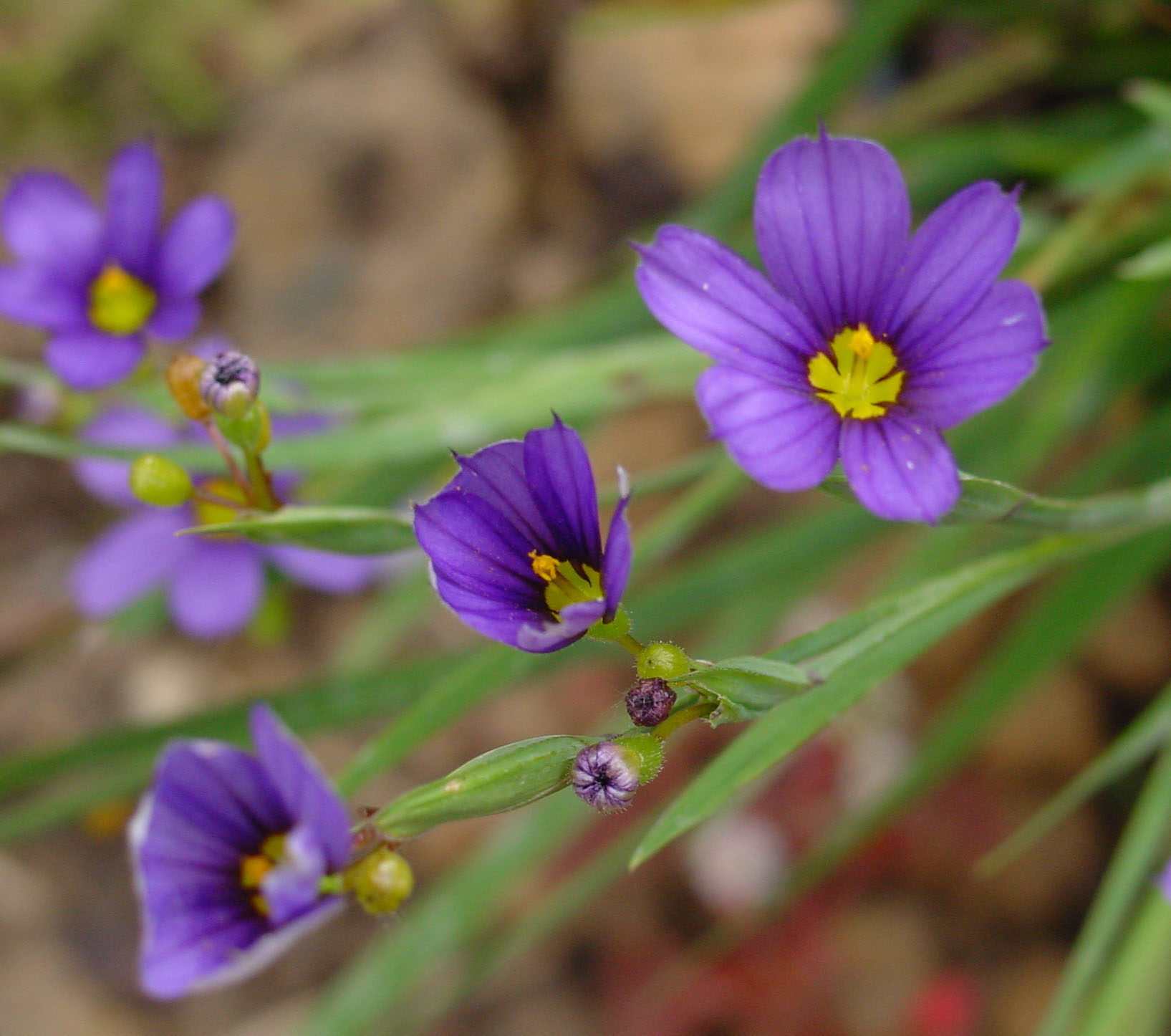
Sisyrinchium is a genus of approximately 212 accepted species of annual and perennial flowering plants in the iris family (Iridaceae), native to the Americas. Despite their popular name "blue-eyed grasses," they are not true grasses — they belong to the monocot order Asparagales alongside irises, freesias, and crocuses.
Plants grow as grass-like tufts, with compressed, two-winged stems and basal leaves arranged in the equitant (fan-like) fashion characteristic of the iris family. Flowers are borne in umbel-like clusters, each subtended by two opposed spathe bracts. The genus is exceptionally varied in flower colour, spanning blue, violet, pink, white, and yellow — the yellow-flowered California golden-eyed grass (S. californicum) is among the best-known departures from the blue hue behind the common name. Fruits are globose capsules holding small, black, granular seeds. The chromosome base number is x = 8, and the genus is taxonomically complex, encompassing significant polyploidy and phenotypic plasticity that has historically made species delimitation difficult.
The greatest diversity of Sisyrinchium is found in South America. Roughly one-third of species have evolved specialised oil-producing hairs (elaiophores) that attract oil-collecting bees as pollinators — a pollination system almost entirely restricted to the South American members of the genus. A smaller contingent of species occurs across North America, with particular richness in the southwestern United States; a few have naturalised beyond the Americas, including populations established in the British Isles and New Zealand. Several eastern North American species are considered threatened or endangered.
Etymology
The genus name Sisyrinchium is drawn from the Ancient Greek word Sisyrinchíon, which ancient authors applied to the Barbary nut (Moraea sisyrinchium). One explanation links it to sisýra, a Greek word for a shaggy goat's-hair coat, referencing the fibrous tunics surrounding the plant's corms. A second, disputed etymology proposes a compound of Latin sus (pig) and Greek rhynchos (snout or nose), though this derivation is generally regarded as unreliable. The genus was formally established by Carl Linnaeus in his Species Plantarum of 1753, with Sisyrinchium bermudiana designated as the type species.
Distribution
Sisyrinchium is a New World genus with its centre of diversity in South America, where the richest assemblages of species occur and almost all oil-bee-pollinated species are found. The genus extends across the Americas from southern South America northward through Central America and into North America. In the United States, the genus is well represented in the southwestern states (Arizona, New Mexico, and Texas) as well as in the east. Sandy soils and moist, open habitats are favoured by many species.
Outside the Americas, populations have become established as introductions: one species occurs in the British Isles (including western Ireland) in marshy meadows and on lake shores, and at least one species has naturalised in New Zealand.
Ecology
Most Sisyrinchium species are perennial herbs growing from rhizomes, though some are annual or short-lived. They occupy a wide range of soil types — from light sandy to heavy clay — at mildly acidic to moderately basic pH, and grow in full sun to semi-shade, often preferring moist conditions. A notable ecological specialisation has evolved in roughly one-third of species: the presence of elaiophores (oil-secreting hairs) that reward oil-collecting bees, which serve as the primary pollinators. This oil-bee pollination system is almost exclusively a South American phenomenon within the genus. Species adapted to sandy (arenic) substrates form a further ecological guild recognised within the genus.
Cultivation
Sisyrinchium species are grown as ornamentals in temperate gardens, valued for their delicate grass-like foliage and cheerful flowers. They are generally hardy plants: USDA zones 3–7 have been noted, with cold tolerance down to approximately −40°C in robust perennial forms. Plants succeed in a variety of soils provided drainage is adequate and moisture is maintained; full sun is preferred, though light shade is tolerated. Sisyrinchium striatum (pale yellow-eyed grass / satin flower) is among the most widely cultivated species in European and North American gardens.
Propagation
Seeds may be sown in autumn under glass or outdoors in spring. Seedlings should be pricked out individually into pots and grown on until large enough to plant out after the last frost. Established clumps can be divided in early spring; division is the most reliable method for maintaining true-to-type perennial selections.
Cultural uses
Among species with documented ethnobotanical use, the leaves have been eaten cooked, typically mixed with other greens as a pot herb. The root is astringent and has been used medicinally: an infusion was prepared to treat diarrhoea in both adults and children, and the root has also been applied to stomach complaints and intestinal worms.
Conservation
Several eastern North American species of Sisyrinchium are considered threatened or endangered, reflecting habitat loss in the sandy and moist open habitats the genus favours. While no Sisyrinchium species was found listed on the IUCN Global Invasive Species Database, at least two species have established naturalised populations outside their native range (British Isles and New Zealand), indicating dispersal capacity beyond native distributions.
Taxonomy notes
Sisyrinchium L. (Sp. Pl. 954, 1753) is placed in family Iridaceae, order Asparagales, class Liliopsida. Within Iridaceae it belongs to subfamily Iridoideae and tribe Sisyrinchieae. The GBIF backbone recognises the genus as accepted under Linnaeus's authorship, with 292 descendant taxa (species and infraspecific ranks) recorded. Other checklists cite approximately 212 accepted species as of 2025, reflecting differing circumscriptions between authorities.
The genus is taxonomically complex: it is a polyploid group in which species boundaries are not always clear and phenotypic plasticity within populations has led to widespread misidentification, particularly on herbarium specimens prepared without fresh flowers. Fresh flowers and spathes provide the most reliable diagnostic characters.










