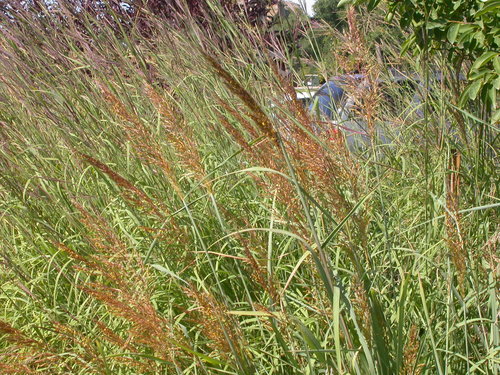
Sorghastrum is a genus of warm-season grasses in the family Poaceae, placed in the order Poales. Commonly known as Indiangrasses, members of this genus are perennial bunch grasses native to Africa and the Americas, with the genus spanning from Canada south through the United States, Mexico, Central America, and South America to Argentina and Uruguay, as well as across sub-Saharan Africa from Senegal east to Tanzania and south to South Africa.
The genus was described by the American botanist George Nash in 1901, published in N. L. Britton's Manual of the Flora of the Northern States, and currently comprises approximately 17–29 species depending on taxonomic treatment. Sorghastrum belongs to the tribe Andropogoneae (the sorghum alliance), which also includes maize, sugarcane, and sorghum, and shares the characteristic paired spikelets typical of that tribe.
The best-known member is Sorghastrum nutans (Yellow Indiangrass), a tall, clump-forming prairie grass native across much of Canada, the United States, and Mexico. It is a dominant component of the North American tallgrass prairie and is widely used in ecological restoration, native plantings, and ornamental horticulture for its showy golden seed heads in autumn. Other notable species include Sorghastrum secundum (Lopsided Indiangrass) of the southeastern United States and Bahamas, and Sorghastrum setosum (Sandysoil Indiangrass), distributed through the Caribbean and from Mexico to Uruguay.
Etymology
The genus name Sorghastrum means "false sorghum" or "sorghum-like," combining Sorghum (the related cereal grass genus) with the Latin suffix -astrum, denoting resemblance or an inferior likeness. This reflects the genus's close morphological similarity to sorghum within the tribe Andropogoneae.
Distribution
Sorghastrum is native to Africa and the Americas. American species range from southern Canada and the United States south through Mexico, Central America, and the Caribbean to Argentina and Uruguay. African species occur across sub-Saharan Africa, with records from Senegal and the Central African Republic in the west to Tanzania, Zambia, Malawi, Mozambique, Angola, Botswana, Namibia, Zimbabwe, and Limpopo in the south and east.
Ecology
Many Sorghastrum species are warm-season (C4) perennial bunch grasses adapted to open, seasonally dry habitats. Sorghastrum nutans is a keystone grass of North American tallgrass, mixed-grass, and oak savanna ecosystems, where it is an important forage species for grazing mammals and provides dense nesting cover for ground-nesting birds. The genus tolerates a wide range of soils and is notably drought-tolerant once established.
Cultivation
Sorghastrum nutans is the most widely cultivated species and is valued in ornamental horticulture and ecological restoration plantings across North America. It performs best in full sun on well-drained to moderately fertile soils, tolerating both clay and sandy conditions, and is highly drought-tolerant once established. It is commonly used in prairie restorations, rain gardens, and naturalistic landscape designs, and several cultivars with distinctive foliage or seed-head colour are commercially available.

