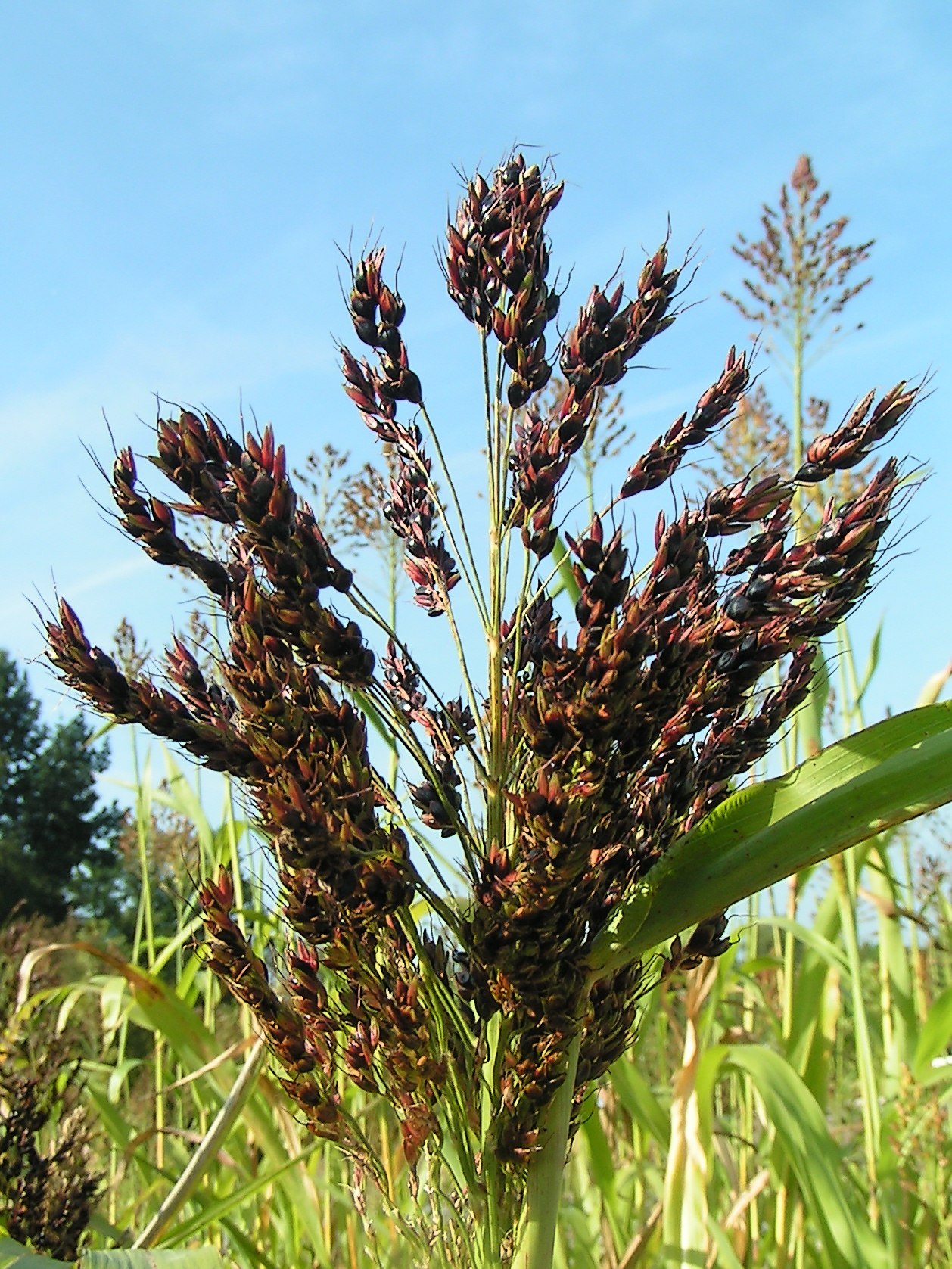
Sorghum is a genus of large, stout grasses in the family Poaceae (order Poales), comprising roughly 25 species native primarily to Africa and the Indian subcontinent. Plants typically grow up to 2.4 metres tall, forming clumps with broad leaf blades and large terminal panicles (flowerheads) that can carry up to 3,000 starchy seeds each. Most cultivated forms are annuals, though several wild species are perennial.
The genus sits within the PACMAD clade of grasses, making it more closely related to maize and the millets than to wheat or barley. The most economically significant member, Sorghum bicolor, is the world's fifth-most important cereal crop after rice, wheat, maize, and barley, with global production of around 57 million tonnes per year (2023). It is a staple food across sub-Saharan Africa, South Asia, and Central America, valued especially in arid and semi-arid regions because most varieties are exceptionally drought- and heat-tolerant, nitrogen-efficient, and able to recover after moisture stress.
Beyond grain, the genus includes sweet sorghum types grown for sugar-rich syrup and biofuel feedstock, broomcorn varieties whose panicle stalks are harvested for broom bristles, and forage types (notably S. drummondii, Sudan grass) that provide livestock feed across tropical regions. Sorghum halepense (Johnsongrass) is a widespread and persistent weed in warm-climate agriculture.
Sorghum has been in continuous cultivation for over 5,000 years, with S. bicolor first domesticated in eastern Sudan. It spread to the Indian subcontinent roughly 4,000 years ago, reached West Africa around 3,000 years ago, and was carried across the Arab world and into Spain during the medieval Arab Agricultural Revolution. Today the United States is the largest single producer, followed by Mexico, Ethiopia, and India.
Etymology
The English name sorghum derives from Italian sorgo, which traces back to 12th-century Medieval Latin surgum or suricum. This in turn is likely from Latin syricum, meaning "[grass] of Syria," reflecting early European knowledge of the plant as something exotic from the eastern Mediterranean world.
Distribution
Sorghum is native to Africa and the Indian subcontinent, with the centre of domestication in eastern Sudan. Wild species remain distributed across sub-Saharan Africa, while cultivated forms have spread to tropical, subtropical, and semi-arid regions worldwide. Major producing countries today include the United States, Mexico, Ethiopia, Nigeria, and India.
History
Sorghum bicolor was domesticated more than 5,000 years ago near the Rivers Atbara and Gash in eastern Sudan, with archaeological evidence from sites near Kassala dating to 3500–3000 BCE. Sorghum bread from Predynastic Egyptian graves (~5,100 years ago) is held in the Egyptian Museum, Turin. Over subsequent millennia, cultivation spread to the Indian subcontinent (~4,000 years ago) and West Africa (~3,000 years ago). During the Arab Agricultural Revolution of the Middle Ages, sorghum reached the Arab world and Al-Andalus. In the 19th century, sweet sorghum attracted significant interest as a potential sugar source in northern United States markets.
Cultivation
Sorghum is typically grown as an annual in warm climates on a wide range of soils (pH 5.0–8.5, from heavy clay to sandy). The optimal growing temperature is 12–34 °C and the season lasts approximately 115–140 days. Most production is by smallholder farmers in developing countries without synthetic inputs; the crop competes effectively with weeds by exuding sorgoleone. It requires rotation with legumes or a two-year fallow. About 194 improved cultivars are in use globally. Primary uses are grain for human food, animal feed (especially poultry), brewing, biofuel ethanol, and sweet sorghum syrup. Pests include over 150 insect species and the parasitic weed Striga hermonthica; pathogens include the anthracnose fungus Colletotrichum sublineolum and ergot.
Cultural Uses
Sorghum has extensive culinary and material uses across cultures. The grain is ground into flour for flatbreads (Indian jōḷada roṭṭi, tortillas), porridge, and couscous, and can be popped in hot oil. In South Africa it is fermented with lactic acid bacteria to produce sour malwa beer; in China and Taiwan it is a primary ingredient in Kaoliang baijiu. In Nigeria, red leaf-sheaths dye leather; in Algeria, sorghum dyes wool. In India, panicle stalks serve as broom bristles. In Australian Aboriginal cultures of the Northern Territory (Dagoman people), sorghum species (S. intrans, S. plumosum) hold spiritual significance. Korean folklore associates the redness of sorghum stalks with a tiger's blood.










