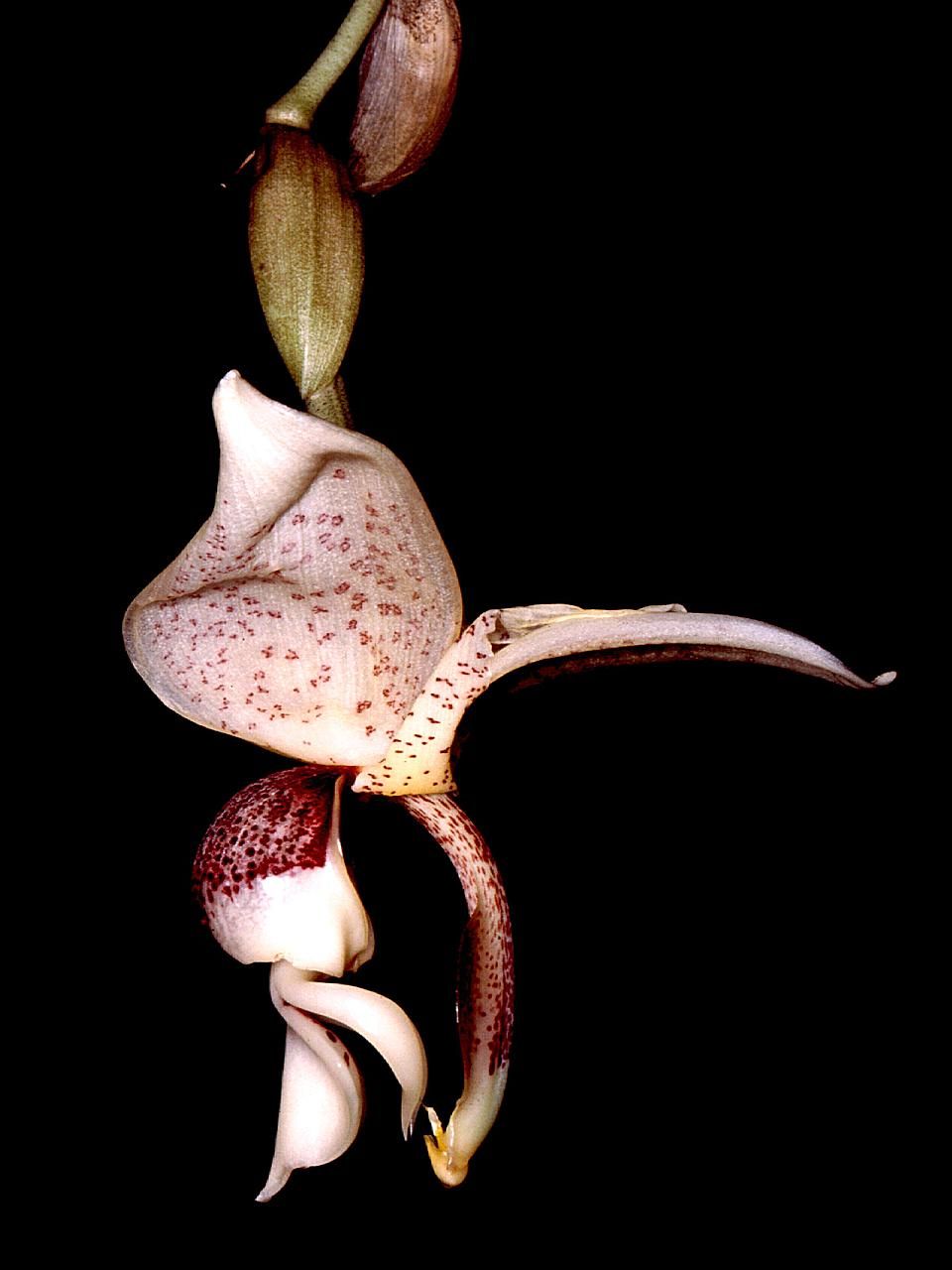
Stanhopea is a genus of approximately 55 orchid species and 5 natural hybrids in the family Orchidaceae, distributed from Mexico south through Central America to Trinidad and northwestern Argentina. The plants grow in damp, humid forests and are predominantly epiphytic, anchoring to tree trunks and branches, though some individuals occasionally grow terrestrially.
The genus is immediately recognizable by its ovate pseudobulbs, each topped by a single long, plicate, elliptic leaf. Its most distinctive trait is the pendant inflorescence, which grows downward and emerges through or from the bottom of the growing container — a habit that gives rise to the popular name "upside-down orchids." Growers must cultivate Stanhopea in open-slatted baskets or net pots specifically to allow these downward-hanging flower spikes to develop unobstructed.
The flowers are among the most spectacular in the orchid family, typically large, richly patterned, and intensely fragrant, with most species producing blooms that bear prominent, elegant horns on the epichile (the front lobe of the lip). Five species in the genus entirely lack these horns, while a second group bears short or truncated ones. Despite their visual impact, the flowers are notably ephemeral, lasting only three days or less before fading. This brevity is offset by the sheer spectacle of the open flowers, which can be remarkably large and powerfully scented.
Pollination is carried out by male euglossine bees (orchid bees), which are drawn to chemical attractants produced in the hypochile (the base of the lip). A visiting bee lands on the waxy, slippery surface of the lip and slides down, making contact with the column and inadvertently picking up or depositing pollinia. Some species are thought to exploit chemical mimicry, producing scent compounds that resemble female bee pheromones, thus drawing in males that would otherwise receive no reward.
The majority of species are robust and adapt well to cultivation, making Stanhopea a popular choice among orchid enthusiasts despite — or perhaps because of — its unconventional flowering habit.
Etymology
The genus name Stanhopea commemorates Philip Henry Stanhope, 4th Earl Stanhope (1781–1855), an English nobleman who served as president of the Medico-Botanical Society of London from 1829 to 1837. The genus was formally described by J. Frost and published by W.J. Hooker in Curtis's Botanical Magazine in 1829 (Bot. Mag. 56: t. 2948). The horticultural abbreviation used in cultivation and registration contexts is Stan.
Distribution
Stanhopea species are native to a broad belt of the Neotropics, ranging from Mexico through Central America and the Caribbean (including Trinidad) southward to northwestern Argentina. The center of diversity lies in the humid tropical and subtropical forests of Colombia, Ecuador, Peru, and Venezuela. Species grow primarily in damp, montane and lowland forests, where they colonize tree branches and trunks as epiphytes.
Ecology
Stanhopea species are predominantly epiphytic, securing themselves to host trees in damp forest habitats from Mexico to northwestern Argentina. Occasional individuals grow terrestrially. The genus has an intimate and highly specialized relationship with male euglossine bees (orchid bees). Bees are attracted by chemical compounds produced in the hypochile of the flower; they land on the waxy, slippery lip surface and slide toward the column, collecting pollinia in the process. Some species appear to employ chemical deception, producing scent compounds that mimic female bee pheromones and thus attract males without providing a nutritional reward. Eulaema meriana is one documented pollinator. Because each Stanhopea species produces a distinct chemical blend, the pollination system acts as a reproductive isolating mechanism, helping to maintain species boundaries within the genus.
Cultivation
Stanhopea species are widely regarded as among the more straightforward orchids to cultivate, with the majority of species described as robust and free-growing under appropriate conditions. The single most important requirement is the container type: because the inflorescences grow downward and emerge from the base or sides of the potting medium, plants must be grown in open-slatted wooden baskets, wire baskets, or net pots. Standard pots prevent the flower spikes from emerging and will result in failed blooms. A coarse, fast-draining medium such as bark, sphagnum moss, or a bark-and-perlite mix is typically used. Plants generally require bright, indirect light, high humidity, regular watering during the growing season, and a modest dry-down period in cooler months to initiate flowering. Being native to humid Neotropical forests, they benefit from good air circulation.
Propagation
Stanhopea can be propagated by division of the pseudobulb clumps, separating back bulbs or actively growing sections at repotting time. Each division should retain at least two to three pseudobulbs to ensure vigorous re-establishment. Given the pendant inflorescence habit, divisions must be returned immediately to open basket culture.
Taxonomy
Stanhopea belongs to the family Orchidaceae, subfamily Epidendroideae, tribe Cymbidieae, and subtribe Stanhopeinae. The accepted name is Stanhopea J.Frost ex Hook., published in 1829. The type species is Stanhopea insignis. Synonyms referred to this genus include Ceratochilus, Stanhopeastrum, Gerlachia, and Tadeastrum. GBIF records approximately 125 names (accepted species plus synonyms and infraspecific taxa) under the genus; the count of accepted species is 55, plus 5 natural hybrids.










