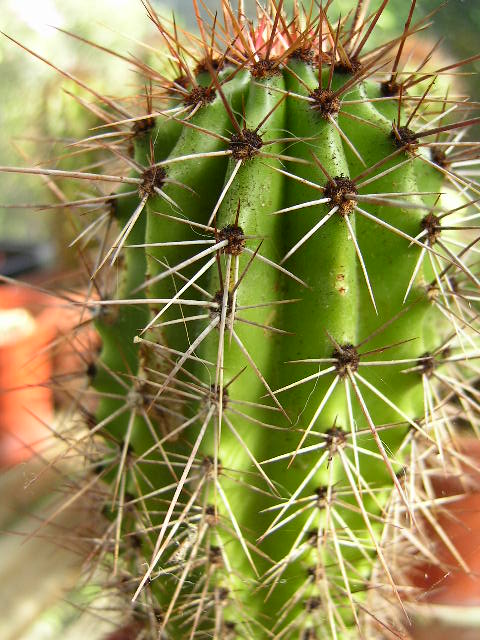
Stenocereus is a genus of columnar cacti in the family Cactaceae, comprising approximately 25 accepted species of large, tree-like or shrubby succulents native to the arid and semi-arid regions of the Americas. Plants grow as erect, arching, or occasionally prostrate columnar stems reaching over 15 meters in height, with trunks up to 40 cm in diameter. The stems bear 4–20 prominent ribs, either rounded or strongly tuberculate, lined with woolly areoles that produce clusters of strong spines — up to 28 per areole, with central spines reaching 7.5 cm.
Flowers are typically nocturnal, though some species bloom by day. They are solitary, funnel- to bell-shaped, 4–12 cm long, with inner tepals ranging from white or rose to rarely yellow or red. The fleshy fruits are globose to ovoid (3–8 cm), green to red when ripe, often remaining spiny, and contain edible pulp in white, red, or purplish tones. Seeds are large and glossy dark.
The genus is regarded as generally easy to cultivate and tends to grow slowly. Species are valued both ecologically — providing food and shelter for desert fauna — and ethnobotanically, with multiple indigenous peoples across Mexico, Central America, and the Caribbean harvesting the sweet and sour fruits and using the woody stem interiors as construction material. Several species are widely grown as ornamentals in hot, arid gardens worldwide.
Etymology
The genus name Stenocereus combines the Ancient Greek word stenós, meaning "narrow," with the Latin cēreus, meaning "candle" — a reference to the genus's slender, upright, candle-like columnar stems. The epithet Cereus was the traditional designation for columnar cacti before modern taxonomic revisions split the group into smaller, more precisely defined genera.
Distribution
Stenocereus is distributed across the arid and seasonally dry zones of the Americas. The core range is Mexico, where most species are endemic or centred, with extension northward into southern Arizona in the United States (notably the Sonoran Desert). The genus also occurs along the Pacific and Gulf coasts of Central America, into Colombia, Venezuela, and other parts of northern South America, and throughout the West Indies. The Baja California Peninsula supports several distinctive species.
Ecology
Stenocereus cacti are keystone plants of desert and dry-tropical ecosystems. Their tall columnar stems provide nesting and roosting habitat for birds, and their nectar-rich nocturnal flowers attract bats and moths as primary pollinators. The fleshy, brightly coloured fruits are consumed by birds and mammals, which disperse seeds across the landscape. The edible pulp in white, red, or purplish varieties sustains wildlife during dry seasons when food is scarce. The genus spans habitats from Sonoran Desert scrub in Arizona and Baja California through dry tropical forests in Central America and the Caribbean.
Cultivation
Stenocereus species are valued ornamentals in xeriscaping and succulent gardens in hot, arid climates. They are generally considered easy to grow and are slow-growing, making them suitable for low-maintenance landscape use. They prefer well-drained soils, full sun, and minimal supplemental water once established, typical requirements shared with other columnar cacti.
Cultural Uses
Stenocereus species have been important to indigenous and local peoples throughout their range. The Seri people of the Sonoran coast prize the fruit of S. gummosus, calling the cactus "thing whose fruit is sour" in their language; fruits are eaten fresh and processed. The Wayuu people of Colombia and Venezuela relish the fruit of S. griseus, known locally as iguaraya. More broadly, the dried, woody interior of mature Stenocereus stems — tough and cane-like — has been used in construction, most notably in the wattle-and-daub wall technique (yotojoro) practiced by Wayuu communities. Several species are also grown as ornamental plants in gardens across hot, arid regions of the world.
Taxonomy
Stenocereus was formally established by Alwin Berger and Vincenzo Riccobono, with the combination published by Riccobono in 1909 in Bollettino del R. Orto Botanico di Palermo (8: 253). The genus is placed in the family Cactaceae, subfamily Cactoideae, tribe Echinocereeae, within the order Caryophyllales. The type species is Stenocereus stellatus.
In the 19th century, ribbed columnar cacti were broadly assigned to Cereus. The early 20th-century work of Britton and Rose (1909; 1919–1923) dismembered this aggregate into smaller genera, creating several names later synonymised under Stenocereus — among them Hertrichocereus, Machaerocereus, Neolemaireocereus, Rathbunia, and Ritterocereus. Modern molecular phylogenetic studies refined circumscription further, using diagnostic characters including silica bodies, distinctive pearl cells in fruit pulp, and oleanane triterpenes in stem tissue. GBIF recognises 25 accepted species; some botanical treatments cite 18–20.










