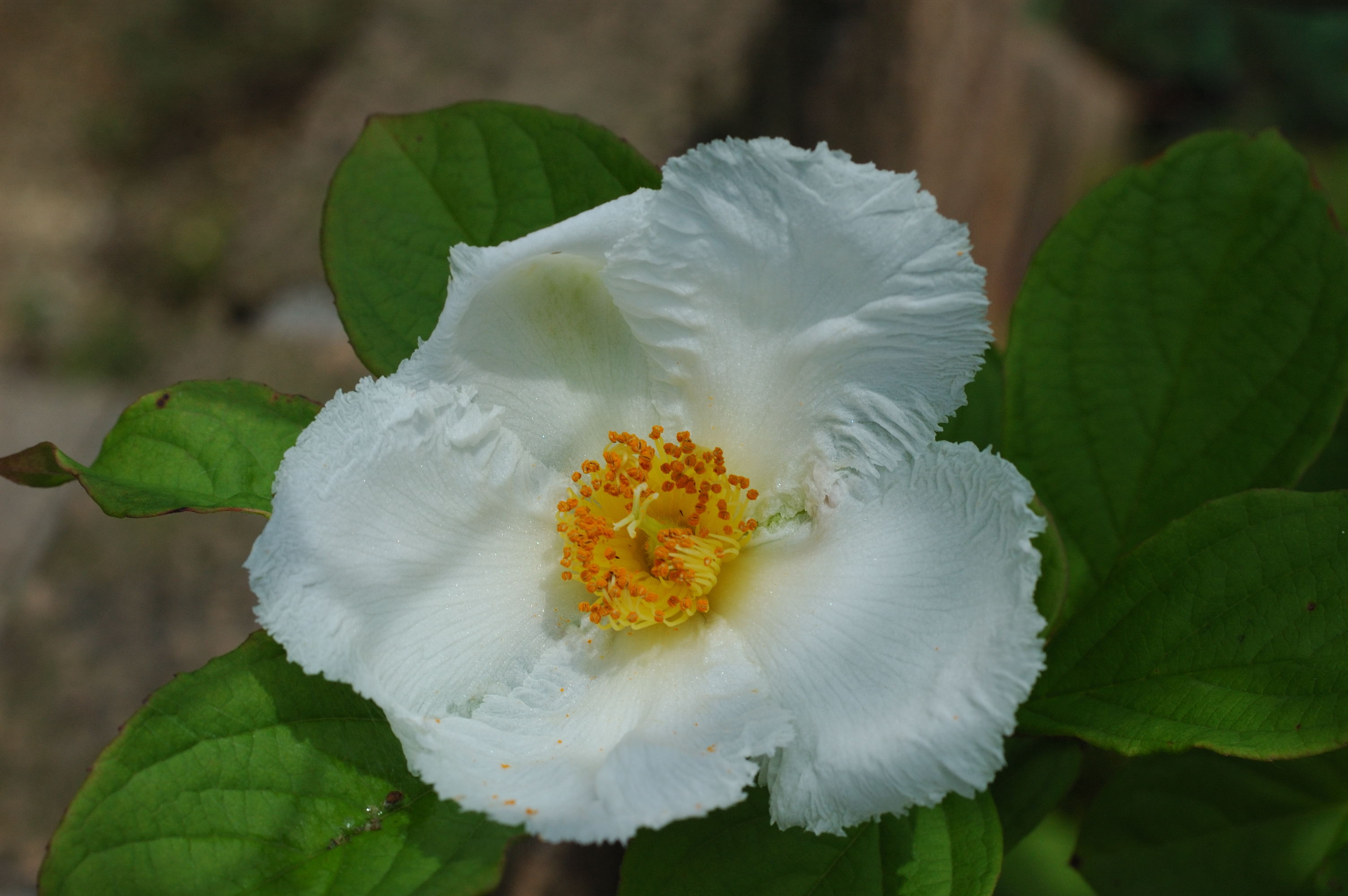
Stewartia is a genus of 8–20 species of flowering shrubs and trees in the family Theaceae (order Ericales), closely related to Camellia. The genus has a disjunct distribution, with most species native to eastern Asia — spanning China, Japan, Korea, Laos, Myanmar, Thailand, and Vietnam — and two species, S. malacodendron and S. ovata, found in southeastern North America from Virginia and Kentucky south to Florida and Louisiana.
Members of Stewartia are mostly deciduous, though a small group of evergreen Asian species (including S. pteropetiolata) is sometimes segregated into the separate genus Hartia. The Asian species range from shrubs to trees reaching 3–20 metres tall; the North American species are shrubs typically 3–5 metres tall, rarely becoming small trees. One of the genus’s most distinctive features is its bark: smooth, orange to yellow-brown, and peeling in fine flakes, making it ornamentally striking even in winter. Leaves are alternately arranged, simple, serrated, usually glossy, and 3–14 cm long.
The flowers are large and showy, 3–11 cm in diameter, with five (occasionally six to eight) white petals, and bloom in mid to late summer — a season when few other woody plants are in flower. The fruit is a dry five-valved capsule containing one to four seeds per section.
The genus was first described by Isaac Lawson in 1753, with Stewartia malacodendron as the type species. Several species are cultivated as ornamental plants, prized for their decorative bark, summer flowers, and, in deciduous species, autumn foliage colour.
Etymology
The genus name Stewartia honours John Stuart, 3rd Earl of Bute, an 18th-century British statesman and botanist. A transcription error led Linnaeus to record the name as “Stewart” rather than “Stuart”, and he consistently spelled the genus Stewartia in all subsequent publications. Some botanists, particularly in the UK, historically preferred the spelling Stuartia, but Stewartia is now accepted as correct by virtually all systematic botanists and major horticultural authorities.
Distribution
Stewartia is distributed across two widely separated regions. The majority of species are native to eastern Asia, occurring in China, Japan, Korea, Laos, Myanmar, Thailand, and Vietnam. Two species — S. malacodendron and S. ovata — occur in southeastern North America, from Virginia and Kentucky south to Florida and Louisiana.
Cultivation
Several Stewartia species are cultivated as ornamental trees and shrubs, valued for their smooth, flaking orange-brown bark, their large white flowers (borne in mid to late summer when few other trees bloom), and, in deciduous species, their autumn foliage colour. They require acidic soils and do not tolerate chalk or calcium-rich substrates. The genus also has a high moisture requirement and will not withstand prolonged drought.
Taxonomy Notes
The genus was described by Isaac Lawson in 1753, with Stewartia malacodendron L. as the type species, and is placed in family Theaceae, order Ericales. Some botanists recognise the evergreen Asian species as a separate genus, Hartia, on the basis of their genetic distinctiveness; others retain them within Stewartia. The alternate spelling Stuartia was almost universally used during the 19th century but is now considered an unjustified orthographic correction under the International Code of Botanical Nomenclature.










