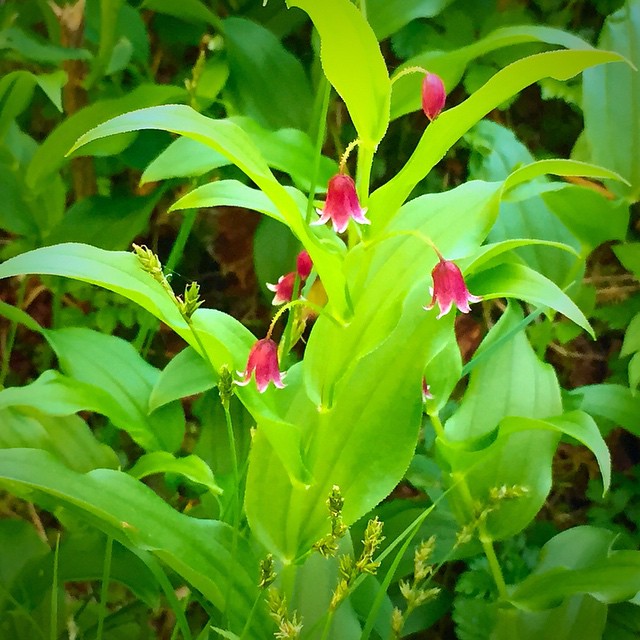
Streptopus, commonly known as twistedstalk, is a genus of perennial flowering herbs in the family Convallariaceae (lily family), native to temperate and boreal regions of Eurasia and North America. The genus is one of the shade-loving members of its family, typically inhabiting cool, moist woodland understories and mountainous terrain.
Plants spread by means of underground rhizomes and produce simple, alternate leaves that clasp or sheath the stem. Flowers are characteristically small — white, greenish-yellow, or rose-coloured — and are borne singly or in pairs on slender, noticeably twisted or geniculate peduncles, which give the genus both its scientific and common names. The flowers hang below the foliage, often making them easy to overlook. Fruits are small berries.
The genus ranges across a wide arc from central and southern Europe and the Russian Far East through Siberia, the Himalayan region (Nepal, Bhutan, Sikkim), Korea, and China, and across North America from Alaska and Arctic Canada through the Great Lakes region, the Appalachians, and the Cascade and Rocky Mountain ranges. Individual species vary considerably in their precise ranges; Streptopus amplexifolius is the most widely distributed, spanning both Eurasia and North America, while several Asian species have narrow endemic ranges.
Within Convallariaceae, Streptopus is placed among the shade-tolerant genera adapted to forest floor habitats. The roughly ten accepted species include S. amplexifolius, S. lanceolatus, S. streptopoides, and S. simplex, among others.
Etymology
The genus name Streptopus is a compound of the Greek adjective στρεπτός (streptos), meaning "twisted," and the noun πούς (pous), meaning "foot." This refers to the distinctively twisted or geniculate peduncle — the flower stalk — a feature that also gives rise to the common name "twistedstalk."
Distribution
Streptopus is distributed across Eurasia and North America, with species occurring in central and southern Europe, Siberia, the Russian Far East, Japan (Hokkaido), Korea, China, Nepal, Bhutan, Sikkim, and across Canada and the United States (including Alaska, the Great Lakes region, the Appalachians, and the Cascade and northern Rocky Mountain ranges). Most species favour colder and temperate regions, particularly moist montane and boreal woodland habitats.
Ecology
Members of Streptopus are shade-tolerant perennial herbs of cool, temperate forest understories and montane zones. They spread vegetatively by underground rhizomes and bloom with inconspicuous flowers hidden beneath the leaves, which are likely pollinated by insects. The small berries that follow are potentially dispersed by birds and mammals.










