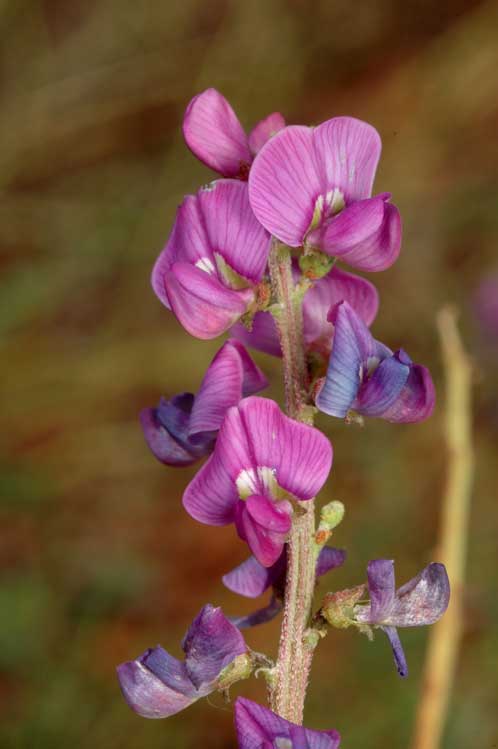
Swainsona is a genus of approximately 85 species of flowering plants in the family Fabaceae (legumes), order Fabales, and is endemic to Australia. The genus encompasses annual and perennial herbs and subshrubs, ranging from prostrate to erect in habit and often producing many stems from the base.
The leaves are characteristically imparipinnate — pinnate with a terminal leaflet — bearing few to many leaflets and a pair of stipules at the base of the petiole. Flowers are arranged in racemes carried on erect peduncles arising from leaf axils, with bracts at the peduncle base and small bracteoles near the sepals. The calyx is bell-shaped, formed by five joined sepals with equal lobes or the upper two slightly shorter. Petals are predominantly purple, though white, pink, yellow, orange, and red forms occur across the genus. The standard petal is kidney-shaped to nearly round and is typically longer than the wing or keel petals. Ten stamens are present, nine of which are fused into a tube with the tenth free and positioned facing the standard — a characteristic legume arrangement.
Swainsona is most closely related to the New Zealand genera Montigena (scree pea), Clianthus (kakabeak), and Carmichaelia (New Zealand broom), reflecting a Gondwanan connection between Australian and New Zealand legume lineages. Species are distributed across all six Australian states, the Northern Territory, and the Australian Capital Territory, occupying a wide range of habitats. Several species, including Swainsona galegifolia (smooth Darling pea), are familiar components of inland Australian flora. A subset of species produce swainsonine, an indolizidine alkaloid phytotoxin that causes neurological damage in grazing livestock; affected animals in Australia are colloquially described as "pea struck."
The genus was first formally described in 1806 by Richard Anthony Salisbury in Paradisus Londinensis, with Swainsona coronillifolia designated as the type species (now treated as a synonym of Swainsona galegifolia). The name honours Isaac Swainson, an English botanist and horticulturalist.
Etymology
The genus name Swainsona was given in honour of Isaac Swainson, an English botanist. It was formally established in 1806 by Richard Anthony Salisbury in Paradisus Londinensis, with Swainsona coronillifolia (now a synonym of Swainsona galegifolia) as the type species.
Distribution
Swainsona species are found across the entire Australian continent, occurring in all six states as well as the Northern Territory and the Australian Capital Territory. The genus is strictly endemic to Australia.
Ecology
Some species within Swainsona produce swainsonine, an indolizidine alkaloid that inhibits the enzyme alpha-mannosidase and causes lysosomal storage disease in grazing animals. Affected livestock in Australia are described as "pea struck." The same compound is responsible for the locoweed syndrome observed in related legumes in North America.
Taxonomy Notes
Swainsona belongs to the legume family Fabaceae, order Fabales. Phylogenetically it is most closely related to the New Zealand genera Montigena (scree pea), Clianthus (kakabeak), and Carmichaelia (New Zealand broom), indicating a trans-Tasman relationship within the broader legume tribe. The genus was accepted with approximately 85 species per Plants of the World Online (as of 2023); GBIF records 108 descendant taxa.

