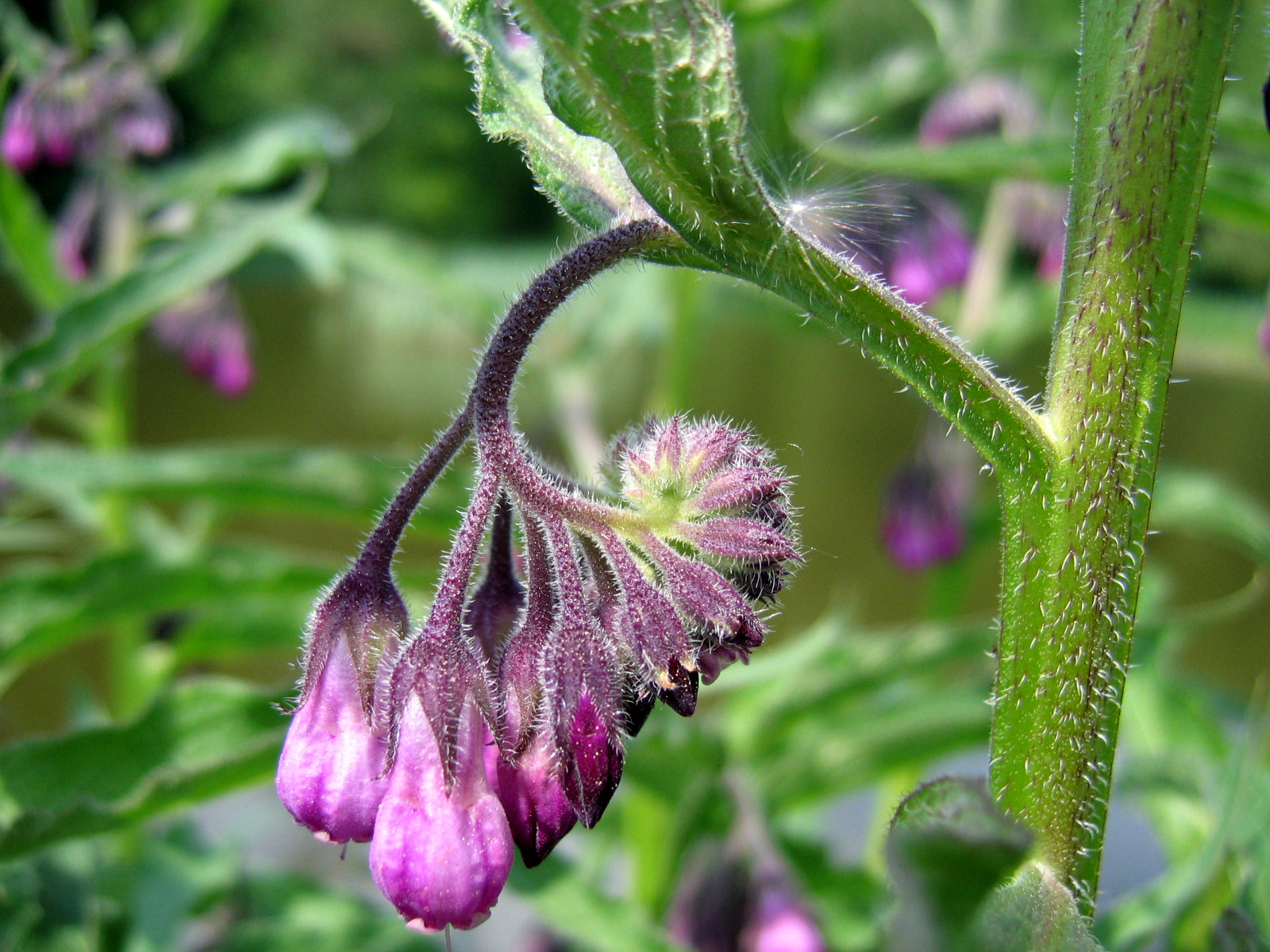
Symphytum, commonly known as comfrey, is a genus of flowering, herbaceous perennials in the family Boraginaceae, order Boraginales. Around 27 species are currently recognized, though botanists have cataloged more than 150 names historically. The genus was formally established in 1753 by Linnaeus, with Symphytum officinale serving as the type species.
Plants are native to the temperate regions of Europe and Asia, where they occupy moist habitats such as riverbanks, meadows, and disturbed ground. Several species and the widely grown hybrid Symphytum × uplandicum (Russian comfrey) have naturalized broadly across the Americas and other temperate parts of the world. Stems and leaves are characteristically bristly or rough-hairy, and flowers are tubular, nodding, and typically purple, blue, pink, or white, borne in one-sided scorpioid cymes typical of the borage family.
Comfreys are valued in horticulture and organic gardening for their ability to accumulate nutrients — particularly potassium — making the leaves useful as a compost activator or liquid fertilizer. The sterile cultivars "Bocking 4" and "Bocking 14", developed in the 1950s by Lawrence D. Hills of the Henry Doubleday Research Association, are especially popular because they cannot set seed and thus do not spread uncontrolled. Propagation is straightforward through root cuttings or crown division; once established, plants are long-lived and difficult to eradicate.
The genus has a long history of medicinal use. Folk names such as knitbone, boneset, and bruisewort record the historical belief that comfrey could heal broken bones and wounds. This reputation rests partly on the plant's content of allantoin, a compound known to promote cell proliferation and tissue repair. However, all parts of the plant also contain pyrrolizidine alkaloids, which are hepatotoxic with cumulative effects; roots contain the highest concentrations. In 2001 the US FDA banned comfrey products intended for internal use and issued caution advisories for external preparations, and use is generally discouraged in pregnancy, lactation, infancy, and for people with liver or kidney conditions.
Etymology
The genus name Symphytum is derived from two Greek words: symphytis, meaning "a growing together of bones," and phyton, meaning "plant." This etymology directly encodes the plant's ancient reputation as a bone-healer.
The common name "comfrey" traces to the Latin confervere, meaning "to heal" or literally "to boil together," again referencing medicinal applications known since antiquity. Several well-known folk names — knitbone, boneset, bruisewort — record the same belief in the plant's power to mend broken bones and damaged tissue.
Distribution
Symphytum is native to temperate Europe and Asia. Species are found from Western Europe across to the Caucasus and into western Asia. Within Europe, Switzerland alone records seven species and one hybrid: S. asperum, S. bulbosum, S. grandiflorum, S. officinale, S. tauricum, S. tuberosum, and the hybrid S. × uplandicum.
Several species, particularly the cultivated hybrid Russian comfrey (S. × uplandicum), have been introduced and have naturalized across the Americas and other temperate regions. In Britain, comfrey is occasionally naturalized in waste places and along roadsides.
Ecology
Symphytum species are fast-growing herbaceous perennials that thrive in moist, nutrient-rich soils. They tolerate heavy clay, partial shade, and repeated cutting. Plants accumulate potassium and other minerals through deep root systems, making the foliage valuable as a compost activator and a potassium-rich liquid fertilizer particularly suited to crops like tomatoes.
The genus produces substantial biomass and can be harvested multiple times per season. Some species and cultivars can spread aggressively — either by self-seeding in wild species or by root fragments in cultivated forms — and are considered difficult to eradicate once established due to their deep, regenerative root systems.
All parts of the plant contain pyrrolizidine alkaloids alongside beneficial compounds including allantoin, mucilage, saponins, tannins, and inulin.
Cultivation
Comfreys are undemanding garden plants that perform well in most soil types, with a preference for heavy, moisture-retentive soils and partial shade, though they tolerate full sun. They are grown both ornamentally and as utilitarian crops in organic gardens, where their leaves are cut repeatedly and added to compost heaps or fermented into a liquid feed.
The sterile clonal cultivars "Bocking 4" and "Bocking 14" were developed during the 1950s by Lawrence D. Hills at the Henry Doubleday Research Association (now Garden Organic). Because they cannot produce viable seed, they do not self-seed and remain where they are planted, making them the preferred forms for garden use.
Cultural Uses
Comfrey has been used in European folk medicine for centuries. Leaves and roots were applied externally as poultices to treat cuts, bruises, sprains, and fractures. The presence of allantoin — a compound that promotes cell proliferation — provides a pharmacological basis for these topical effects. Leaf tea was historically taken internally for chest complaints.
Young leaves and shoots have also been eaten: leaves are edible raw or cooked (though hairy texture limits palatability), young shoots have been used as an asparagus substitute, and dried leaves have been brewed as tea. Peeled roots can be added to soups or roasted as a coffee substitute.
Regulatory bodies including the US FDA have classified internal comfrey preparations as unsafe due to the cumulative liver toxicity of pyrrolizidine alkaloids and banned them for internal sale in 2001. External use is permitted with caution advisories, and use during pregnancy, lactation, infancy, or by people with liver or kidney disease is discouraged.
Taxonomy Notes
The genus Symphytum L. was formally described by Linnaeus in 1753 and is placed in the family Boraginaceae, subfamily Boraginoideae, order Boraginales. Approximately 27 species are currently accepted; the GBIF backbone recognizes 80 descendant records (including synonyms and infraspecific taxa). The type species is Symphytum officinale L.
The genus-level synonym Consolida Riv. ex Ruppius (published 1745) is recorded in GBIF as a synonym of Symphytum. Several interspecific hybrids are recognized, the most horticulturally significant being S. × uplandicum Nyman (prickly comfrey × common comfrey).
Propagation
Symphytum can be propagated from seed sown in spring or autumn in cold frames, though most cultivated forms are sterile hybrids that must be propagated vegetatively. Root cuttings and crown division are the primary methods: sections of root chopped and buried just below soil level will regenerate into new plants reliably. Division can be carried out at almost any time of year. Because root fragments left in the soil will also regenerate, removal of established plants is difficult.










