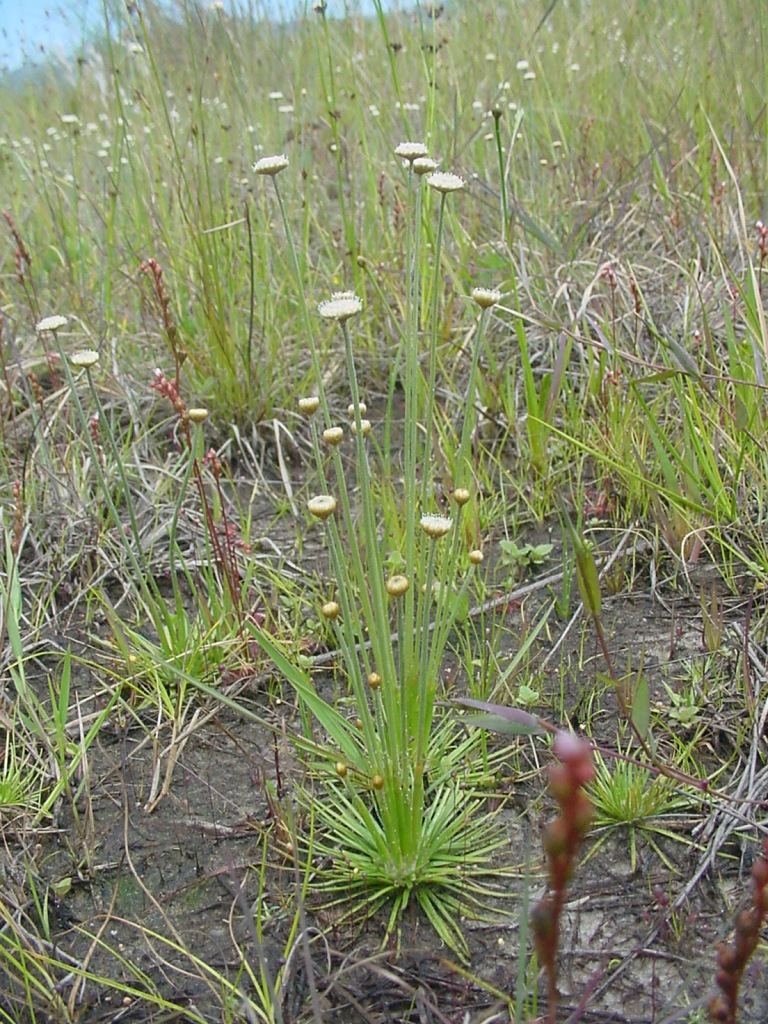
Syngonanthus is a genus of flowering plants in the family Eriocaulaceae, a family of rush-like monocots placed in the order Poales. The genus contains approximately 146 accepted species of small, tufted herbs, commonly known as pipeworts or button flowers, characterised by slender scapes bearing small, compact flower heads that often appear white, cream, or pale yellow and are frequently papery or woolly in texture.
The genus has a disjunct distribution spanning tropical Africa and Latin America. In the New World it ranges from Mexico and Cuba south through Central America, the Antilles, and across South America to Argentina. The overwhelming concentration of diversity, however, lies in Brazil — particularly in the campos rupestres and cerrado vegetation of Minas Gerais state, where dozens of endemic species grow in wet, nutrient-poor, seasonally flooded, or rocky grassland habitats. A smaller contingent of species occurs in sub-Saharan Africa, with records from Central Africa (Democratic Republic of Congo, Angola, Zambia, Tanzania) through to West Africa and a single species reaching Madagascar.
Syngonanthus belongs to the subfamily Eriocauloideae within Eriocaulaceae alongside the related genera Eriocaulon and Paepalanthus. The family as a whole is noted for its adaptation to oligotrophic, often waterlogged soils and for the ecological prominence of its members in the Brazilian campos rupestres, a biodiversity hotspot threatened by agricultural expansion and mining. Several species in the genus, including Syngonanthus nitens and Syngonanthus chrysanthus, are harvested for use in dried floral arrangements — their papery, everlasting inflorescences are traded internationally under the name "sempre-vivas" (everlastings).
Distribution
Syngonanthus is native to tropical Africa and Latin America, ranging from Mexico and Cuba south to Argentina. The centre of diversity lies in the campos rupestres and cerrado of Minas Gerais, Brazil, where the majority of species are endemic; a smaller contingent occurs across sub-Saharan Africa from the Democratic Republic of Congo and Angola east to Tanzania.
Ecology
Most species grow in oligotrophic, seasonally waterlogged or well-drained rocky grasslands, including the Brazilian campos rupestres and cerrado savannas — habitats characterised by nutrient-poor soils and high seasonal rainfall variability. The genus is well adapted to fire-maintained open vegetation and plays a notable role in these ecosystems.
Cultural Uses
Several Syngonanthus species — most notably S. nitens and S. chrysanthus — are harvested as "sempre-vivas" (everlastings) for the dried-flower trade. Their papery, long-lasting inflorescences are gathered from wild populations in Minas Gerais and exported internationally, making the genus economically significant to local communities.
Taxonomy Notes
Syngonanthus belongs to the family Eriocaulaceae, order Poales, and is accepted as a distinct genus by GBIF (key 317322395). It is closely allied to Eriocaulon and Paepalanthus within the family. The genus was established by Ruhland and comprises about 146 accepted species, with the African contingent sometimes treated as a separate clade in molecular studies.










