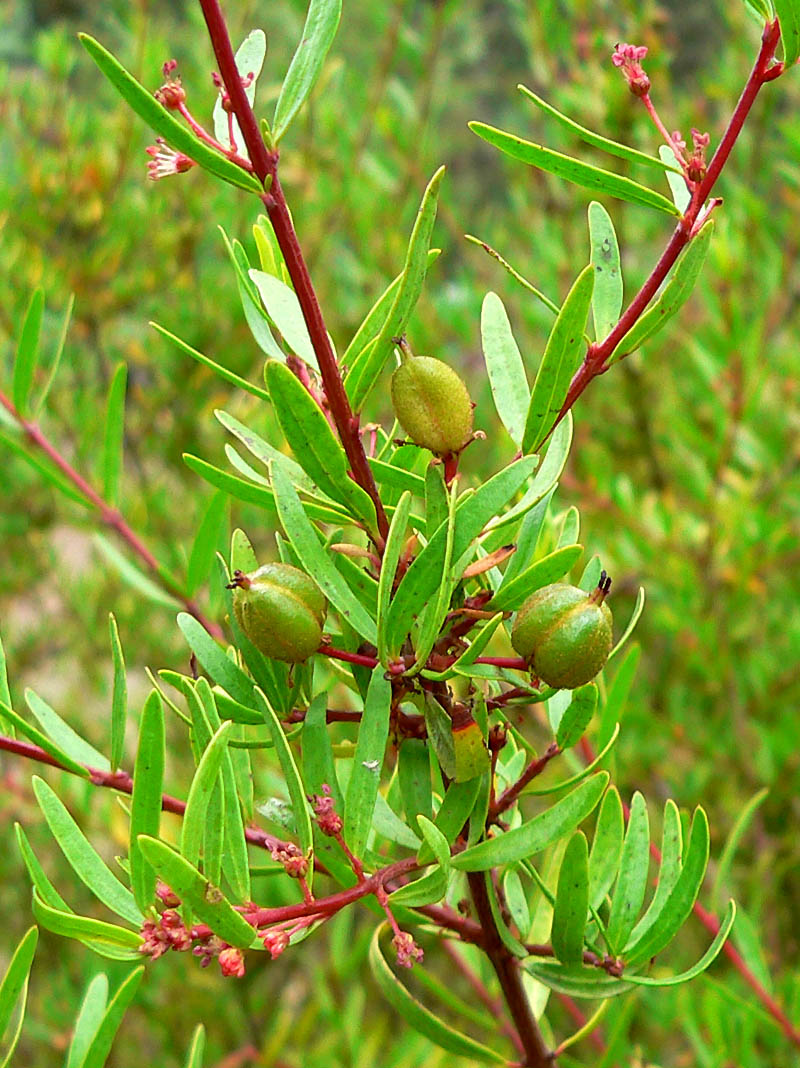
Tetracoccus is a small genus of flowering shrubs in the family Picrodendraceae, placed within the order Malpighiales. It was first described in 1885 by Charles Christopher Parry (published as Engelm. ex Parry) and currently comprises around five to six accepted species. The genus is commonly known as shrubby-spurge.
Plants in this genus are characteristically dioecious — individual shrubs bear either male or female flowers but not both — and are often covered in fine hairs. They are woody, branching shrubs adapted to arid and semi-arid conditions.
The genus is native to the desert and chaparral regions of the southwestern United States and northern Mexico, with species distributed across California, Nevada, Arizona, and the Baja California Peninsula, as well as interior Mexican states. Notable members include Tetracoccus ilicifolius, which is endemic to Death Valley National Park in the Mojave Desert, and Tetracoccus dioicus, restricted to the Peninsular Ranges of northwestern Baja California and adjacent southern California counties.
Etymology
The name Tetracoccus derives from the Greek words tetra ("four") and kokkos ("kernel" or "grain"), meaning "four seeds" — a reference to the four-seeded fruit characteristic of the genus. The genus was first described in 1885 by Charles Christopher Parry.
Distribution
Tetracoccus is native to the southwestern United States and northern Mexico. Species are found in desert and chaparral habitats, including the Mojave and Sonoran Deserts across California, Nevada, Arizona, and Baja California, as well as interior Mexican states such as Chihuahua, Durango, Nuevo León, and Puebla. Tetracoccus ilicifolius is endemic to Death Valley National Park.
Ecology
Species in this genus grow in desert scrub and chaparral habitats, tolerating arid conditions in the southwestern United States and northern Mexico. They are dioecious, requiring both male and female plants for seed set.

