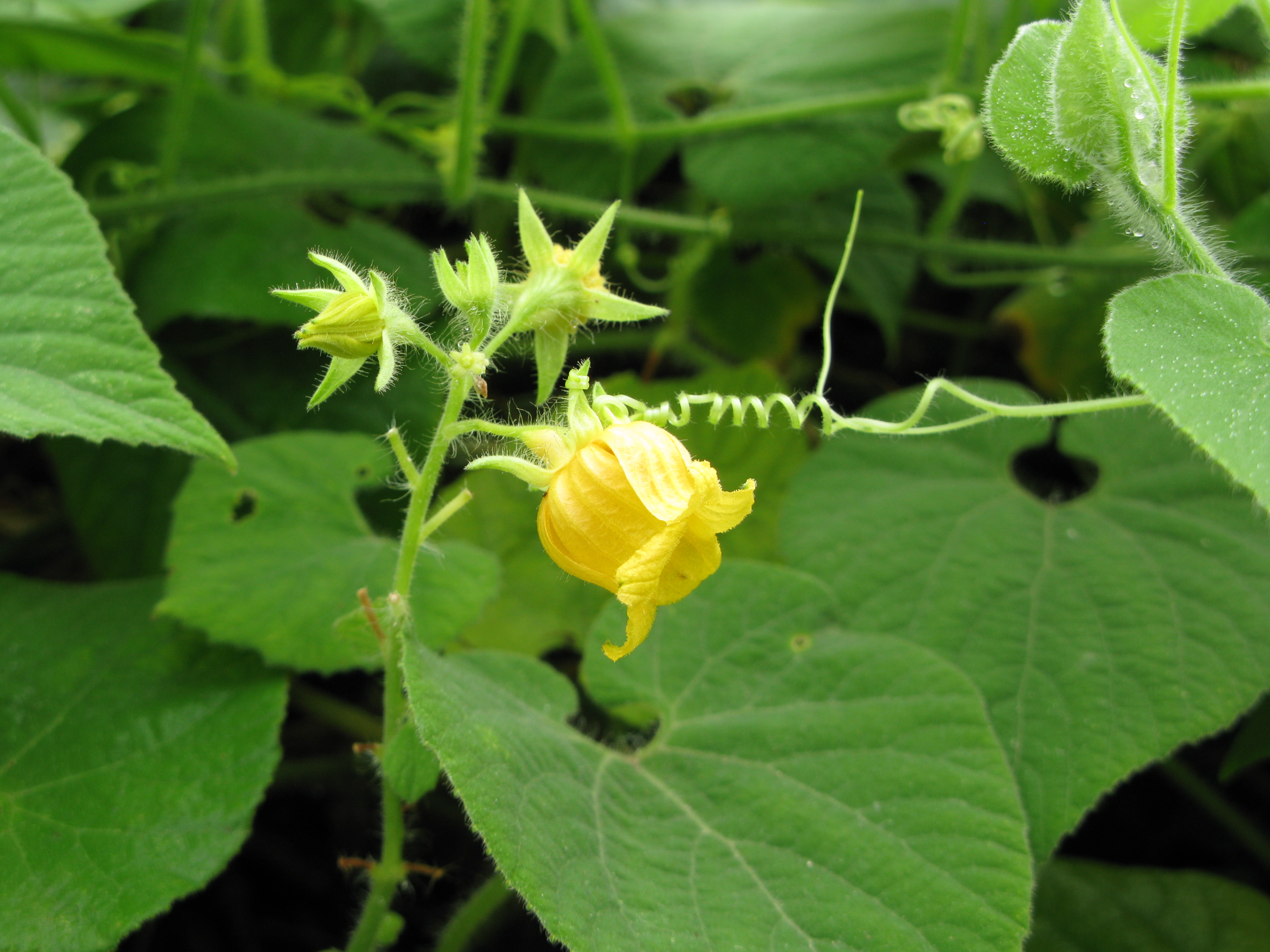
Thladiantha is a genus of roughly 25 accepted species of flowering plants in the cucumber family, Cucurbitaceae, placed in the order Cucurbitales. The genus was described by the Russian-German botanist Alexander von Bunge in 1835, based on collections from northern China. Its closest relatives within Cucurbitaceae include other Asian genera such as Siraitia and Momordica.
Members of Thladiantha are dioecious, perennial herbs — individual plants bear either male or female flowers, never both. They typically grow as climbing or scrambling vines with tendrils, producing yellow, bell-shaped flowers. The genus is notable for the presence of extrafloral nectaries in at least one species (T. cordifolia), structures that secrete nectar outside the flower and are associated with ant attendance.
The geographic range spans the Indian subcontinent, Southeast Asia, and China, with the centre of diversity in southern and central China. The most widely known species is Thladiantha dubia (Bunge), which has become naturalised as an ornamental and occasional weed in parts of Europe and North America.
Etymology
The genus name Thladiantha was coined by Alexander von Bunge in 1835. It derives from the Greek thladias (a type of eunuch or castrated figure), an allusion to the dioecious habit of the plants — male and female flowers are borne on separate individuals — together with the Greek anthos (flower).
Distribution
Thladiantha is native to a broad arc of Asia, ranging from the Indian subcontinent through mainland Southeast Asia to China, where the greatest diversity of species occurs. Thladiantha dubia has additionally become naturalised in parts of temperate Europe and eastern North America.










