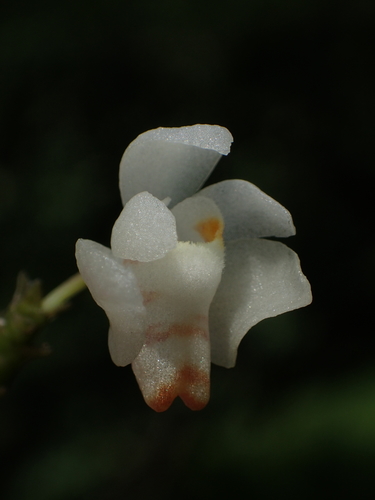
Thrixspermum is a genus of approximately 190 species of orchids in the family Orchidaceae (order Asparagales), distributed across tropical and subtropical Asia and the western Pacific. The genus was first formally described in 1790 by the Portuguese botanist João de Loureiro in his work Flora Cochinchinensis.
Members of Thrixspermum are predominantly epiphytic or lithophytic monopodial herbs, meaning they grow on other plants or rocks and produce new growth from a single, continuously elongating stem rather than from pseudobulbs. They have long, thick roots and flat, fleshy leaves arranged in two alternating ranks, with leaf bases that sheath the stem. A distinctive characteristic of the genus is its remarkably short-lived flowers, which frequently open for less than a single day. The flowers are borne on pendulous or arching stems arising from leaf axils.
The floral structure is diagnostic: sepals and petals are free from one another and largely similar in appearance, while the petals are slightly shorter than the sepals. The labellum (lip) is stiffly attached to the column and features a pouched base with three lobes — two erect, typically short and blunt side lobes and a thick, fleshy middle lobe. The fruit is a long, slender capsule, and it is the hair-like seeds that give the genus its name.
Species are found across a broad arc from the Indian subcontinent through Southeast Asia to the western Pacific islands, with representatives in China, Japan, Taiwan, the Philippines, New Guinea, northern Australia, and various Pacific archipelagos. Most grow in lowland or tropical rainforest environments up to approximately 1,200 metres in elevation.
Etymology
The genus name Thrixspermum derives from the Ancient Greek thrix (θρίξ), meaning "hair", and sperma (σπέρμα), meaning "seed", a reference to the hair-like seeds characteristic of the genus. The name was coined by João de Loureiro when he formally described the genus in 1790.
Distribution
Thrixspermum species are found throughout tropical and subtropical Asia and the western Pacific, from India (including the Andaman and Nicobar Islands), Bangladesh, Nepal, and Sri Lanka eastward through Myanmar, Thailand, Cambodia, Laos, Vietnam, Malaysia, Borneo, Indonesia, and the Philippines, continuing to China, Japan (including the Ryukyu Islands), Korea, and Taiwan, and south to New Guinea, the Solomon Islands, northern Australia (including Christmas Island), and Pacific islands such as Fiji, New Caledonia, Samoa, Vanuatu, and the Caroline Islands. About fourteen species occur in China, nine in Taiwan, and three in Australia. Most species inhabit lowland and tropical rainforest, typically below 1,200 m altitude.
Ecology
Species in Thrixspermum grow primarily as epiphytes on tree branches or as lithophytes on rocky substrates in lowland and tropical rainforest habitats, rarely as terrestrial plants. Their thick roots and fleshy leaves are adaptations to the variable moisture conditions of forest canopies. The notably fleeting flowers — often open for less than a day — suggest a pollination strategy tied to specific, short-window insect visitors, though pollination biology for most species remains poorly documented.

