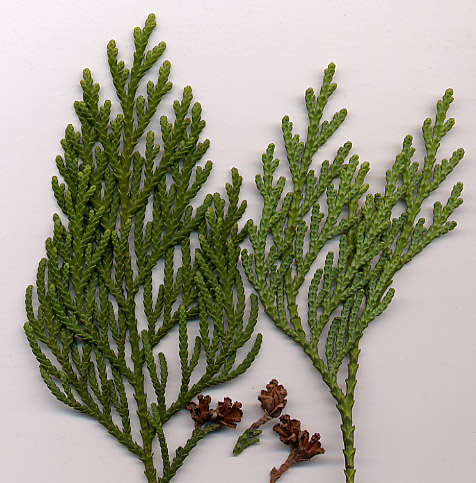
Thuja is a genus of five species of evergreen coniferous trees and shrubs in the family Cupressaceae (the cypress family), order Pinales. Two species are native to North America and three to eastern Asia, making the genus one of the few conifers with a disjunct trans-Pacific distribution. Members are commonly known as arborvitaes — from the Latin for "tree of life" — as well as thujas or, in North America, false cedars.
In habit, thujas range from shrubby specimens to tall forest trees reaching up to 61 metres (200 ft), with stringy, reddish-brown bark that peels in long fibrous strips. The shoots are distinctly flattened, branching in a single plane to form fan-like sprays. Foliage consists of tiny scale-like leaves 1–10 mm long arranged in opposite, decussate pairs in four ranks along the twigs; young seedlings in their first year bear needle-like leaves instead. The small male pollen cones sit at twig tips; the female seed cones are ellipsoid, typically 9–14 mm long, and mature and open in their first year, each bearing 4–6 pairs of thin woody scales with 1–3 winged seeds per fertile scale.
The genus is monophyletic and most closely related to Thujopsis dolabrata. Platycladus orientalis, long treated as Thuja orientalis, is now recognised as a distinct genus. Fossil evidence places ancestral Thuja forms in Cretaceous rocks of northern Europe; the genus migrated southward through the Pliocene before disappearing from Europe entirely, and is also recorded from Miocene beds of the Dakotas. One species, T. sutchuenensis, was thought extinct until a small wild population was rediscovered in the mountains of Chengkou county, China, in 1999.
Thujas are among the most widely planted ornamental conifers in temperate regions, valued for hedging, screening, and specimen planting. The hybrid cultivar 'Green Giant' (T. standishii × T. plicata) is especially popular for fast-growing privacy screens. The wood of T. plicata is prized for its light weight, ease of splitting, and outstanding decay resistance; it has been used for canoes, shingles, guitar soundboards, and beehive construction. T. plicata holds deep cultural significance for First Nations peoples of the Pacific Northwest. The foliage of T. occidentalis has a history of medicinal use among Indigenous peoples of Canada, who prepared a tea rich in vitamin C to prevent and treat scurvy.
Etymology
The common name arborvitae comes from the Latin for "tree of life," a name reportedly given by French explorer Jacques Cartier after Indigenous peoples of Canada demonstrated the use of T. occidentalis tea to cure scurvy. The genus name Thuja derives from the Ancient Greek θυία (thúia), originally applied to Tetraclinis articulata, which was formerly placed in Thuja before being separated into its own genus.
Distribution
Two species occupy North America: T. plicata ranges widely through the Pacific Northwest from northern California north to Alaska and east into Idaho and central British Columbia, while T. occidentalis is found in the northeastern United States and Canada north into Ontario and Quebec, extending south to Tennessee. The three Asian species are distributed in Japan (T. standishii, on Honshu and Shikoku), Korea and Jilin province of China (T. koraiensis), and a critically restricted range in Chengkou county, Chongqing, China (T. sutchuenensis).
Ecology
Thuja foliage is a larval food source for several Lepidoptera species, including the autumnal moth, the engrailed, and juniper pug. Deer browse the foliage readily, and in areas of high deer density this can suppress the growth of young trees and the establishment of seedlings. The foliage and essential oil (thujone) have allelopathic and antimicrobial properties; a 2017 trial found that Thuja extract effectively killed both gram-positive and gram-negative bacteria. As with many Cupressaceae, Thuja can trigger allergic reactions involving skin, eyes, and respiratory passages.
Cultivation
Thujas are among the most extensively planted ornamental conifers in temperate gardens, prized for their dense, fast-growing evergreen foliage. They are widely used for formal hedges, windbreaks, and privacy screens; the hybrid cultivar 'Green Giant' can grow up to 80 cm per year when young. Numerous cultivars with varying habit, foliage colour, and ultimate size are available for landscape use. The wood of T. plicata is commercially harvested for shingles, siding, and specialty woodworking such as guitar soundboards, owing to its light weight and exceptional resistance to decay. Thuja poles are also commonly used for fence posts and rails.
Cultural Uses
T. plicata is of great cultural importance to First Nations peoples of the Pacific Northwest, who used the timber for dugout canoes, totem poles, longhouse construction, and many other purposes — earning it the name "Canoe Tree." Indigenous peoples of Canada prepared a tea from the scale leaves of T. occidentalis containing approximately 50 mg of vitamin C per 100 g, which was used to prevent and treat scurvy. In 19th-century Western medicine, Thuja tinctures and ointments were applied topically to treat warts, ringworm, and thrush; local injection of tincture was also used for venereal warts. Oil of Thuja contains the terpene thujone, which has been studied for its GABA receptor antagonising effects and carries potentially lethal properties at high doses.
Taxonomy Notes
The five extant species of Thuja form a monophyletic genus sister to Thujopsis. Platycladus orientalis, formerly treated as T. orientalis, is now placed in its own genus. Many other species were historically placed in Thuja but have since been moved to genera including Austrocedrus, Callitris, Cupressus, Dacrycarpus, Glyptostrobus, Libocedrus, Tamarix, Tetraclinis, Thujopsis, and Widdringtonia. The genus has a fossil record extending to the Cretaceous of northern Europe and is known from Miocene deposits in the Dakotas. T. sutchuenensis was considered extinct until its rediscovery in 1999.










