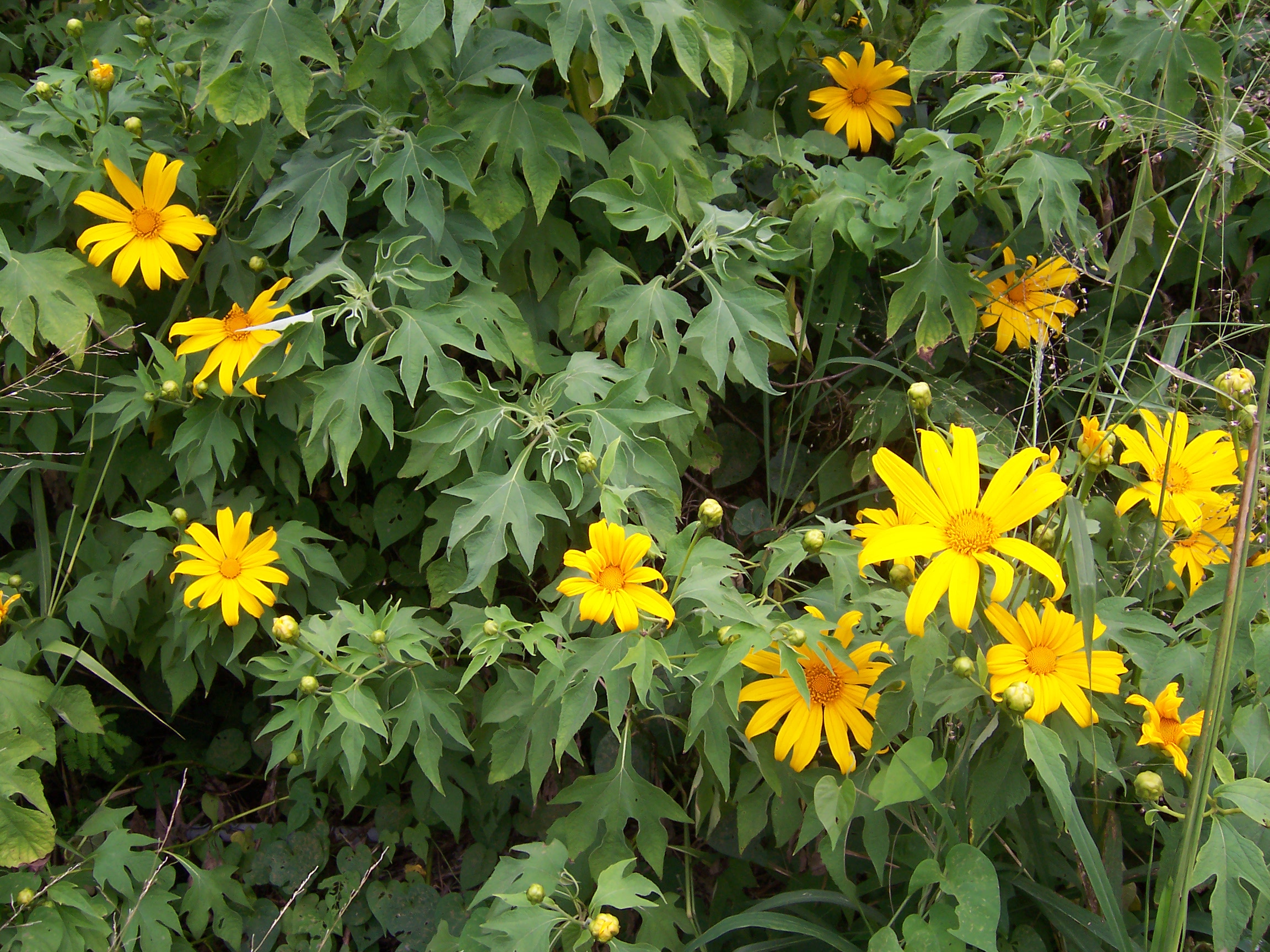
Tithonia is a genus of roughly eleven to twelve species of flowering plants in the tribe Heliantheae, family Asteraceae (the daisy family), order Asterales. The genus is placed within the sunflower alliance and its closest relatives include genera such as Helianthus and Viguiera.
Members of the genus are coarse annual or perennial herbs or shrubs; the exception is T. koelzii, a small tree native to Jalisco, Mexico. All species share the genus's most distinctive morphological character: a fistulose peduncle — the flower stalk is hollow and widens (flares) toward the apex just below the flower head.
Tithonia has its centre of diversity in Mexico, with the majority of species endemic to Mexican states. The range extends northward into the southwestern United States (notably T. thurberi in Arizona) and southward into Central America. Two species have spread far beyond their native range through cultivation: T. diversifolia (tree marigold) and T. rotundifolia (Mexican sunflower) are now naturalised as weeds in tropical and subtropical regions across Asia, Australia, Africa, and South America, as well as in Florida and Louisiana.
The genus was described by René Louiche Desfontaines and Antoine Laurent de Jussieu (Desf. ex Juss.) and published in 1789–1802. The name Tithonia derives from Tithonus of Greek mythology.
Etymology
The genus name Tithonia alludes to Tithonus, the figure of Greek mythology who was granted immortality but not eternal youth — a classical allusion common in Linnaean-era botanical naming. The authorship is attributed to Desfontaines ex Jussieu (Desf. ex Juss.), with the name published in Jussieu's Genera Plantarum (1789).
Distribution
Tithonia is centred in Mexico, where most species are endemic to individual states such as Jalisco, Oaxaca, Durango, and Sinaloa. The native range extends into Central America (Belize, Honduras, Guatemala) and just reaches the southwestern United States (T. thurberi in Arizona). Two species — T. diversifolia and T. rotundifolia — have naturalised widely in pantropical and subtropical regions including Africa, Asia, Australia, and the Americas outside their native range.
Cultivation
Tithonia rotundifolia (Mexican sunflower) is widely grown as an ornamental annual for its large, vivid orange flower heads and is valued as a cut flower, blooming from midsummer to late summer in the Northern Hemisphere. T. diversifolia is cultivated in tropical regions both as an ornamental and as a green manure / biomass crop.










