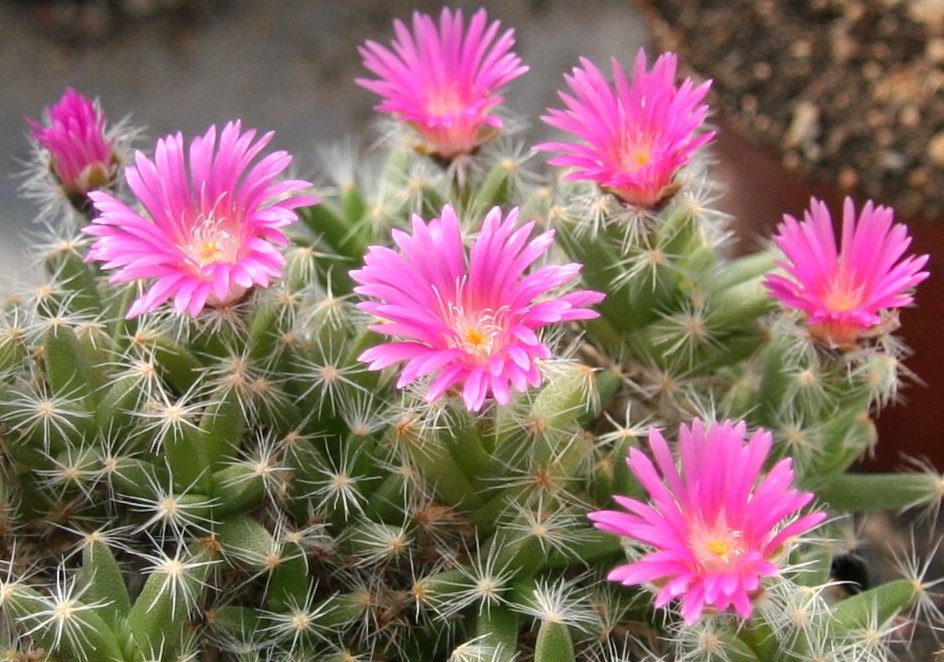
Trichodiadema is a genus of around 35 small succulent plants in the family Aizoaceae, native to southern Africa. The genus was described by the German botanist Gustav Schwantes in 1926, and its name combines the ancient Greek words for "hair" (τρῐχός, trichos) and "crown" (διαδεμα, diadema), a direct reference to the tuft of bristles that crowns each stem segment — a feature that superficially resembles the areoles of cacti.
Plants are compact and low-growing, with short fleshy stems divided into alternating sections of grey and green colouring, each roughly 8 mm in length. The apex of every stem segment bears a ring of radiating white or silvery bristles, giving the plant a distinctive spiky appearance. Despite this resemblance to cacti, Trichodiadema belongs entirely to the ice-plant family.
Flowers are solitary and daisy-like, with narrow petals in shades of red, pink, or white; a handful of species produce yellow blooms. The effect has earned many members of the genus the common name "Desert Rose", though they are unrelated to true roses. Some species also develop a thickened, tuberous root (caudex) that is prized by bonsai enthusiasts and collectors of caudiciform plants.
The genus is confined to the arid and semi-arid regions of Namibia and South Africa, including the Cape Provinces, Free State, and Northern Provinces, where plants grow in rocky or sandy soils with excellent drainage. In cultivation worldwide, Trichodiadema is valued as an undemanding container succulent requiring bright light, a free-draining substrate, and minimal watering outside the growing season.
Etymology
The genus name Trichodiadema derives from two ancient Greek words: τρῐχός (trichos), meaning "hair" or "bristle", and διαδεμα (diadema), meaning "crown". The combination describes the defining feature of the genus — a ring of radiating bristles at the tip of each stem segment that forms a small bristle crown, superficially resembling the areoles of cacti. The name was coined by the German succulent botanist Gustav Schwantes when he formally described the genus in 1926.
Distribution
Trichodiadema is endemic to the southern African subregion. Its range encompasses Namibia and several South African provinces, principally the Western, Eastern, and Northern Cape, the Free State, and the northern provinces. Plants occupy arid to semi-arid habitats characterised by rocky outcrops, gravel plains, and sandy soils with low rainfall and high summer temperatures. The distribution largely coincides with the Succulent Karoo and adjacent Nama-Karoo biomes — two of the world's most diverse succulent flora hotspots. Herbarium specimens of at least T. bulbosum and T. densum are also held in North American collections, reflecting their long history in cultivation.
Taxonomy
Trichodiadema was established by Schwantes in 1926, with the original description published in Zeitschrift für Sukkulentenkunde (Z. Sukkulentenk. 2: 187). The genus belongs to the family Aizoaceae, subfamily Ruschioideae, tribe Ruschieae — a large lineage of southern African succulents that also includes Lithops, Conophytum, and Lampranthus. GBIF recognises approximately 36 descendant taxa (as of 2023), while other treatments list around 32 accepted species; the discrepancy reflects ongoing taxonomic revision within the tribe. No genus-level synonyms are recorded in GBIF. The common name "Crownfigs" is noted by GBIF, though "Desert Rose" is more widely used in cultivation.
Cultivation
Trichodiadema species are popular among succulent collectors and are generally easy to grow under glass or in warm, dry climates outdoors. They thrive in full sun or bright indirect light and demand a sharply drained substrate — a mix of coarse sand or perlite with minimal organic matter is standard. Watering should be moderate during the growing season and significantly reduced or withheld during dormancy; overwatering is the most common cause of failure. Some species produce a pronounced tuberous caudex and are grown as caudiciform or bonsai subjects, with the thickened root displayed above the soil surface for ornamental effect. Trichodiadema densum has been awarded the Royal Horticultural Society's Award of Garden Merit, a formal recognition of its reliability and quality in garden conditions.
Propagation
The primary method of propagation is division of established clumps, which can be carefully separated and repotted. Propagation from stem cuttings is possible but carries a higher risk of rot at the cut surface, requiring the cutting to be left to callous thoroughly before planting in a dry, well-drained medium. Seed propagation is also practised by specialist growers.

