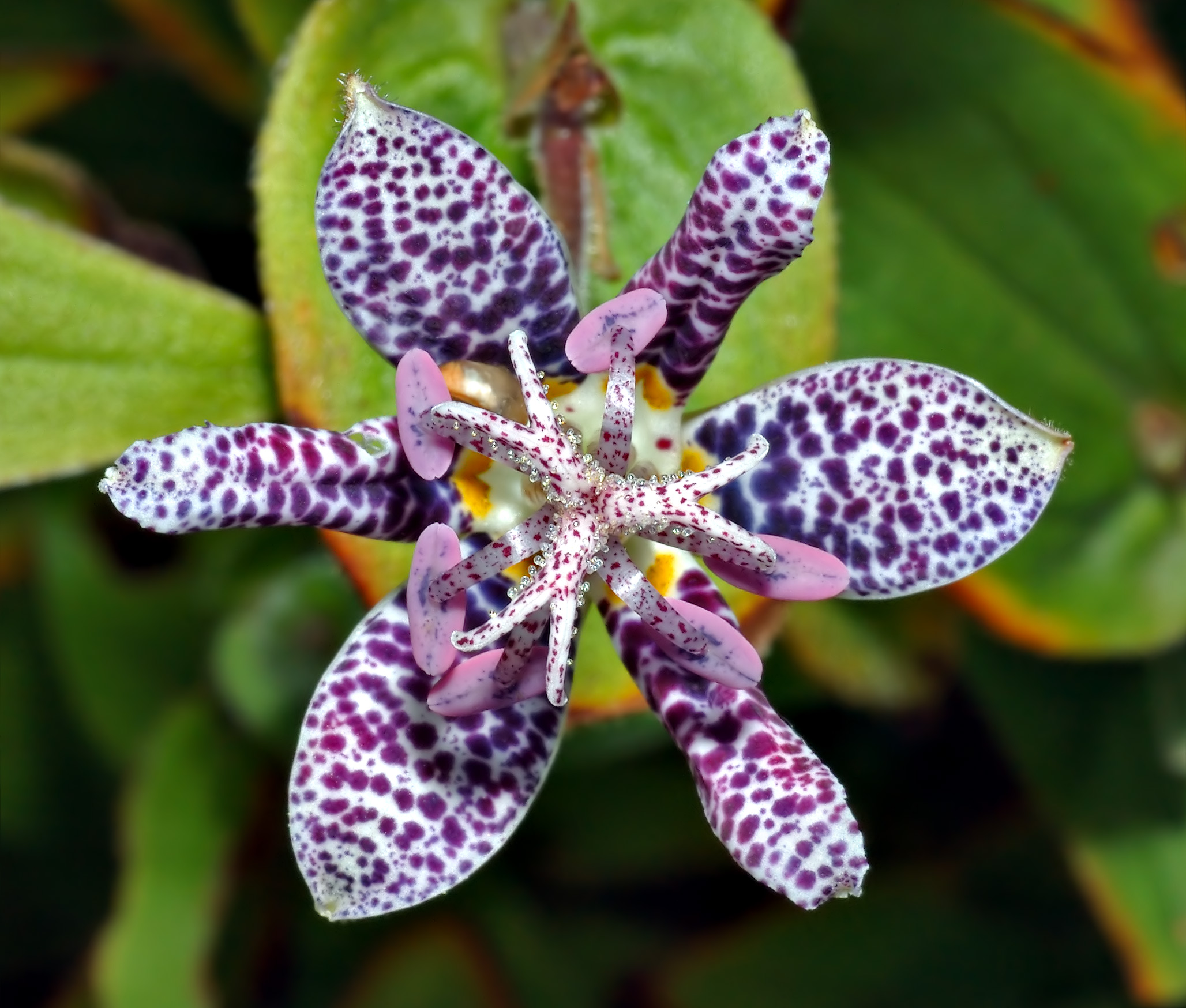
Tricyrtis, commonly known as toad lilies, is a genus of approximately 20 species of herbaceous perennial plants in the lily family (Liliaceae), order Liliales. The genus is native to a broad arc of eastern Asia, extending from the Himalayas through China, Japan, Taiwan, and the Philippines, where species typically inhabit shaded forest margins and rocky slopes.
Plants grow from creeping rhizomes and produce erect or ascending stems that may branch from the middle upward. The alternate, subsessile leaves clasp the stem. The flowers are among the most intricate in the lily family: each bisexual flower bears six free tepals arranged in two whorls, the outer whorl furnished with nectary pouches at the base and the inner whorl bearing distinctive dorsal crests. The tepals are typically white or pale yellow heavily marked with purple or reddish-purple spots — a patterning that gives the plants their common name. The six stamens are inserted at the tepal bases with slightly flattened, briefly tubular filaments; the ovary is three-loculed with numerous ovules. Fruit is a broadly cylindrical capsule that, when ripe, releases many small, flat, ovate to orbicular seeds.
The genus is subdivided into four sections. With roughly 42 taxa recognized in GBIF, Tricyrtis occupies a modest but horticulturally significant place in the lily family. Several species and numerous cultivars — particularly selections of Tricyrtis hirta and Tricyrtis formosana — are grown as ornamentals in temperate gardens worldwide for their late-season, orchid-like flowers.
Etymology
The common English name "toad lily" alludes to the spotted, warty-patterned tepals of the flowers. The genus name Tricyrtis derives from the Greek tri- (three) and kyrtos (humped or arched), referring to the three nectar-bearing pouches at the base of the outer tepals.
Distribution
Tricyrtis is native to eastern Asia, with species occurring from the eastern Himalayas across China, Taiwan, Japan, and the Philippines. Most species grow in shaded or partly shaded habitats such as forest edges and rocky slopes at various elevations.
Cultivation
Tricyrtis species thrive at the edges of woodland or shrub plantings in shade or partial shade, with rich, consistently moist soil. They bloom from summer into autumn, making them valuable for late-season garden color. The plants are sufficiently hardy to tolerate rapid shifts between mild and cold winter conditions.










